WJEC · A-Level · Mathematics
Differentiation
Differentiation is the WJEC A-Level tool for converting a curve into precise information about gradient, change and optimum values. Master the route from derivative to interpretation and you can pick up marks across tangents, normals, stationary points, graphs and modelling.
- 10 min read
- 3 worked examples
- 5 practice questions
- 7 key terms
Study Notes
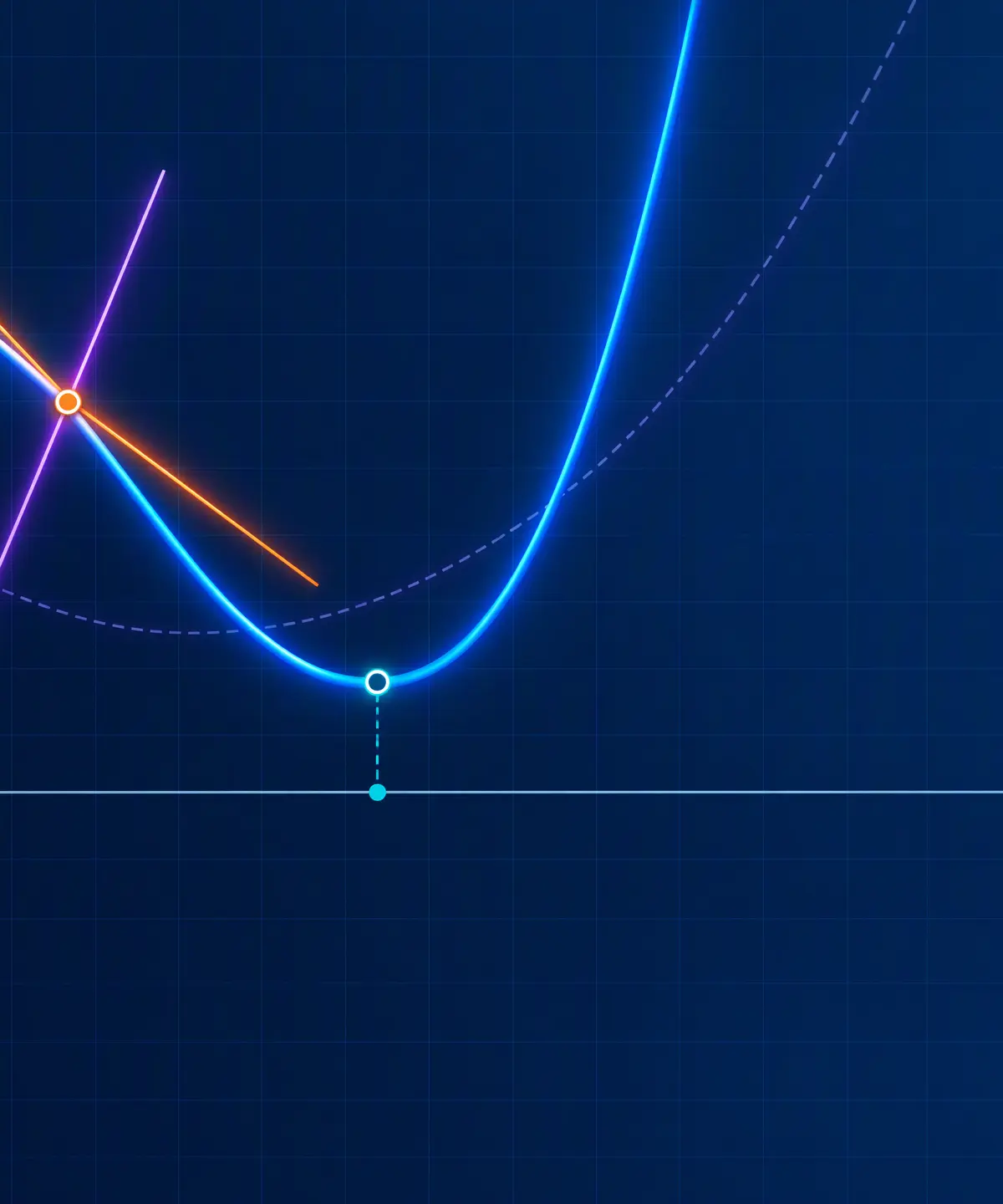
Overview
Differentiation turns a curve into information. It tells you the gradient at an exact point, whether a quantity is increasing or decreasing, and where a maximum or minimum occurs. In WJEC A-Level Mathematics 2.1.7, candidates are expected to move confidently between a graph, a derivative and a practical model. A one-line error in the derivative can therefore cost several later method marks.
This topic is central to calculus and returns later in integration, kinematics, modelling and numerical methods. Typical WJEC questions ask candidates to differentiate a polynomial, use first principles for a small positive integer power, find a tangent or normal, classify stationary points, sketch from derivative information, or maximise/minimise a simple quantity. The key habit is simple: differentiate first, then interpret what the derivative means in the question.
Specification focus: WJEC 2.1.7 requires the derivative as a tangent gradient and rate of change, gradient-function sketches, second derivatives, first principles for small positive integer powers, rational powers, tangents/normals, stationary points, increasing/decreasing intervals, simple curve sketches and simple optimisation.
Audio Revision Podcast
10-minute tutor-led recap: listen after reading the overview, then pause during the quick-fire recall section to test retrieval.
Key Concepts
1. The derivative: an instant slope and a rate of change
For a curve y=f(x), the derivative f'(x) or \frac{dy}{dx} gives the gradient of the tangent at a general point. The word general matters: f'(x) is an expression in x, not yet a single number. Once a particular value, say x=2, is substituted, f'(2) is the gradient at that point.
Imagine a hilly road. Average gradient compares two places on the road. The derivative is the steepness exactly where the bicycle is now. In a modelling question, this becomes a rate: if s is displacement and t is time, \frac{ds}{dt} is velocity. The same mathematics works because both gradient and rate describe change per unit change.
Exam wording to decode
| WJEC-style wording | Mathematical action |
|---|---|
| “Find the gradient at $x=a$” | Find $f'(x)$, then calculate $f'(a)$. |
| “Find the rate of change when …” | Identify the derivative required, then substitute the stated value. |
| “Find the equation of the tangent” | Find $f'(a)$ and the point $(a,f(a))$. |
| “Determine where the function is increasing” | Solve $f'(x)>0$. |
Worked micro-example: If f(x)=x^3-2x, then f'(x)=3x^2-2. At x=2, the tangent gradient is 3(2)^2-2=10. Candidates who write just “10” when asked for the derivative lose credit: the derivative is 3x^2-2; 10 is one value of it.
2. Differentiation from first principles
First principles explains why differentiation gives a gradient. Start with the gradient of a chord through (x,f(x)) and (x+h,f(x+h)):
\frac{f(x+h)-f(x)}{h}
The chord is not yet a tangent. Let h approach zero. The second point moves into the first point, so the chord gradient tends to the tangent gradient:
f'(x)=\lim_{h\to0}\frac{f(x+h)-f(x)}{h}.
For WJEC 2.1.7, practise this securely for small positive integer powers, up to and including x^3. The mark-winning sequence is always: substitute x+h, expand, subtract f(x), factor out h, cancel h, then take the limit. You cannot substitute h=0 before cancellation because that would create division by zero.
Why it works: expansion exposes a common factor of h, representing the shrinking horizontal gap. After cancellation, the remaining expression has a sensible limit. This is the rigorous route from an average rate of change to an instantaneous rate of change.
Memory hook: S-E-S-F-C-L: Substitute, Expand, Subtract, Factor, Cancel, Limit. Write those initials in the margin before a first-principles question.
3. The power rule, including rational powers
For a term ax^n:
\frac{d}{dx}(ax^n)=anx^{n-1}.
Multiply by the existing power, then reduce the power by one. Constants differentiate to zero. Differentiate each term separately in a sum or difference.
| Function | Derivative | Reasoning |
|---|---|---|
| $7x^4$ | $28x^3$ | $7\times4=28$; $4-1=3$. |
| $-3x$ | $-3$ | $-3x^1\to-3x^0=-3$. |
| $5$ | $0$ | A horizontal line has zero gradient. |
| $x^{1/2}$ | $\frac12x^{-1/2}=\frac{1}{2\sqrt{x}}$ | A rational power follows the same rule. |
| $x^{-2}$ | $-2x^{-3}$ | Negative powers also follow the same rule. |
Do not confuse differentiation with integration. Differentiation makes the power one smaller; integration makes it one larger and divides by the new power. Before differentiating, rewrite roots and fractions as powers where useful, for example \sqrt[3]{x^2}=x^{2/3} and \frac{4}{x^2}=4x^{-2}.
Examiner commentary: Credit is normally awarded for a correct derivative before a later substitution. Therefore state f'(x)= clearly on its own line. This protects method marks and makes an arithmetic slip easier to spot.
4. Tangents and normals
A tangent touches the curve at the stated point and has gradient m=f'(a). A normal is perpendicular to that tangent. Perpendicular non-vertical lines have gradients whose product is -1, so:
m_{\text{normal}}=-\frac{1}{m_{\text{tangent}}}.
Use point-slope form once both a point and a gradient are known:
y-y_1=m(x-x_1).
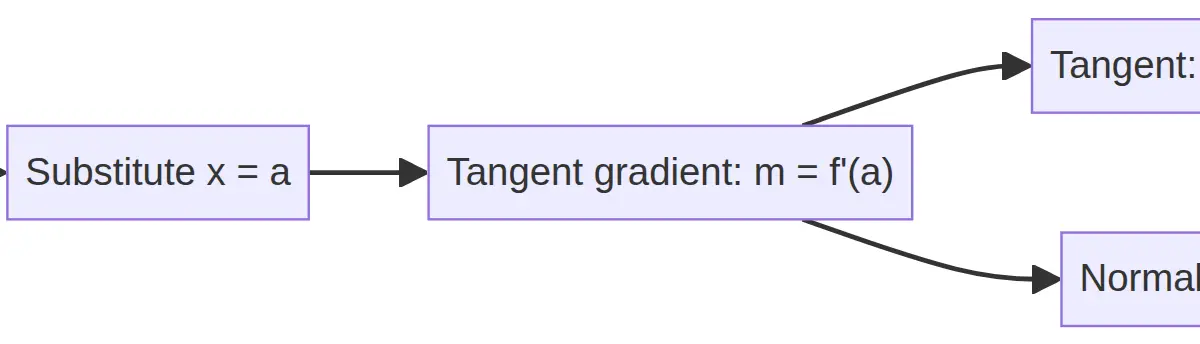
Reliable method for a tangent or normal
- Find the coordinate on the curve: (a,f(a)).
- Differentiate and calculate f'(a) for the tangent gradient.
- For a tangent, use that gradient. For a normal, take its negative reciprocal.
- Substitute the point and chosen gradient into point-slope form.
- Simplify only after the correct line has been formed.
A frequent error is to negate a gradient but not take the reciprocal. If the tangent gradient is -5, the normal gradient is \frac15, not 5 or -\frac15.
5. Stationary points, second derivatives and monotonicity
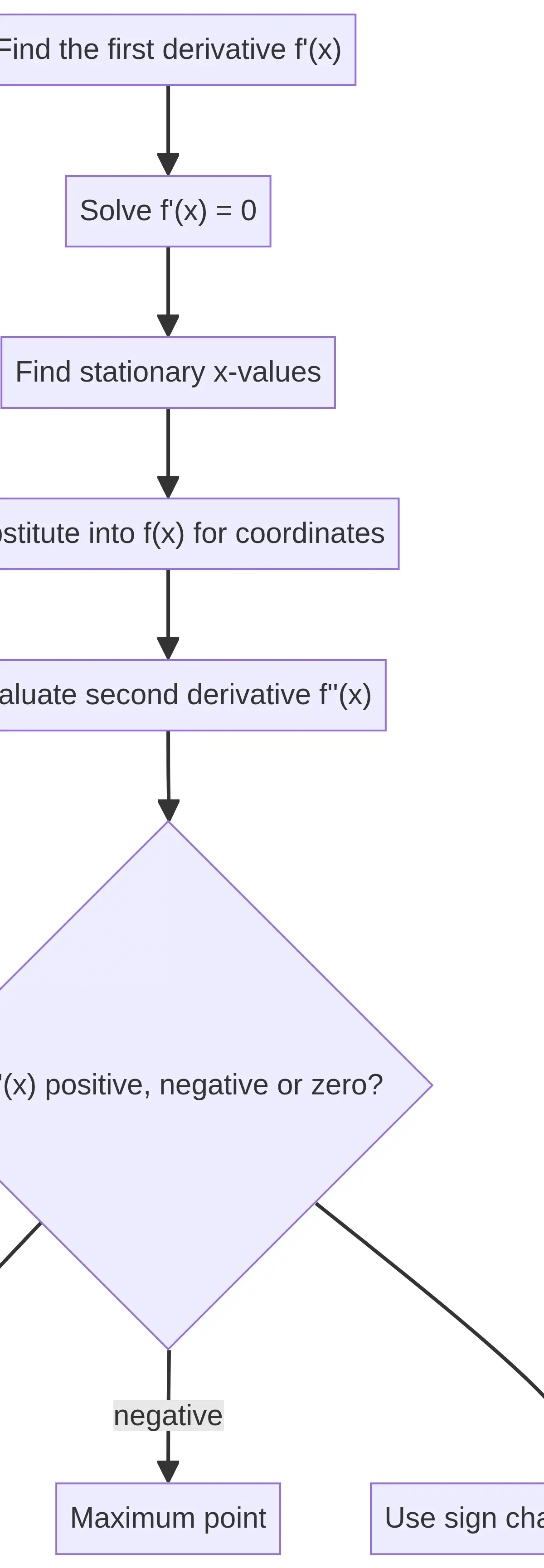
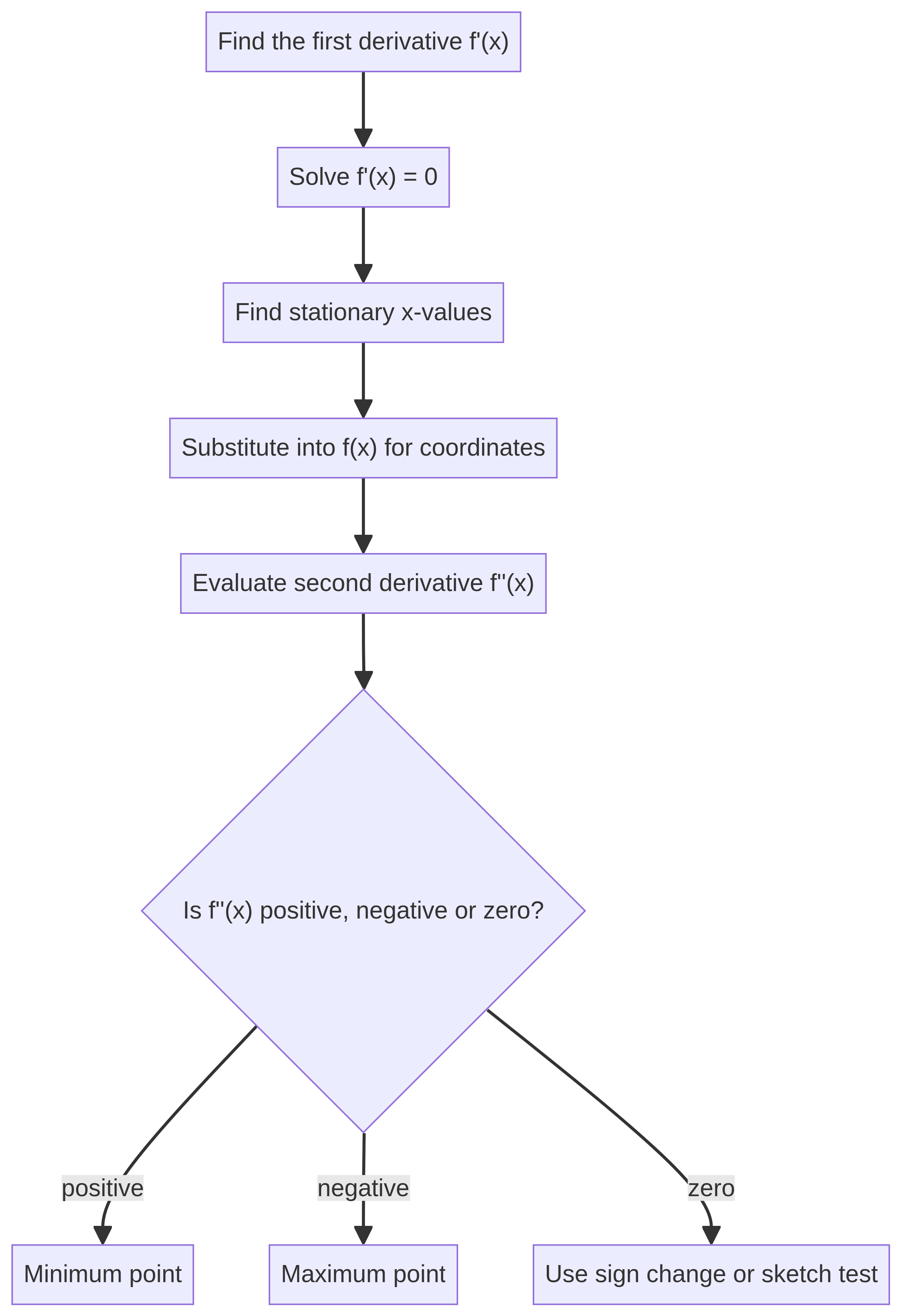
A stationary point is where the tangent is horizontal, so f'(x)=0. It may be a local maximum, a local minimum or a stationary point of inflection. Finding f'(x)=0 gives only the possible x-coordinates. Substitute each value into f(x) to find the corresponding y-coordinate.
The second derivative measures how the gradient is changing:
- f''(a)>0: gradient is increasing, the curve bends like a smile, so a local minimum.
- f''(a)<0: gradient is decreasing, the curve bends like a frown, so a local maximum.
- f''(a)=0: this test is inconclusive. Test the sign of f'(x) on either side or use a justified sketch.
For increasing/decreasing intervals, do not merely list stationary points. Solve the inequality. If f'(x)>0, f is increasing; if f'(x)<0, f is decreasing. A sign diagram is often the quickest way to make this visible.
6. Optimisation: mathematics with a decision
Optimisation questions are a chain of reasoning, not a request to differentiate a random expression. First make one variable dependent on the other using the constraint. Then write the quantity to be maximised or minimised in one variable. Differentiate, solve \frac{dQ}{dx}=0, classify the result, and state it in context with units.
For example, a rectangular pen against a wall needs fencing on three sides only. If 40 m of fencing is available and each width is x, the length is 40-2x. The area is A=x(40-2x), not just 40x. The constraint has changed the model. The second derivative, a sign change, or an end-point check supplies the justification for “maximum” or “minimum”.
Examiner habit: in a 5- or 6-mark optimisation question, candidates should expect credit for the model, derivative, stationary condition, classification and contextual conclusion. A naked value of x rarely earns full marks.
Mathematical Relationships and Formula Status
| Relationship | Status for this topic | How to use it |
|---|---|---|
| $f'(x)=\lim_{h\to0}\frac{f(x+h)-f(x)}{h}$ | Must understand and reproduce | First-principles derivations; cancel $h$ before taking the limit. |
| $\frac{d}{dx}(x^n)=nx^{n-1}$ | Given in the WJEC differentiation formula section, but must be fluent | Applies to rational $n$ and to each polynomial term. |
| $\frac{d}{dx}(ax^n)=anx^{n-1}$ | Apply from the power rule | Keep the coefficient and multiply by $n$. |
| $m_{\text{tangent}}=f'(a)$ | Must know | Gradient at a specified point. |
| $m_{\text{normal}}=-1/m_{\text{tangent}}$ | Must know | Only for non-vertical tangent/normal cases. |
| $y-y_1=m(x-x_1)$ | Must know | Equation of tangent or normal through a known point. |
| $f'(x)=0$ | Must know | Candidate stationary points. |
| sign of $f''(a)$ | Must know | Positive: local minimum; negative: local maximum. |
Graph and Data Skills
Sketches should communicate derivative information, not artwork. Mark stationary points with their coordinates where known. Use the sign of f'(x) to decide whether each section rises or falls and use f''(x) to comment on curvature. A graph of f'(x) is itself a gradient map: where it is above the x-axis, f increases; where it crosses the x-axis, f has a stationary point; where it is below, f decreases. Its own gradient is f''(x).
Practical Applications
Differentiation drives decisions whenever a changing quantity matters: a designer can maximise area from fixed materials; a transport model uses velocity as the rate of change of displacement; a business model can identify a maximum revenue point. The exam may use an unfamiliar context, but the marks still reward the same sequence: form a function, differentiate, interpret, justify.## Examiner’s Final Check
Before moving on, run this 20-second audit. Have you differentiated rather than integrated? Have you substituted into the original function for a coordinate, not into the derivative? If a line is requested, does it pass through the point and use the correct tangent or normal gradient? If an optimum is claimed, have you justified it and answered in the real-world units? These checks target the small omissions that turn an otherwise correct solution into dropped marks.
Visual Resources
2 diagrams and illustrations

Interactive Diagrams
2 interactive diagrams to visualise key concepts
Conceptual Flow Outline
From curve to the equations of a tangent and its normal at x=a.
Conceptual Flow Outline
A reliable route for locating and classifying stationary points.
Worked Examples
3 worked examples — open one to explore the question and available guidance.
Practice Questions
Test your understanding — click to reveal model answers
Differentiate y = 5x³ − 3√x + 7. [3 marks]
Hint: Rewrite √x as x^(1/2) before differentiating.
For f(x)=x³−3x²−9x+5, find and classify the stationary points. [5 marks]
Hint: Solve f′(x)=0, then use f′′(x) at each value.
Find the equation of the tangent to y=2x^(3/2)−5x at x=4. [4 marks]
Hint: You need both the point on the curve and the derivative at x=4.
Using first principles, show that the derivative of f(x)=x³ is 3x². [4 marks]
Hint: Expand (x+h)³ before subtracting x³.
For f(x)=x³−3x, determine the intervals for which f is increasing and decreasing. [3 marks]
Hint: Factor f′(x), then check its sign in the three intervals created by its roots.