WJEC · A-Level · Mathematics
Exponentials and Logarithms
Exponentials and logarithms turn repeated multiplication into a precise language for growth, decay, inverse functions and data modelling. WJEC 2.1.6 rewards candidates who can show why the rules work, not just press calculator buttons. Master the graph axes, logarithm laws and equation methods, and this topic becomes a reliable source of method marks.
- 9 min read
- 4 worked examples
- 5 practice questions
- 9 key terms
Study Notes

Overview
Exponentials and logarithms are the mathematical language of repeated multiplication, rapid growth and measured decay. In WJEC 2.1.6, candidates must move confidently between an exponential statement such as (3^x=17) and its logarithmic meaning, use the laws of logarithms accurately, interpret graphs and build models from data. This is not a topic to revise as a list of button presses: marks are awarded for recognising structure, stating the transformed relationship and showing algebra that a marker can follow.
It connects directly to functions and graphs, algebraic manipulation, differentiation as a rate of change, statistics through fitted straight lines, and real modelling. Typical questions ask candidates to prove or simplify a log law, solve an exponential equation, use a substitution such as (u=5^x), or extract parameters from a (\log y) graph. WJEC also expects candidates to explain why a quantity whose rate of change is proportional to its current value is suitably modelled exponentially. Aim to know the meaning behind every rule, then the methods become reliable under timed conditions.
Key Concepts
1. Exponential functions, bases and the special number (e)
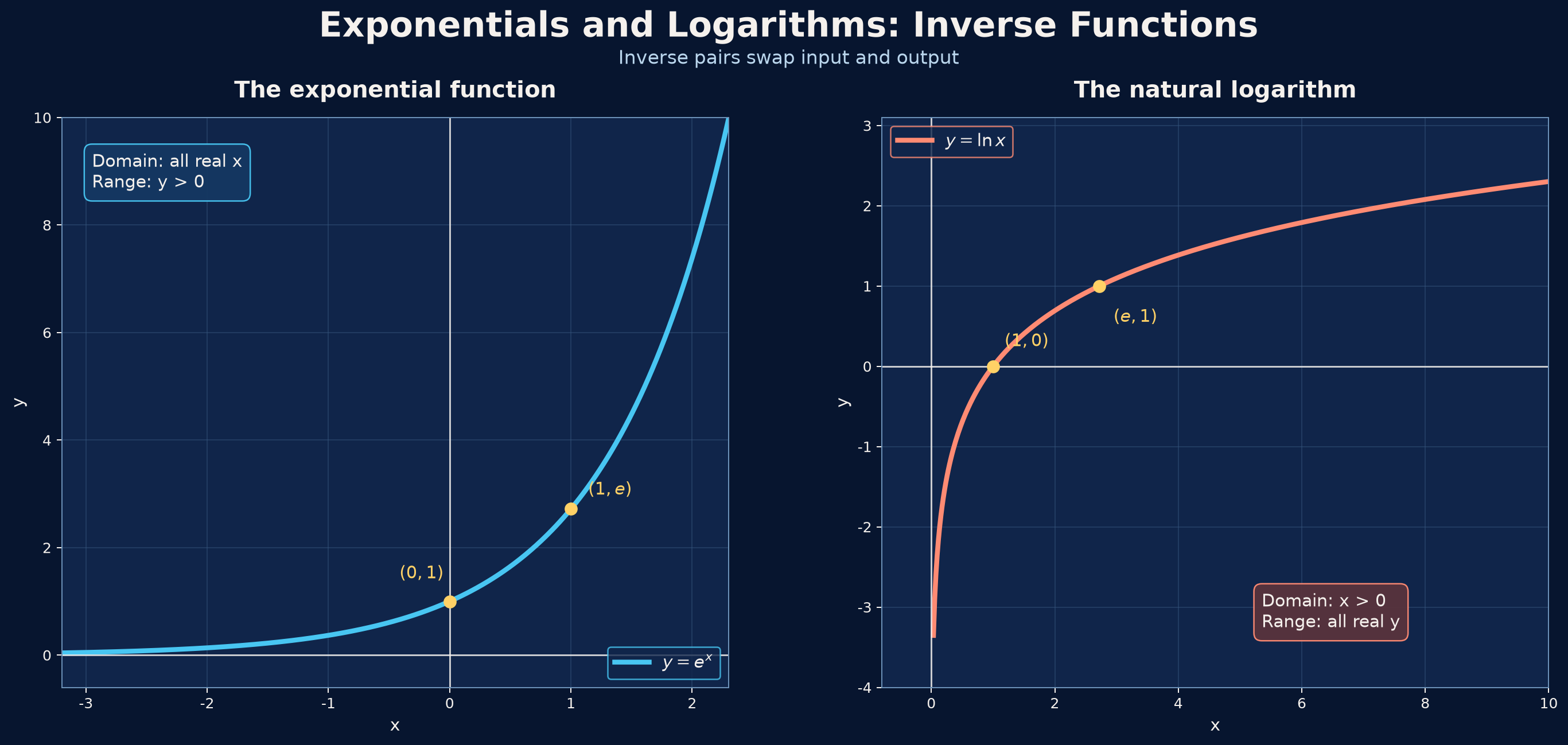
An exponential function has the variable in the power: (y=a^x), where (a>0). If (a>1), the graph rises as (x) increases. If (0<a<1), it falls, giving exponential decay. In either case (a^x>0) for every real (x), so the graph never touches the (x)-axis. It crosses the (y)-axis at ((0,1)), because (a^0=1).
The function (e^x) is the natural exponential. It matters because it has a distinctive rate-of-change property: the gradient of (e^{kx}) is (ke^{kx}). Therefore the gradient is proportional to the current (y)-value. If (y=Ae^{kx}), then (\frac{dy}{dx}=kAe^{kx}=ky). This is the mathematical reason, not merely a fact to quote, for using an exponential model when a quantity grows or decays at a rate proportional to how much is present.
Example. For (y=120e^{-0.08t}), (\frac{dy}{dt}=-0.08y). The negative constant tells you that the amount is decreasing, and the size of the decrease each unit of time is 8% of the amount currently present, not a fixed 9.6 units forever.
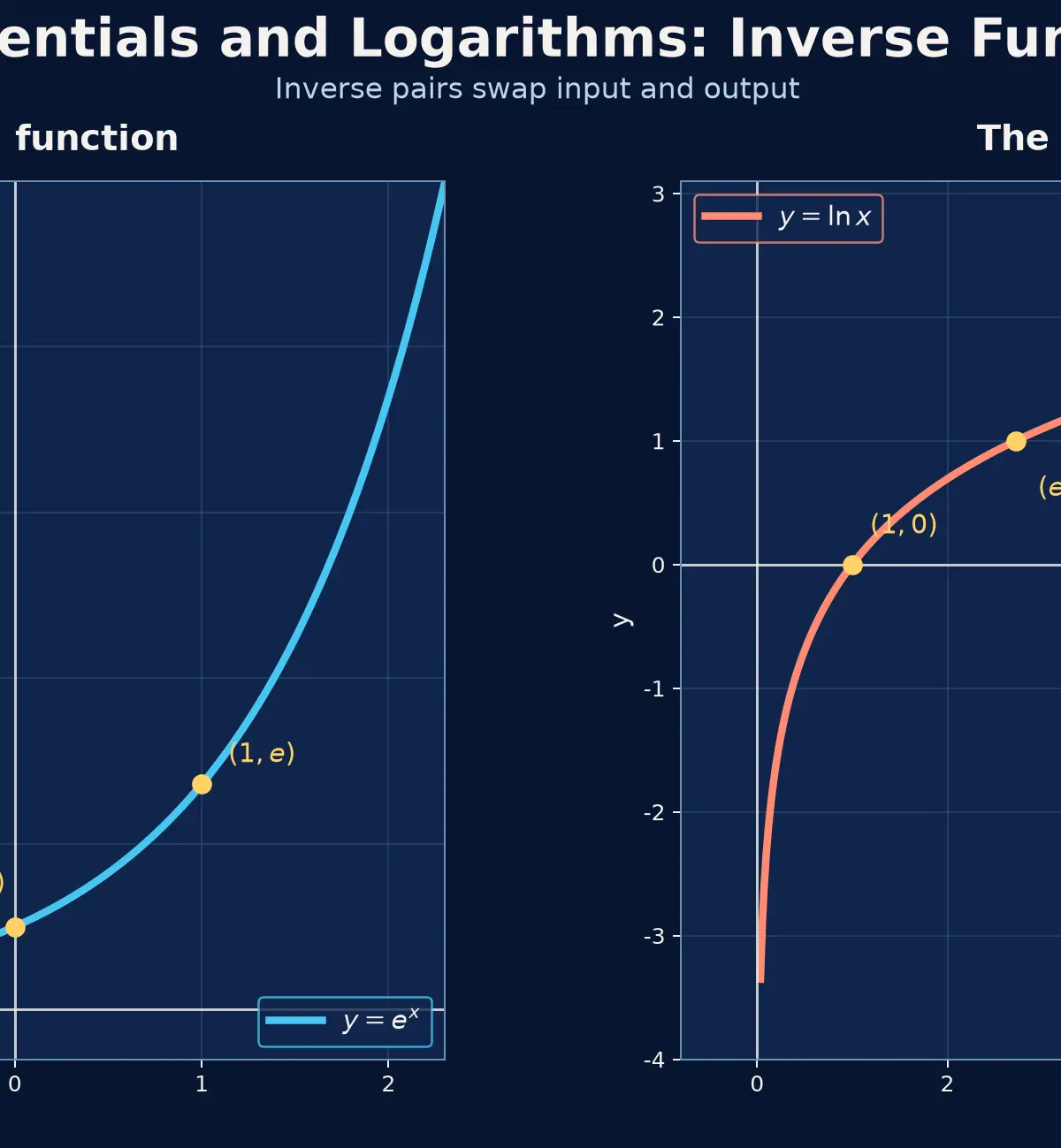
2. Logarithms are inverse functions
(\log_a x) means “the power to which (a) must be raised to give (x)”. Formally,
[
\log_a x=y \quad \Longleftrightarrow \quad a^y=x,
]
where (a>0), (a
e1), and (x>0). This is the inverse relationship between (a^x) and (\log_a x). In particular, (\ln x) is logarithm base (e), so (\ln x) and (e^x) undo one another:
[
\ln(e^x)=x \qquad \text{and} \qquad e^{\ln x}=x \quad (x>0).
]
The domain restriction is a frequent source of lost credit. A real logarithm can only accept a positive input. Thus (\ln(x-4)) requires (x>4), while (\ln x) has a vertical asymptote at (x=0). The graph of (\ln x) passes through ((1,0)), because (\ln1=0), and is the reflection of (y=e^x) in (y=x).
Why this matters in an equation. If (7^x=19), the unknown is trapped in a power. Applying (\ln) to both sides creates (x\ln7=\ln19), so (x=\frac{\ln19}{\ln7}). WJEC does not require change of base as a named technique, but this use of calculator logarithms is a valid way to solve an equation in the form (a^x=b).
3. Laws of logarithms: derive them, then use them
The laws come from index laws. Do not try to make logarithms “distribute” over addition or subtraction. Let (\log_a x=m) and (\log_a y=n). Then (x=a^m) and (y=a^n). Hence (xy=a^{m+n}), so (\log_a(xy)=m+n=\log_a x+\log_a y). This proof earns credit because each equality has a reason.
| Law | Meaning | Exam-safe reminder |
|---|---|---|
| (\log_a x+\log_a y=\log_a(xy)) | Addition of logs becomes multiplication inside one log | PLUS → PRODUCT |
| (\log_a x-\log_a y=\log_a!\left(\frac{x}{y}\right)) | Subtraction becomes division | MINUS → DIVIDE |
| (k\log_a x=\log_a(x^k)) | A multiplier becomes a power | COEFFICIENT → POWER |
The power law includes negative and fractional powers. For example, (-\frac12\ln x=\ln(x^{-1/2})=\ln!\left(\frac1{\sqrt{x}}\right)). The forbidden statement (\log(x+y)=\log x+\log y) is false: multiplication, not addition, triggers the product law.
Example. (\log_2 36-2\log_2 15+\log_2 100+1) can be written as (\log_2!\left(\frac{36\times100\times2}{15^2}\right)=\log_2 32=5). Here (1=\log_2 2). Writing that conversion is the detail that makes the working convincing.
4. Solving exponential equations
First decide whether the equation can be converted to a common base, reduced with a substitution, or needs logarithms. For a direct equation such as (3^x=2), use logs. For a repeated expression such as (25^x-4(5^x)+3=0), set (u=5^x), so (25^x=(5^x)^2=u^2). Solve the resulting quadratic, then return to (x). Never stop at (u=3): the question is asking for (x).
When a log is introduced, preserve equality by applying it to both sides and show the algebra in a readable order. If an exact answer is requested, leave it as (\frac{\ln b}{\ln a}). If a decimal is asked for, give a sensible rounded value only at the end. A final substitution check is quick and catches sign errors.
5. Linearising data with logarithmic graphs
WJEC expects candidates to estimate parameters by turning a curved model into a straight-line relationship.
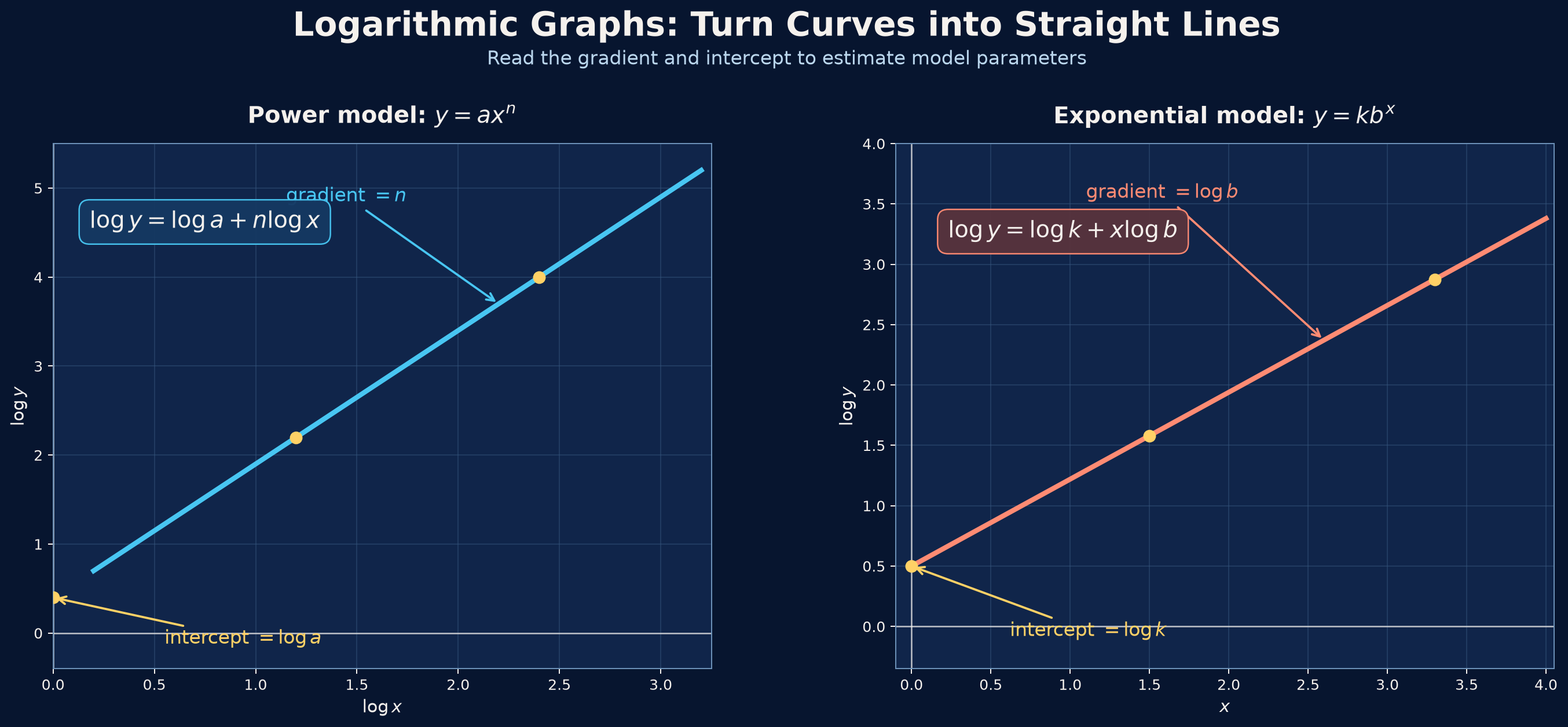
For a power model (y=ax^n), take logs:
[
\log y=\log a+n\log x.
]
A plot of (\log y) against (\log x) is a straight line. Its gradient is (n), and its intercept is (\log a). Therefore recover (a) by raising the log base to the intercept. With common logs, (a=10^{\text{intercept}}).
For an exponential model (y=kb^x), take logs:
[
\log y=\log k+x\log b.
]
A plot of (\log y) against (x) is a straight line. Its gradient is (\log b), and its intercept is (\log k). The axis labels are decisive. A graph of (\log y) against (\log x$) does not identify (b) for an exponential model; it identifies (n) for a power model.$
$ $
$
Use the phrase “comparing with (Y=mX+c)” before stating the parameter values. That creates a clear chain of reasoning and is exactly what allows marks to be awarded for method even if the final numerical value is rounded incorrectly.
6. Exponential growth, decay and model limitations
A discrete model can be written (y=ab^x), while a continuous model is often (y=Ae^{kt}). In (Ae^{kt}), (A) is the value at (t=0); (k>0) gives growth and (k<0) gives decay. Examples include continuous compound interest, population growth over a short period, radioactive decay and drug concentration.
A model is useful only within its assumptions. A population cannot normally grow exponentially forever because resources become limited. Drug concentration can depart from a one-compartment model if doses are repeated or removal rate changes. A high-quality evaluation answer names the assumption, states why it may fail in context, and says how the prediction is affected. “Models are not accurate” alone earns little credit.
Mathematical Relationships and Formula Status
| Relationship | Use | Status for revision |
|---|---|---|
| (y=a^x), (a>0) | General exponential function | Must memorise / recognise |
| (\log_a x=y\iff a^y=x) | Convert between log and exponential forms | Must memorise |
| (\ln x=\log_e x) | Natural logarithm | Must memorise |
| (\ln(e^x)=x), (e^{\ln x}=x) | Inverse relationship | Must memorise |
| Three logarithm laws above | Simplify, prove and solve | Must memorise |
| (\frac{d}{dx}e^{kx}=ke^{kx}) | Explain proportional rate of change | Must memorise as a specified fact |
| (y=ax^n\Rightarrow\log y=\log a+n\log x) | Power-law linearisation | Must memorise |
| (y=kb^x\Rightarrow\log y=\log k+x\log b) | Exponential linearisation | Must memorise |
| (y=Ae^{kt}) | Continuous growth or decay model | Must memorise / recognise |
No WJEC required practical applies to this Pure Mathematics topic. Formal differentiation and integration of expressions involving (e^x) or (a^x) are not required here; the specified gradient fact for (e^{kx}) is the relevant expectation.
Practical Applications
- Finance: continuous compound interest can be modelled by (A=Pe^{rt}). The percentage rate is applied to the current balance, so growth accelerates in pounds even when the percentage rate is constant.
- Medicine: if a drug is removed at a rate proportional to the amount in the bloodstream, a model such as (C=Ae^{-kt}) is appropriate. The negative (k) encodes decay.
- Science: radioactive nuclei each have the same chance of decaying over a short interval, so the number remaining is modelled exponentially.
- Data analysis: log plots enable a straight-line fit, making an unknown exponent or multiplier visible as a gradient or intercept.
When using observed data, check whether the transformed points are reasonably close to a line before trusting the model. A single straight-line fit does not prove that the original relationship holds outside the measured range.
Visual Resources
2 diagrams and illustrations
Interactive Diagrams
2 interactive diagrams to visualise key concepts
Conceptual Flow Outline
Decision route for choosing a method when solving an exponential equation.
Conceptual Flow Outline
How the model form determines the correct logarithmic plot and the parameters read from it.
Worked Examples
4 worked examples — open one to explore the question and available guidance.
Practice Questions
Test your understanding — click to reveal model answers
Simplify (\log_2(8x^3)-\log_2(2x)) to a single logarithm, then simplify fully. Assume (x>0).
Hint: Use the quotient law only after expressing both terms as logarithms.
Solve (3^{2x-1}=7). Give (x) exactly.
Hint: Take natural logs of both sides before expanding the exponent.
A candidate writes (\ln(5+3)=\ln5+\ln3). Explain why this is incorrect and give the correct use of a logarithm law.
Hint: Test it numerically, then state the product law.
Data are believed to follow (y=ax^n). A graph of (\log y) against (\log x) has gradient 1.8 and intercept -0.3010, using base-10 logs. Estimate (a) and (n), then state the model.
Hint: Compare the graph equation with \(\log y=\log a+n\log x\).
The number of bacteria in a culture is modelled by (N=500e^{0.18t}), where (t) is in hours. Find the time when (N=2000), to 3 significant figures. State one limitation of this model over a long period.
Hint: Divide by 500, then take \(\ln\) of both sides.