WJEC · A-Level · Mathematics
Numerical Methods
Numerical Methods turns equations and curves that resist exact algebra into well-justified approximations. For WJEC A-Level Mathematics 2.3.8, candidates must confidently bracket roots, iterate, use Newton-Raphson and estimate area with trapezia, then explain the reliability and meaning of each answer.
- 10 min read
- 4 worked examples
- 5 practice questions
- 8 key terms
Study Notes

WJEC A-Level Mathematics: Numerical Methods (2.3.8)
Overview
Numerical methods are the examiner's test of whether you can make a reliable approximation when algebra does not produce an exact answer. In WJEC A-Level Mathematics, the topic covers locating roots by changes in sign, using a supplied iterative formula and its cobweb or staircase diagram, applying Newton-Raphson, and estimating an integral with the trapezium rule. These are not unrelated techniques: all replace an exact curve or equation with an organised sequence of manageable calculations.
Expect questions that give a function, table or graph and ask you to show, calculate, state or explain. Typical marks are awarded for correct setup, accurate numerical work and a conclusion in context. A 3-mark root-location task may credit two function evaluations and a correct interval; a 5-mark Newton-Raphson or trapezium question usually needs a formula, valid substitution, numerical process and interpretation. This topic links directly to differentiation, integration, graphs, modelling and calculator fluency. A candidate who keeps full calculator precision, labels each estimate and reads the curve's shape will gain routine method marks even when an exact answer is impossible.
Key Concepts
1. Locating roots using a change of sign
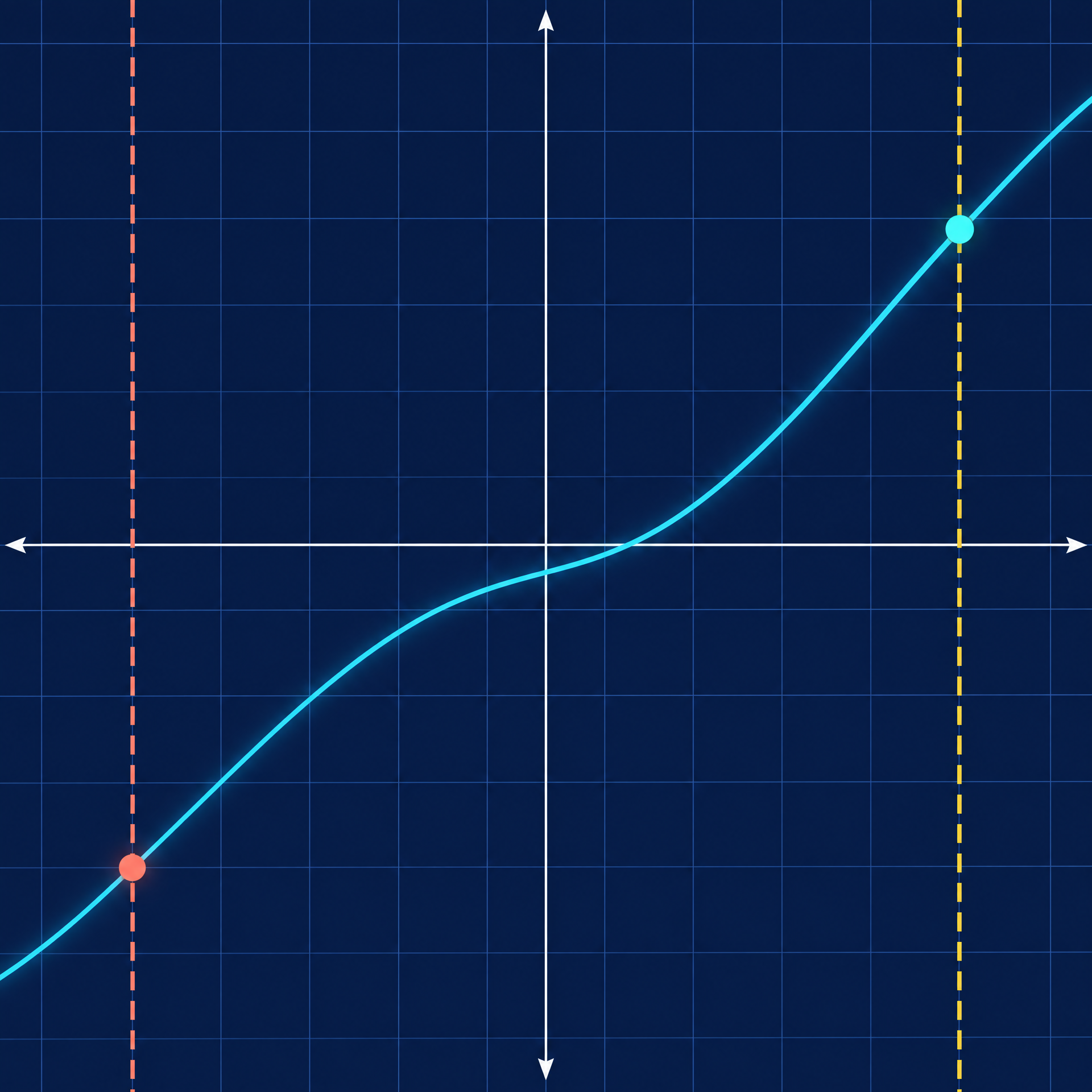
A root of (f(x)=0) is an x-coordinate where the graph meets the x-axis. If a continuous, sufficiently well-behaved function has opposite signs at (x=a) and (x=b), it must cross the axis somewhere between them. Write the test as (f(a)f(b)<0).
For example, if (f(2.1)=-0.139) and (f(2.2)=0.848), the signs differ, so a root lies in ((2.1,2.2)). The values do not need to be equally spaced. What earns credit is the explicit logical chain: calculate, identify sign change, state interval.
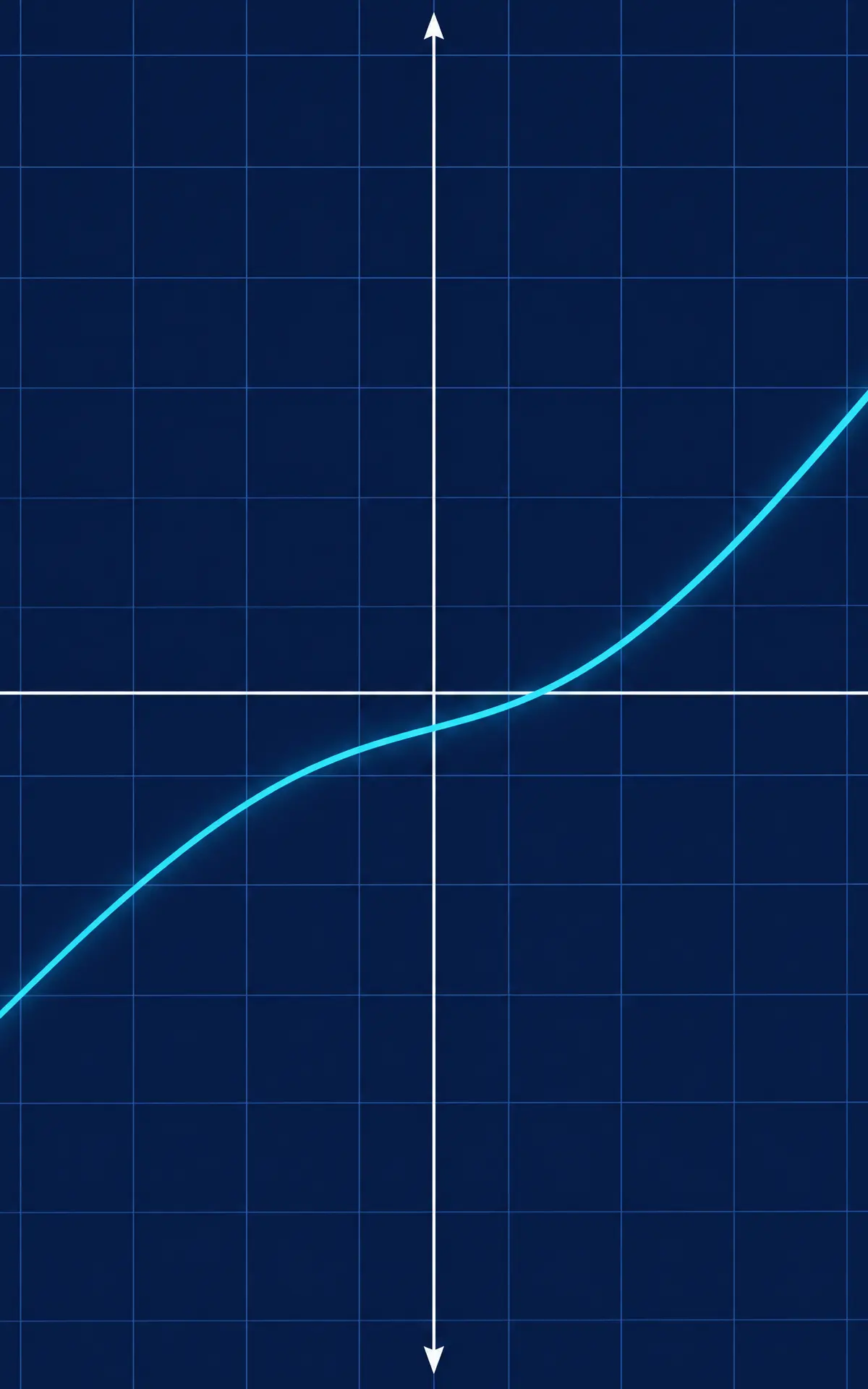
Why it works: a continuous graph cannot travel from above the axis to below it without passing through zero. But do not reverse the logic. No sign change does not prove that no root exists: (f(x)=(x-1)^2) touches the axis at 1 and remains non-negative. A discontinuity can also appear to change sign without crossing the axis. This is why the specification says “sufficiently well-behaved”.
2. Fixed-point iteration and cobweb diagrams
A question may rearrange an equation as (x=g(x)) and give a recurrence (x_{n+1}=g(x_n)). Start with the stated (x_0), substitute it into the right-hand side, then repeat. Keep the sequence labelled and round only at the end. If consecutive values agree to the requested accuracy, quote the root to that accuracy.
A cobweb or staircase diagram combines (y=g(x)) with (y=x). From (x_0), move vertically to (y=g(x)), then horizontally to (y=x), and repeat. Steps closing in on the intersection suggest convergence. Steps moving away, alternating with growing size, or encountering an undefined value show failure. WJEC does not require formal conditions for convergence, but candidates must interpret the visible behaviour.
Exam phrase: “The iterates are converging to approximately … because successive values are becoming stable.” If they are not stable, say so rather than forcing a final answer.
3. Newton-Raphson: tangent-based root finding
Newton-Raphson uses the x-intercept of the tangent at the current approximation. For (f(x)=0), the formula-booklet recurrence is
[
x_{n+1}=x_n-\frac{f(x_n)}{f'(x_n)}.
]
Calculate (f'(x)) first. At each iteration, substitute the previous unrounded estimate. The numerator measures the current vertical error; the derivative controls the tangent's slope and therefore the correction size. It is often very fast near a simple root.
Failure is examinable. If (f'(x_n)=0), division by zero occurs. If the derivative is very small, the tangent can jump a long way. A poor starting value can approach a different root or diverge. Credit is given for a clear reason tied to the formula, for example: “At this estimate (f'(x)=0), so the Newton-Raphson recurrence is undefined.”
4. Numerical integration with the trapezium rule
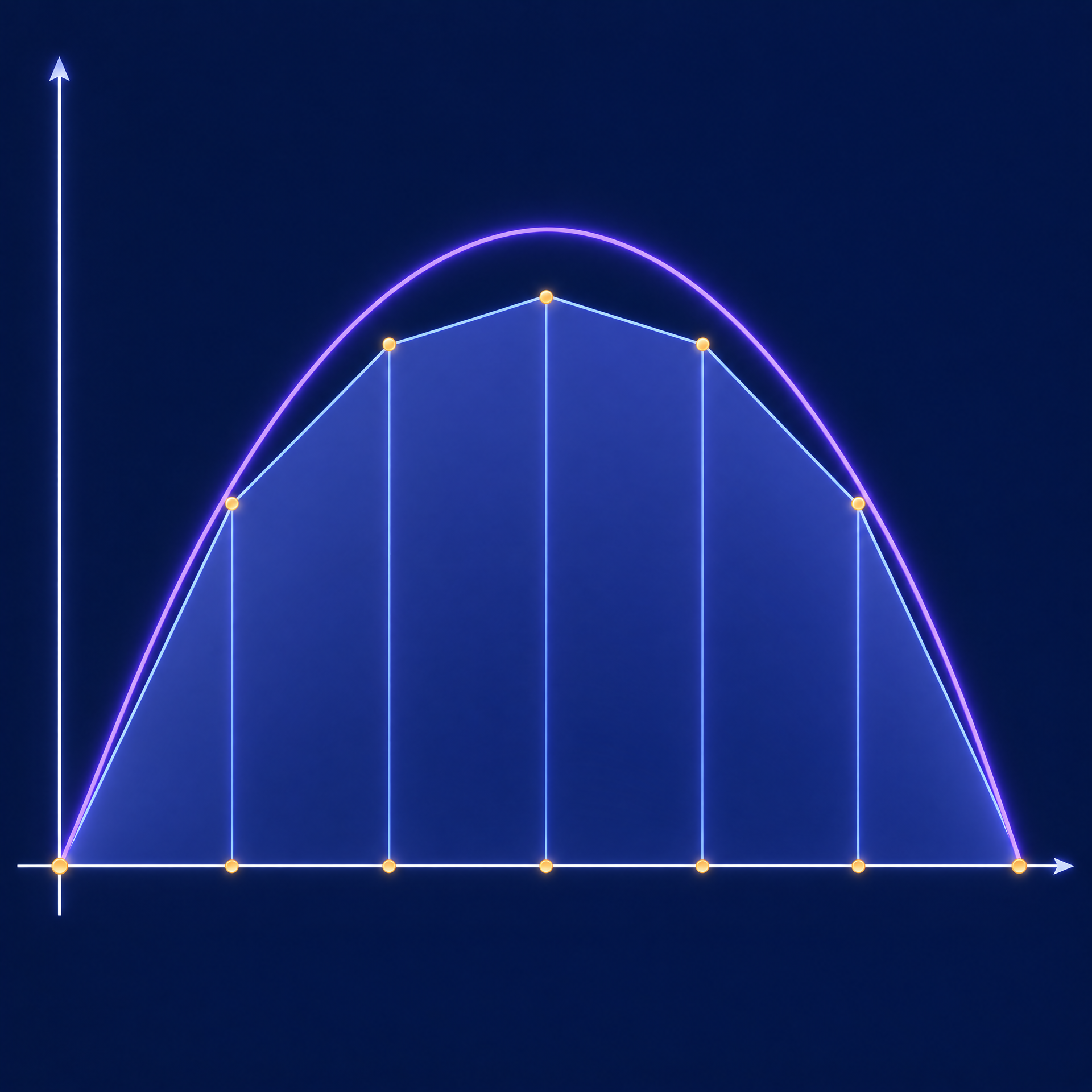
When exact integration is unavailable or a table of ordinates is supplied, replace curved strips by trapezia. With (n) equal intervals and width (h=\frac{b-a}{n}),
[
\int_a^b y,dx \approx \frac{h}{2}\left[y_0+y_n+2(y_1+y_2+\ldots+y_{n-1})\right].
]
The endpoints appear once; every interior ordinate appears twice. A safe memory check is E-M-E: Ends once, Middles twice, Everything in brackets. First find (h), then list the ordinates, then make one full substitution line. Do not use a difference between y-values as (h).

For the direction of error, inspect concavity. On a concave-up curve, the straight tops of the trapezia lie above the curve, so the estimate is an overestimate. On a concave-down curve, they lie below it, so it is an underestimate. Increasing or decreasing is irrelevant on its own. If the curve changes concavity, a blanket claim needs further evidence.
5. Context and calculator control
Numerical answers are approximations, so match the requested accuracy exactly: decimal places, significant figures, a stated interval or an inequality. Keep more digits on the calculator than you show in your final answer. Trigonometric ordinates in numerical integration normally require radian mode unless the question says otherwise. In a context, include units and choose meaningful roots. A negative time or length may solve an equation but be invalid for the model.
6. Choosing the right numerical method
Read the command word before reaching for a formula. If the question asks you to show that there is a root in an interval, it is asking for a sign-change argument, not a Newton-Raphson decimal. If it supplies (x_{n+1}=g(x_n)), use that precise recurrence: a different algebraic rearrangement is not an acceptable substitute. If it specifically names Newton-Raphson, begin with (f'(x)), not a generic iteration. If values are provided at equally spaced x-coordinates and the question asks for area or an estimate of an integral, the trapezium rule is intended.
Several methods can be combined sensibly. A sign-change calculation can give a safe initial interval, then Newton-Raphson can refine the root. In a context, you might use a graph to identify a physically plausible starting point and then run the supplied iteration. Explain the role of each stage: the sign test locates; the iteration or tangent method refines. This is clearer than presenting a stream of unexplained calculator outputs.
7. Accuracy, intervals and sensible reporting
The final line must match the requested form. “Correct to 3 decimal places” requires a rounded decimal such as (1.325), whereas “show that a root lies in an interval” needs the brackets, such as ((2.1,2.2)). An interval is not the same as an approximate root. Avoid claiming that an iterative result is exact: write (x\approx 2.303) where appropriate.
When a model involves time, distance, volume or energy, carry the unit into the conclusion. If a numerical root represents time after launch, a response such as “(t\approx 1.32) seconds” is complete, but “1.32” is not. Check that the root falls within the stated domain and makes physical sense. For example, two positive times may represent an object reaching the same height once on the way up and once on the way down. Do not discard one just because a calculator found another first.
8. Failure modes worth naming
WJEC expects candidates to understand that methods can fail, not to prove abstract convergence theorems. A sign-change method can miss a root that merely touches the axis, because the function does not change from positive to negative. Fixed-point iteration may oscillate, move away from a fixed point or become undefined for the chosen start value. Newton-Raphson may fail at a stationary point because (f'(x_n)=0), or may leap away when the tangent is nearly horizontal. The trapezium rule does not normally “fail”, but its reliability decreases with wide intervals or rapidly changing curvature. Smaller equal intervals generally give straighter chords that follow the curve more closely. State the relevant failure in words connected to the calculation or graph given; do not memorise a detached list.
Mathematical Relationships and Formula-Sheet Status
| Relationship | Meaning and use | Status |
|---|---|---|
| (f(a)f(b)<0) | Opposite signs bracket at least one root for a continuous, sufficiently well-behaved function. | Must understand and state |
| (x_{n+1}=g(x_n)) | Fixed-point recurrence. Use exactly the iteration supplied in the question. | Iteration formula supplied in question |
| (x_{n+1}=x_n-\frac{f(x_n)}{f'(x_n)}) | Newton-Raphson update from a tangent. | Given on WJEC formula booklet |
| (h=\frac{b-a}{n}) | Equal interval width for numerical integration. | Given within the trapezium-rule formula |
| (\int_a^b y,dx\approx\frac h2[y_0+y_n+2(y_1+\cdots+y_{n-1})]) | Trapezium-rule estimate. | Given on WJEC formula booklet |
Graph and Data Skills
- Label a sequence (x_0,x_1,x_2,\ldots) so an examiner can follow which value feeds the next iteration.
- A cobweb diagram uses both (y=g(x)) and (y=x); vertical then horizontal steps make the iteration visible.
- For a table, count intervals, not ordinates: five ordinates create four intervals.
- Curvature, not gradient, determines whether trapezia lie above or below the curve.
- WJEC excludes Simpson's rule from this section. Do not introduce it when a question calls for the trapezium rule.
Practical Applications
Engineers use numerical roots to find the time at which a moving object reaches a target height when a resistance model cannot be rearranged exactly. Environmental scientists can estimate accumulated rainfall or pollutant concentration from readings at equal time intervals using trapezia. Designers use iterative numerical solutions where a formula contains an unknown both inside and outside a nonlinear expression. In each case, the mathematical approximation must be interpreted: is the calculated time positive, is the accumulated quantity in correct units, and is the estimate known to be high or low?
Examiner's priority: method marks are only accessible when candidates show the method. A lone calculator decimal is rarely a complete numerical-methods answer.
Visual Resources
2 diagrams and illustrations
Interactive Diagrams
2 interactive diagrams to visualise key concepts
Conceptual Flow Outline
Decision flow for locating a root by a sign change. An absence of a sign change is not proof that no root exists.
Conceptual Flow Outline
Fixed-point iteration workflow. A cobweb diagram depicts the same repeated mapping geometrically.
Worked Examples
4 worked examples — open one to explore the question and available guidance.
Practice Questions
Test your understanding — click to reveal model answers
Let f(x)=x^3-5x+1. Show that f(x)=0 has a root in (0,1). [3 marks]
Hint: Evaluate f(0) and f(1), then compare their signs.
Given x_(n+1)=1+2/x_n and x_0=2, find x_1 and x_2. Hence state the fixed point. [3 marks]
Hint: Substitute x_0 into the right-hand side first, then use your x_1.
Use two Newton-Raphson iterations with x_0=0.7 to solve cos x - x=0. Give the root to 4 decimal places. [4 marks]
Hint: For f(x)=cos x-x, differentiate before substituting: f'(x)=-sin x-1.
The values of y=sqrt(1+x) at x=0, 0.25, 0.50, 0.75, 1 are 1.0000, 1.1180, 1.2247, 1.3229 and 1.4142. Use the trapezium rule to estimate integral from 0 to 1 of sqrt(1+x) dx. State the direction of error. [5 marks]
Hint: There are four equal intervals, so h=1/4. Endpoints are counted once.
A model for the height h metres of a drone t seconds after launch is h=20t-4.9t^2+3sin t. Explain how you would estimate the positive time at which h=15, and state one check needed before reporting your result. [4 marks]
Hint: Convert the model into f(t)=0 and choose an appropriate numerical root method.