WJEC · A-Level · Mathematics
Proof
Proof turns mathematical patterns into certainty: candidates learn how to build a logical chain from assumptions to conclusion, or destroy an over-confident claim with one valid counterexample. For WJEC A-Level Mathematics, it is a compact, high-leverage topic because the same disciplined reasoning powers algebra, indices and the compulsory proofs of the logarithm laws.
- 9 min read
- 4 worked examples
- 5 practice questions
- 8 key terms
Study Notes

WJEC A-Level Mathematics: Proof (2.1.1)
Overview
Proof is the discipline of showing that a mathematical statement must be true, or of showing precisely why it is false. In WJEC AS Unit 1: Pure Mathematics A, candidates need to move from stated assumptions through a logical sequence to a conclusion. This is more demanding than spotting a pattern: three successful numerical examples can suggest a result, but they cannot establish a claim about every integer.
WJEC names three methods: proof by deduction, proof by exhaustion and disproof by counterexample. The specification also explicitly requires proof by deduction for the laws of logarithms. These ideas link straight to algebra, indices, functions and later argument in calculus and statistics. In the 2 hour 30 minute, 120-mark Unit 1 examination, use about 75 seconds per mark. A short proof can be high-value because clear definitions, justified algebra and a visible conclusion allow marks to be awarded efficiently.
Typical questions use command words such as prove, show and disprove. First identify the domain and the type of claim. Then choose a method that fits it. A proof that is logically complete is usually concise; a long calculation with one unjustified jump is not.
Ten-Minute Revision Podcast
Listen once to establish the method-selection framework, then replay the quick-fire recall section without looking at your notes.
Key Concepts
1. The architecture of a valid proof
A proof has three parts:
- Assumptions and definitions: state what is given and introduce variables with their conditions.
- Valid logical steps: each line follows from a definition, an earlier line or an accepted result.
- Conclusion: state exactly the result required by the question, normally introduced by “therefore”, “hence” or a conclusion symbol.
Imagine a bridge: the assumptions are one bank and the conclusion is the other. Every equality sign or implication is a load-bearing plank. Candidates lose credit when a step is only asserted, when a condition is silently dropped, or when the conclusion is assumed in the working.
For example, to prove a statement about an odd integer, write (n=2k+1), where (k\in\mathbb Z). The phrase “where (k) is an integer” matters. If the working ends with (2m+1), say why (m) is an integer before declaring the quantity odd. This transforms an expansion into a proof.

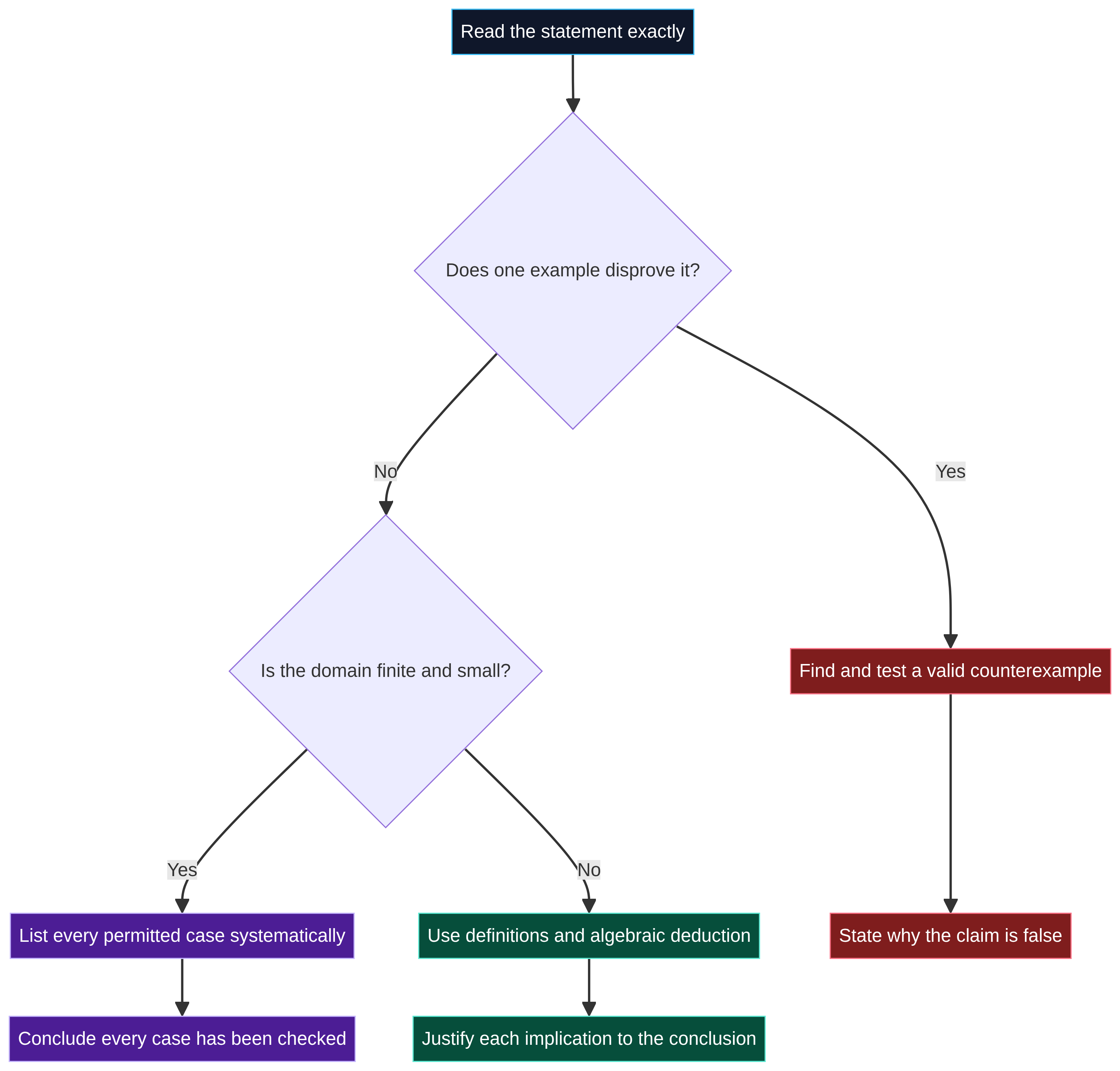
Use this decision flowchart before starting a proof question. The correct method depends on the domain and on whether one counterexample can defeat the claim.
2. Proof by deduction
Use deduction when a statement is general, especially one involving all integers or all permitted values of a variable. Start from the definition of the relevant class of number, manipulate it using valid algebra, then arrive at the defining form of the conclusion.
For instance, to show that the square of every odd integer is odd, let (n=2k+1). Then
[
n^2=(2k+1)^2=4k^2+4k+1=2(2k^2+2k)+1.
]
Since (2k^2+2k) is an integer, (n^2) has the form (2m+1), so it is odd. Credit is given for the definition, valid expansion and factorisation, recognition of an integer, and the final conclusion. Merely checking (3^2,5^2) and (7^2) gives evidence, not a general proof.
Be precise with notation. Use an equals sign only when both expressions are equal. Use “therefore” or an implication when moving from a fact to a conclusion. Never begin with the result you are meant to prove and work backwards unless every reverse step is explicitly justified as an equivalence.
3. Proof by exhaustion
Exhaustion works only when the possible cases form a finite list that you can cover completely. State the set, organise the cases systematically, test every permitted case, then conclude that the result holds for the entire stated domain.
If (n\in{1,2,3}), proving (n^2+n) is even by exhaustion means evaluating all three values: (2,6,12). Do not test just (n=1) and (n=3) because both happen to work. The whole force of this method is the wordevery.
A useful examiner check is: could another allowed case exist that has not appeared in the answer? If yes, the proof is incomplete. Listing 1 to 10 cannot prove a claim for all positive integers, because the domain is infinite. Use deduction instead.
4. Disproof by counterexample
A universal claim has the form “for every” or “all”. One permitted value that makes the claim false is enough to disprove it. The counterexample must be inside the stated domain, and candidates should substitute it fully rather than merely name it.
For example, the statement “for every real number (x), (x^2>x)” is false. Choose (x=\tfrac12). Then (x^2=\tfrac14), and (\tfrac14
ot>\tfrac12). Therefore the universal statement is false. The counterexample is decisive because it obeys the condition “real number”. If the domain were positive integers, (\tfrac12) would not be valid.
A counterexample disproves a universal statement; it does not prove its opposite universal statement. From one failure, you may conclude “the claim is false”, not “the reverse is always true”.
5. Deductive proofs of logarithm laws
WJEC specifically requires deductive proof of the logarithm laws. The key connection is the definition of logarithm and the laws of indices. For base (a), always state the restrictions (a>0), (a
e1), and that each logarithm argument is positive.
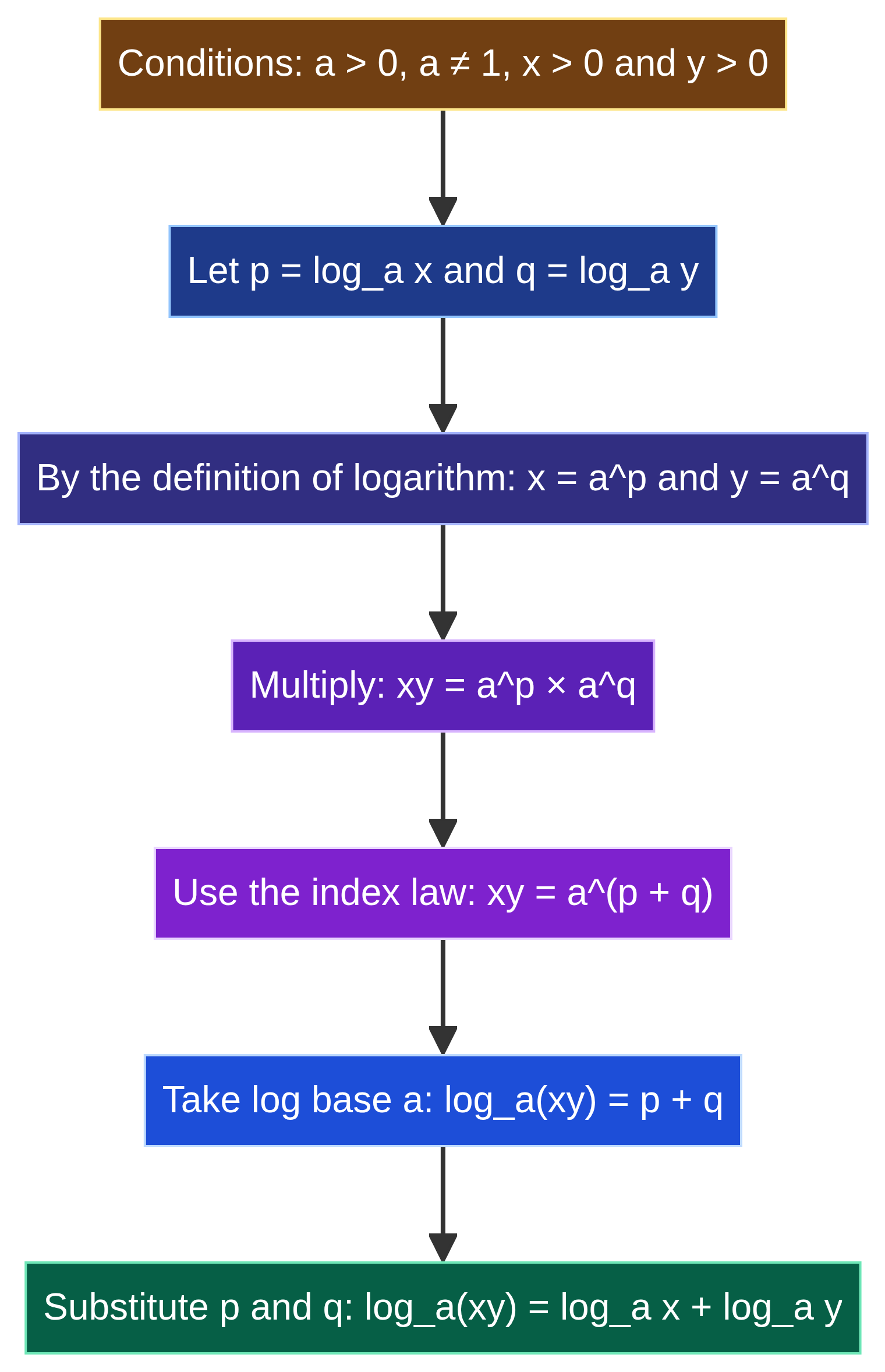
To prove (\log_a(xy)=\log_a x+\log_a y), let (p=\log_a x) and (q=\log_a y). Then, by the definition of logarithm, (x=a^p) and (y=a^q). Therefore
[
xy=a^p\times a^q=a^{p+q}.
]
Taking logarithms base (a) gives (\log_a(xy)=p+q). Substituting back for (p) and (q) produces the required result. The proof is not a mnemonic written in symbols: every line has a reason.

The product law proof is a chain from the definition of a logarithm to the index law and back to logarithms.
The related laws are (\log_a(x/y)=\log_a x-\log_a y) and (\log_a(x^r)=r\log_a x). The memory phrase is Product Plus, Quotient Minus, Power to the front. Be alert for the non-law (\log_a(x+y)=\log_a x+\log_a y), which is false in general. Addition inside a logarithm does not split.
Mathematical Relationships: Formula and Fact File
All of the following should be treated as must memorise for proof questions; do not rely on a formula sheet to supply the reasoning.
- Even integer: (n=2k), where (k\in\mathbb Z).
- Odd integer: (n=2k+1), where (k\in\mathbb Z).
- Index product law: (a^p\times a^q=a^{p+q}).
- Index quotient law: (a^p/a^q=a^{p-q}), for (a
e0). - Index power law: ((a^p)^r=a^{pr}).
- Log product law: (\log_a(xy)=\log_a x+\log_a y).
- Log quotient law: (\log_a(x/y)=\log_a x-\log_a y).
- Log power law: (\log_a(x^r)=r\log_a x).
For logarithms, (a>0), (a
e1), and arguments such as (x) and (y) must be positive. Write these restrictions before a formal proof. They show that the logarithms exist and that the base is valid.
Practical Applications and Why Proof Matters
Proof guards against over-generalising from data. A software test might work for a thousand inputs yet still fail on an untested input; a counterexample identifies the failure. Exhaustion mirrors checking every possible state in a small system. Deduction mirrors how algorithms are verified for every input of a specified type.
Logarithm laws are used when multiplicative processes are turned into additive relationships, for example in growth models and log-linear graphs later in the course. The proof tells you why the algebraic shortcut is valid, rather than asking you to trust it. In an examination, this understanding helps candidates decide whether they may simplify an expression and, just as importantly, whether a proposed simplification is invalid.
Examiner Checklist: Turning Working into Marks
Before moving on, read a proof once as though you were marking it. Can you point to the given condition? Can you explain the reason for every non-obvious line? Can you see the exact statement that was required in the conclusion? If any answer is no, make the missing link explicit.
For deduction, a reliable answer frame is: “Let …, where … . Then … . Since …, … . Therefore … .” The value of this frame is not its style; it forces the candidate to establish a domain, carry out a derivation and close the argument. If a bracket needs to be an integer, name it as an integer. If an index law is used, cite it. A correct final answer without this connective reasoning may lose the method marks.
For exhaustion, avoid a loose list of arithmetic. Announce the complete finite set first. Put every result in a deliberate order, then say that no cases remain. This is particularly important when pairs or combinations are involved: state whether order matters and ensure that the list matches that decision.
For a counterexample, answer in three compact moves: select a permitted value, substitute it, then state the contradiction. For example, a counterexample to a positive-integer claim must itself be positive and integral. A negative or fractional value would be irrelevant even if it produced a failure.
Finally, use the command word as a quality-control check. Prove demands general reasoning. Disprove demands one decisive valid failure. Show demands visible working that reaches the requested target. In all three, a conclusion is not optional: it tells the examiner what your calculation has established and is often where the final mark is awarded.
Visual Resources
2 diagrams and illustrations
Interactive Diagrams
2 interactive diagrams to visualise key concepts
Conceptual Flow Outline
A method-selection flowchart for WJEC proof questions.
Conceptual Flow Outline
The deduction chain proving the product law of logarithms.
Worked Examples
4 worked examples — open one to explore the question and available guidance.
Practice Questions
Test your understanding — click to reveal model answers
Which method is most suitable for disproving the claim 'For every positive real number x, x^2>x'? Give a valid counterexample. [3 marks]
Hint: The wording 'for every' signals that one allowed value can defeat the claim.
Prove that if n is an even integer, then n^2 is an even integer. [4 marks]
Hint: Start from the definition of an even integer.
By exhaustion, show that n^2+n is divisible by 2 for n∈{1,2,3,4}. [4 marks]
Hint: List the entire set before evaluating.
Disprove the statement 'For every integer n, n^2+n+41 is prime.' [3 marks]
Hint: Try an integer that makes the expression factor or gives an obviously composite result.
Given a>0, a≠1, x>0 and y>0, prove that log_a(x/y)=log_a x−log_a y. [6 marks]
Hint: Set p=log_a x and q=log_a y, then use the index quotient law.