WJEC · A-Level · Mathematics
Sequences and Series - The Binomial Theorem
The WJEC binomial theorem turns long-looking bracket powers into an organised sequence of coefficients, falling first powers and rising second powers. Mastering the general term lets candidates expand confidently, isolate a required coefficient without wasted work, and explain the same counting logic used in binomial probability. Every mark is protected by one disciplined routine: choose r, keep brackets intact, simplify powers, and answer the command word.
- 9 min read
- 3 worked examples
- 6 practice questions
- 7 key terms
Study Notes

Overview
The binomial theorem is the organised way to expand a bracket of the form (a + bx)^n when n is a positive integer. Rather than multiplying out several brackets blindly, candidates use a predictable coefficient pattern and a predictable movement of powers. This makes full expansions, single-term questions and coefficient questions quicker and safer.
For WJEC A-Level Mathematics, this is specification reference 2.1.4: Sequences and Series – The Binomial Theorem. The specification requires the notation n!, (n over r) and nCr, use of Pascal’s triangle, and a link to binomial probabilities. Typical questions ask candidates to expand an expression, identify a specified coefficient, show that a stated term occurs, or connect a combination count to a probability calculation. In every form, marks are awarded for organised algebra: correct binomial coefficients, correct powers, careful signs and accurate simplification.
The topic is more than a shortcut. A binomial coefficient counts how many ways the second term can be selected from a set of brackets. That same counting idea later becomes the nCr in binomial probability. Learn the structure now and you gain a dependable method for both pure mathematics and statistics.
Key Concepts
Concept 1: The finite binomial expansion
A binomial has two terms, for example 2 + 3x, 1 - 2x, or 2x + 1/x. When a binomial is raised to a positive integer power, the expansion has a finite number of terms. For (a + bx)^n, there are n + 1 terms, because the term index r runs from 0 to n.
The first term is a^n. At each new term, one factor of a is replaced by one factor of bx. Therefore the power of a falls by one while the power of bx rises by one. This is a built-in accuracy check. If (a + bx)^5 has a term containing a^2, the same term must contain (bx)^3; the exponents add to five.
Memory hook: FIRST FALLS, SECOND CLIMBS. The first bracket term starts with power n and descends to zero. The second bracket term starts with power zero and ascends to n.
Example:
(a + bx)^4 = a^4 + 4a^3(bx) + 6a^2(bx)^2 + 4a(bx)^3 + (bx)^4
The powers of a are 4, 3, 2, 1, 0; the powers of bx are 0, 1, 2, 3, 4. Both patterns must be visible in a secure answer.
Concept 2: Binomial coefficients and factorial notation
The numerical coefficients are binomial coefficients: nC0, nC1, ..., nCn. They can be calculated using
nCr = n! / [r!(n-r)!].
Here n! means n × (n-1) × ... × 2 × 1, and 0! = 1. For example,
6C2 = 6! / (2!4!) = (6 × 5) / (2 × 1) = 15.
Candidates should cancel factorials before multiplying. It is more efficient and reduces arithmetic errors. The WJEC formula booklet gives the binomial coefficient and the expansion formula, but credit is still given for selecting and applying them correctly.
Why does nCr appear? In an expansion of n identical brackets, an x^r contribution is made by choosing the second term from exactly r brackets. The number of different selections is nCr. The coefficient is therefore a count of arrangements.
Memory hook: COEFFICIENTS COUNT. They count the ways to choose the second term.

Concept 3: Pascal’s triangle
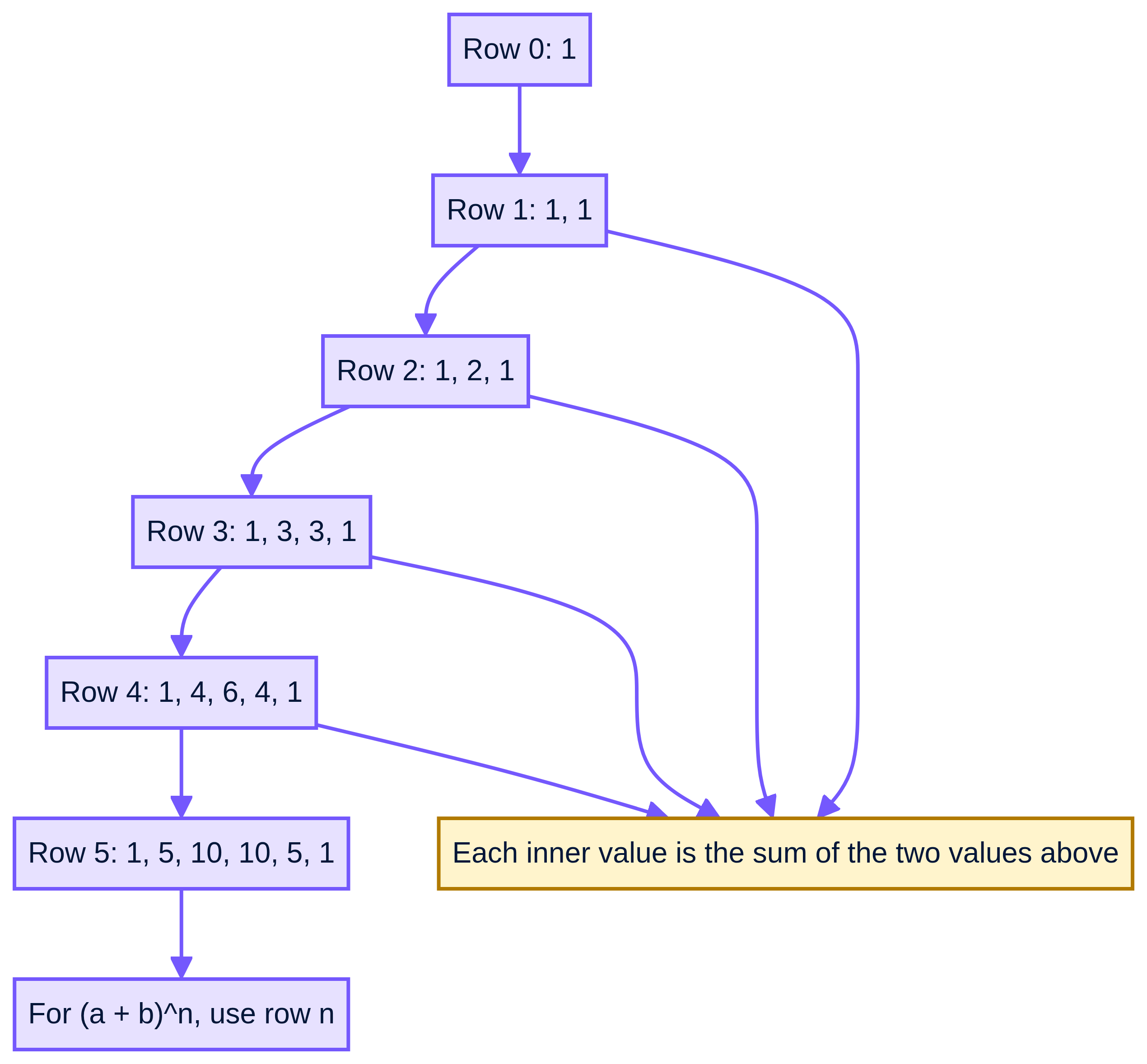
Pascal’s triangle provides the coefficient rows quickly for small positive powers:
n = 0: 1
n = 1: 1, 1
n = 2: 1, 2, 1
n = 3: 1, 3, 3, 1
n = 4: 1, 4, 6, 4, 1
n = 5: 1, 5, 10, 10, 5, 1
Each inner number is found by adding the two numbers above it. For (p + q)^5, use row five. Pascal’s triangle is fast, but it does not replace the need to manage powers and coefficients such as (3x)^r. Use it as a coefficient source, then build the algebraic terms carefully.
A frequent error is to use a correct row but treat (3x)^2 as 3x^2. This misses the square on the numerical coefficient. Always simplify the complete bracketed quantity: (3x)^2 = 9x^2.
Concept 4: The general term
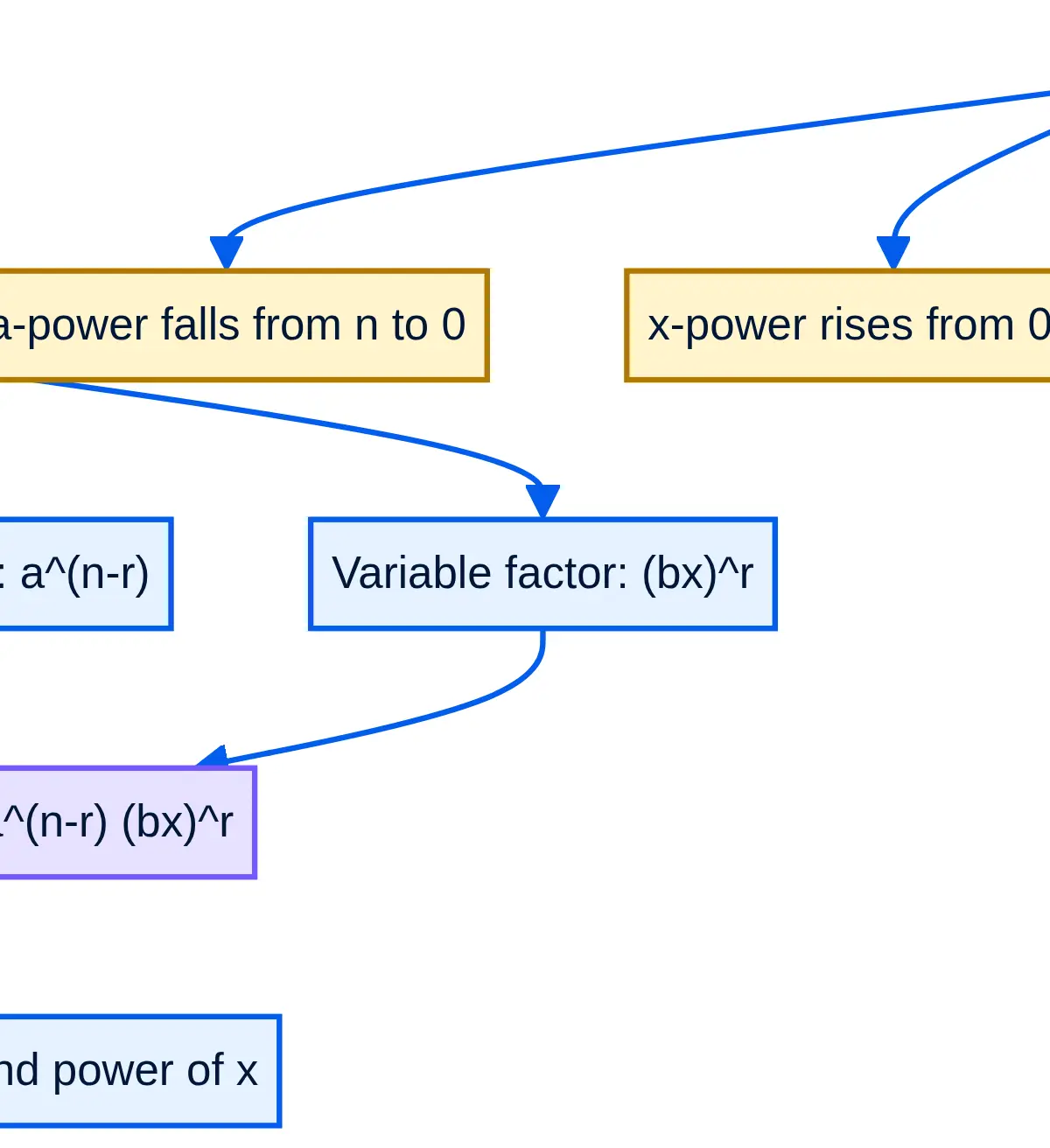
The general term, often written T_(r+1), is
T_(r+1) = nCr a^(n-r)(bx)^r, for r = 0, 1, ..., n.
It is the most efficient method when a question asks for one coefficient rather than the whole expansion. The index is r, but the term number is r + 1: r = 0 gives the first term, r = 1 gives the second term, and so on. Do not confuse the two.
Worked pattern: To find the x^3 term in (2 + 5x)^7, set r = 3 because (5x)^r supplies x^r:
T_4 = 7C3 × 2^(7-3) × (5x)^3.
Now simplify each component separately before multiplying. This structure earns method credit even if a final arithmetic calculation slips.
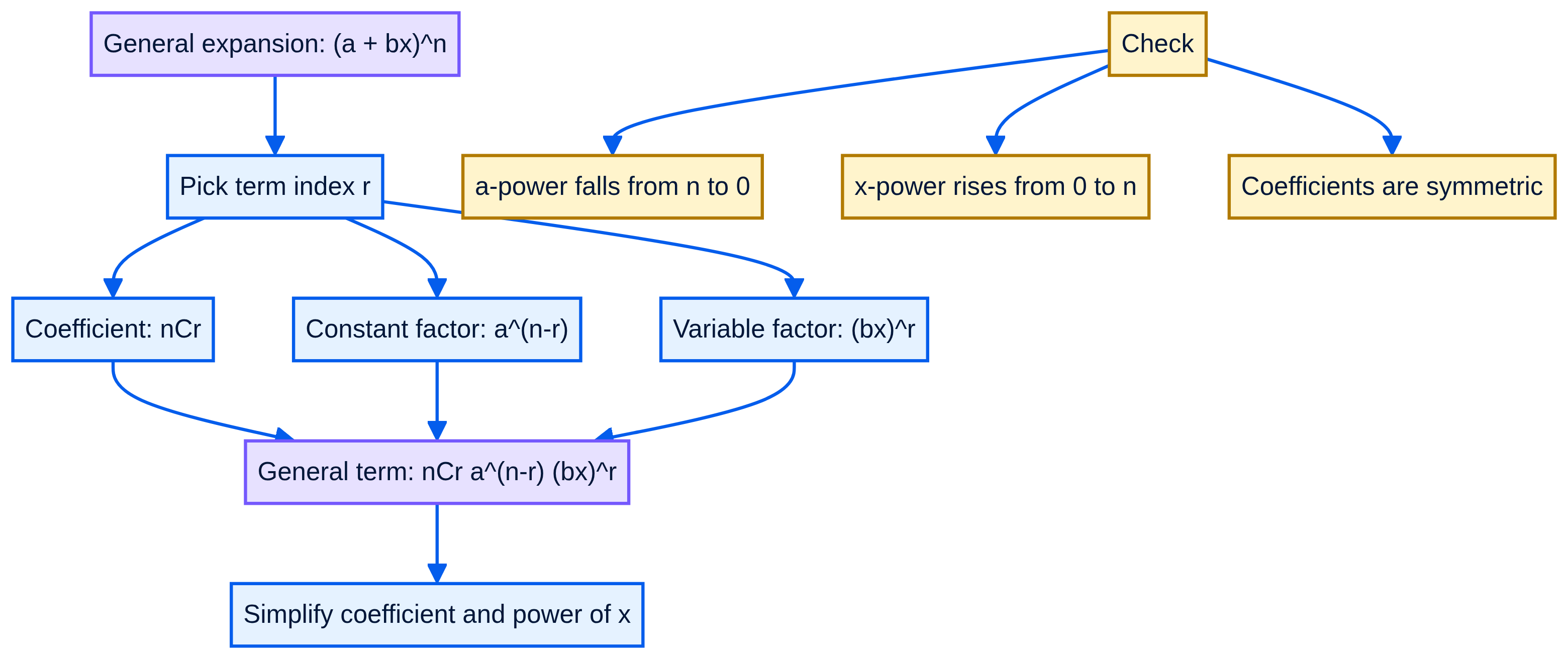
Memory hook: C-F-R. Write the term in this order: Coefficient nCr, First power a^(n-r), Rising second power (bx)^r.
Concept 5: Signs, coefficients and powers
When the second term is negative, retain the bracket until its power has been dealt with. For (1 - 2x)^5, the powers of (-2x) alternate in sign: positive, negative, positive, negative, and so on. This gives the expansion
1 - 10x + 40x^2 - 80x^3 + 80x^4 - 32x^5.
The alternating pattern is a useful check, not a substitute for calculation. It only occurs because the second term is negative. Candidates lose accuracy marks by writing the coefficient from Pascal’s triangle correctly but dropping the sign or by forgetting that (-2)^3 = -8.
For brackets involving powers of x or negative indices, determine the power of x algebraically. In (1 + 2x^2)^6, term r contains x^(2r), so the x^8 term has 2r = 8, giving r = 4. In (2x + 1/x)^6, choosing 1/x exactly r times gives an x power of (6-r) - r = 6 - 2r. Build this exponent equation before evaluating nCr.
Mathematical Relationships and Formula-Booklet Use
| Relationship | Use | WJEC status |
|---|---|---|
(a + b)^n = a^n + nC1a^(n-1)b + ... + nCr a^(n-r)b^r + ... + b^n | Full finite expansion for positive integer n | Given in the WJEC formula booklet |
T_(r+1) = nCr a^(n-r)(bx)^r | A specified term or coefficient in (a + bx)^n | Derived directly from the given expansion; learn to use fluently |
nCr = n! / [r!(n-r)!] | Calculating a binomial coefficient | Given in the WJEC formula booklet |
n! = n(n-1)...2×1, with 0! = 1 | Interpreting factorial notation | Given in the WJEC formula booklet |
The formula booklet is a tool, not an automatic mark. A candidate must substitute the correct values of n and r, preserve brackets, simplify powers correctly, and present the response asked for. In a coefficient question, do not give an expression containing x; give the numerical coefficient unless the command word asks for the full term.
Practical Applications and Synoptic Context
The direct real-world use is combinatorial counting. If a system has n independent yes-or-no decisions, nCr counts the ways exactly r of them can take the second outcome. This becomes the coefficient in the binomial probability formula P(X = r) = nCr p^r(1-p)^(n-r). The algebra and the probability therefore use the same counting structure.
The theorem also underpins approximation work later in A-Level Mathematics, where a suitable expression is rearranged into a binomial form and expanded. At this stage, WJEC 2.1.4 is specifically the finite expansion for positive integer powers. Do not confuse it with the later general binomial series for fractional or negative powers.
High-value self-check before submitting
Cover your working and inspect only the final expansion. The first term should contain no second bracket factor; the final term should contain no first bracket factor. The coefficients should be symmetric, for example 1, 5, 10, 10, 5, 1, even when the terms themselves are not numerically symmetric. Finally, check that every individual term has total bracket-factor power n. This structural check is often faster than repeating the entire calculation.
Exam Technique: Marks, Timing and Command Words
Allow roughly one minute per mark, unless the paper gives a different timing instruction. For a 3-mark specified-term question: identify r, write the correct general term with substitution, then simplify. For a 4- to 6-mark full expansion: choose a coefficient method, show the sequence of powers, simplify every term, then perform a final sign-and-power check.
- Expand: write every required term, normally ordered by ascending or descending powers of
xas requested. - Find the coefficient: identify only the relevant term and give the numerical multiplier.
- Show that: give a clear chain of substitution and simplification, because method marks are available even when the destination is printed.
- Hence / use your answer: carry forward the previous result. Do not restart with a different method unless necessary.
Before moving on, apply the SCOPE check: Signs, Coefficients, Opposite-moving powers, Powers of numerical factors, Exact command word. It takes seconds and catches the errors that most often cost marks.
Listen and Recall
Use the podcast after reading this guide once. Pause at each recall prompt and answer aloud before hearing the explanation. That active retrieval is much stronger than replaying the answer passively.
Visual Resources
2 diagrams and illustrations
Interactive Diagrams
2 interactive diagrams to visualise key concepts
Conceptual Flow Outline
Decision process for choosing a binomial-expansion method and checking the result.
Conceptual Flow Outline
The three ingredients of the general term and the meaning of each one.
Worked Examples
3 worked examples — open one to explore the question and available guidance.
Practice Questions
Test your understanding — click to reveal model answers
Expand (2 + x)^4. [3 marks]
Hint: Use coefficients 1, 4, 6, 4, 1 and let the power of 2 fall while the power of x rises.
Use factorial notation to calculate 8C3. [2 marks]
Hint: Cancel 8! against 5! before multiplying.
Find the coefficient of x^4 in (1 - 3x)^6. [3 marks]
Hint: The x power is r, so choose r = 4.
Find the coefficient of x^6 in (1 + 2x^2)^5. [4 marks]
Hint: In term r, the x power is 2r. Solve 2r = 6 first.
In (2x + 1/x)^8, find the coefficient of x^2. [5 marks]
Hint: If r selections are 1/x, the x power is (8-r) - r.
Explain why 7C3 appears in the probability of exactly three successes in seven independent trials. [3 marks]
Hint: Think about how many positions the three successes can occupy.