WJEC · A-Level · Mathematics
Vectors
Vectors turn movement into precise algebra: every answer combines a horizontal i-component with a vertical j-component. For WJEC A-Level Mathematics 2.1.9, candidates who consistently use end minus start, visible brackets and a quick diagram can secure method marks on displacement, distance, parallelism and ratio questions.
- 9 min read
- 3 worked examples
- 6 practice questions
- 8 key terms
Study Notes
Overview
Vectors are quantities with magnitude and direction. On WJEC A-Level Mathematics, section 2.1.9 Vectors, candidates use two-dimensional vectors in the unit-vector basis i and j, then turn the algebra into geometry. The topic is small enough to feel manageable, but it is a high-value foundation: a sign error in a position-vector question can remove several linked marks, while a clean method often gains marks even if an arithmetic slip occurs later.
A vector question may ask you to add or scale vectors, identify parallel vectors, find the vector (\overrightarrow{AB}), calculate a distance, or locate a point dividing a line in a stated ratio. Do not treat these as separate tricks. They all begin with components: horizontali, vertical j. The examiner is looking for accurate notation, visible substitution and a conclusion that answers the command word. Vectors also feed directly into coordinate geometry, proof, mechanics and later three-dimensional work.
Ten-minute revision podcast
Use the episode after reading the overview, then pause at each recall question and answer aloud before the model answer is given.
Key concepts
1. What a vector says
A scalarhas size only, such as 8 cm or 12 seconds. A vector has size and direction, such as a displacement of (3\mathbf i-2\mathbf j). In two dimensions, (\mathbf i) is one unit in the positive horizontal direction and (\mathbf j) is one unit in the positive vertical direction. Thus (3\mathbf i-2\mathbf j) means “three right, two down”. The column form (\begin{pmatrix}3\-2\end{pmatrix}) is the same vector.
Keep the notation honest. Use bold or an arrow where the question does, and do not call a distance a vector. The magnitude (|\mathbf a|) is a scalar. A useful examiner habit is to finish with the requested form: if a question asks for unit-vector notation, write (3\mathbf i-2\mathbf j), not merely a pair of coordinates.
2. Addition, subtraction and scalar multiplication
Add component by component:
[
(3\mathbf i-2\mathbf j)+(-\mathbf i+4\mathbf j)=2\mathbf i+2\mathbf j.
]
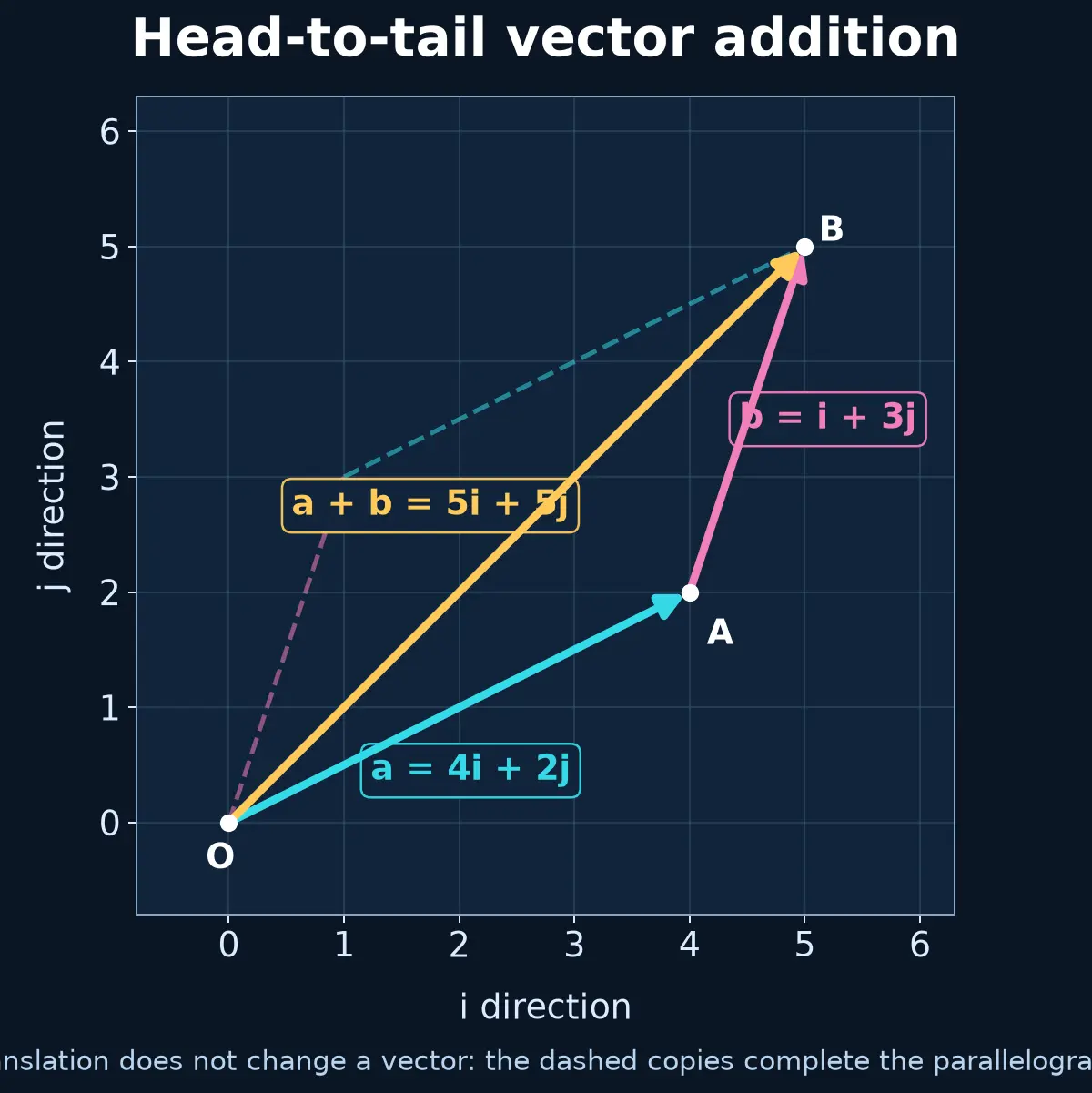
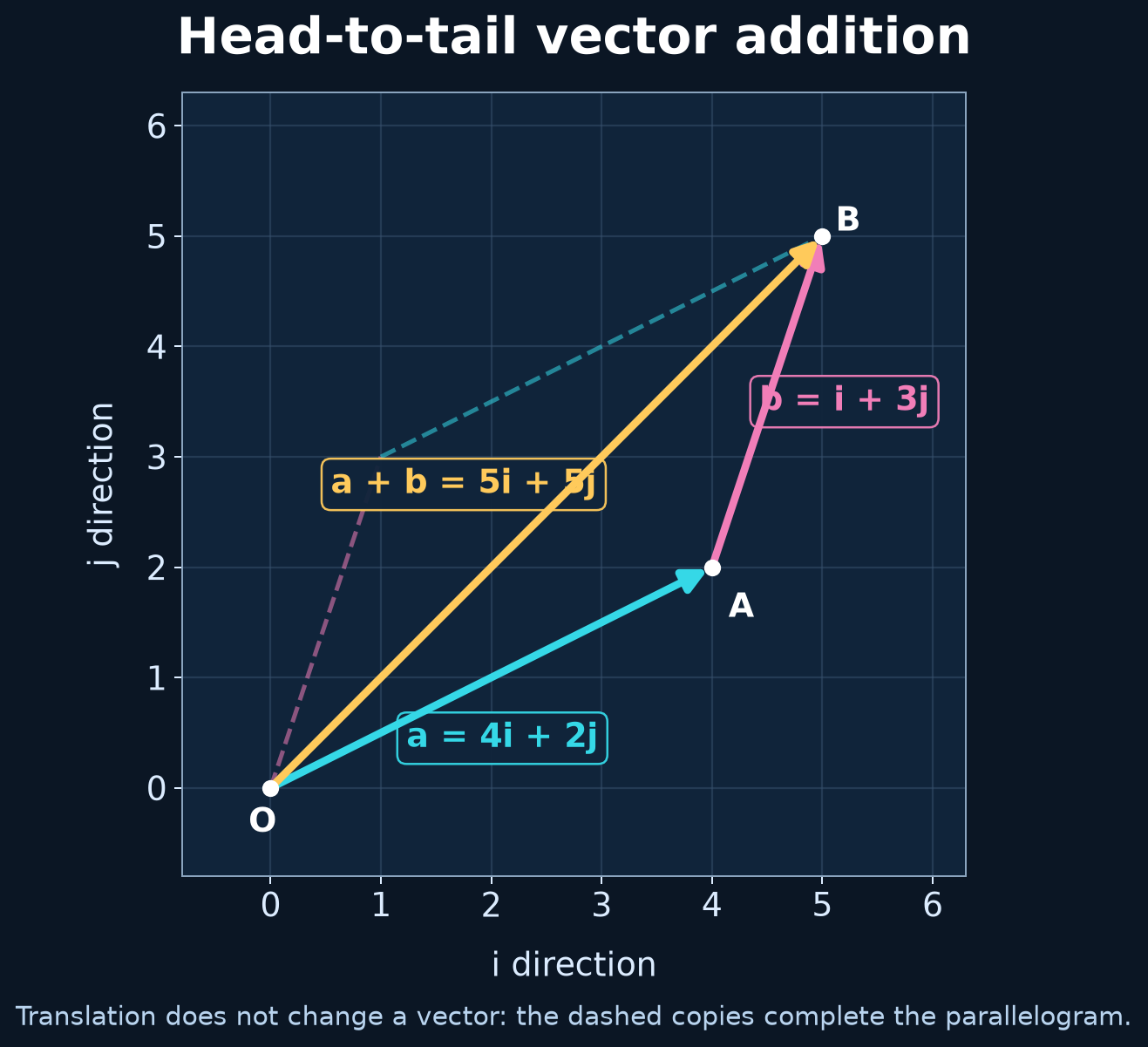
Geometrically, translate the second arrow so that its tail is at the head of the first. The result runs from the original tail to the final head. Translation changes position, not the vector itself, so this head-to-tail diagram is valid.
A scalar multiplies every component. For (\mathbf a=2\mathbf i-3\mathbf j), (-2\mathbf a=-4\mathbf i+6\mathbf j). The negative reverses direction; the factor 2 doubles the magnitude. Memory check:scale stretches, it does not steer. The direction is unchanged for a positive scalar and reversed for a negative scalar. Candidates commonly multiply only the first component or lose the negative sign. Brackets prevent both errors: (-2(2\mathbf i-3\mathbf j)).
3. Magnitude and distance
For (\mathbf a=x\mathbf i+y\mathbf j), Pythagoras gives
[
|\mathbf a|=\sqrt{x^2+y^2}.
]
The square is essential: a negative component contributes a positive square. For example, (|6\mathbf i-8\mathbf j|=\sqrt{6^2+(-8)^2}=10). The answer is a length, so it is non-negative and has no (\mathbf i) or (\mathbf j) attached.
Distance between points is just the magnitude of a displacement vector. First find (\overrightarrow{AB}); only then take its magnitude. This two-line routine exposes method marks and stops a common confusion between the vector (\overrightarrow{AB}) and its length (AB).
4. Position vectors and the direction of subtraction
A position vectorbegins at the origin. If point A has position vector (\mathbf a) and B has position vector (\mathbf b), then
[
\overrightarrow{AB}=\mathbf b-\mathbf a.
]
Read it as end minus start: travel starts at A and ends at B, so B minus A. If (\mathbf a=2\mathbf i-\mathbf j) and (\mathbf b=8\mathbf i+7\mathbf j), then (\overrightarrow{AB}=6\mathbf i+8\mathbf j), and (AB=10).
Check direction before accepting your result. Reversing the order gives (\overrightarrow{BA}), the same length but the opposite direction. A diagram or the spoken prompt “from A to B” catches this before it costs marks.
5. Parallel vectors
Two non-zero vectors are parallel when one is a scalar multiple of the other. For example, (6\mathbf i-9\mathbf j=-3(-2\mathbf i+3\mathbf j)), so the vectors are parallel. A negative multiplier still proves parallelism because it reverses, rather than changes, the line of direction.
In a show-that question, write the multiplier explicitly. “The components look proportional” is not a proof. State (\mathbf u=k\mathbf v), show the same non-zero (k) works for both components, then conclude “therefore (\mathbf u) is parallel to (\mathbf v)”. Do not compare just one component.
6. Dividing a line in a ratio
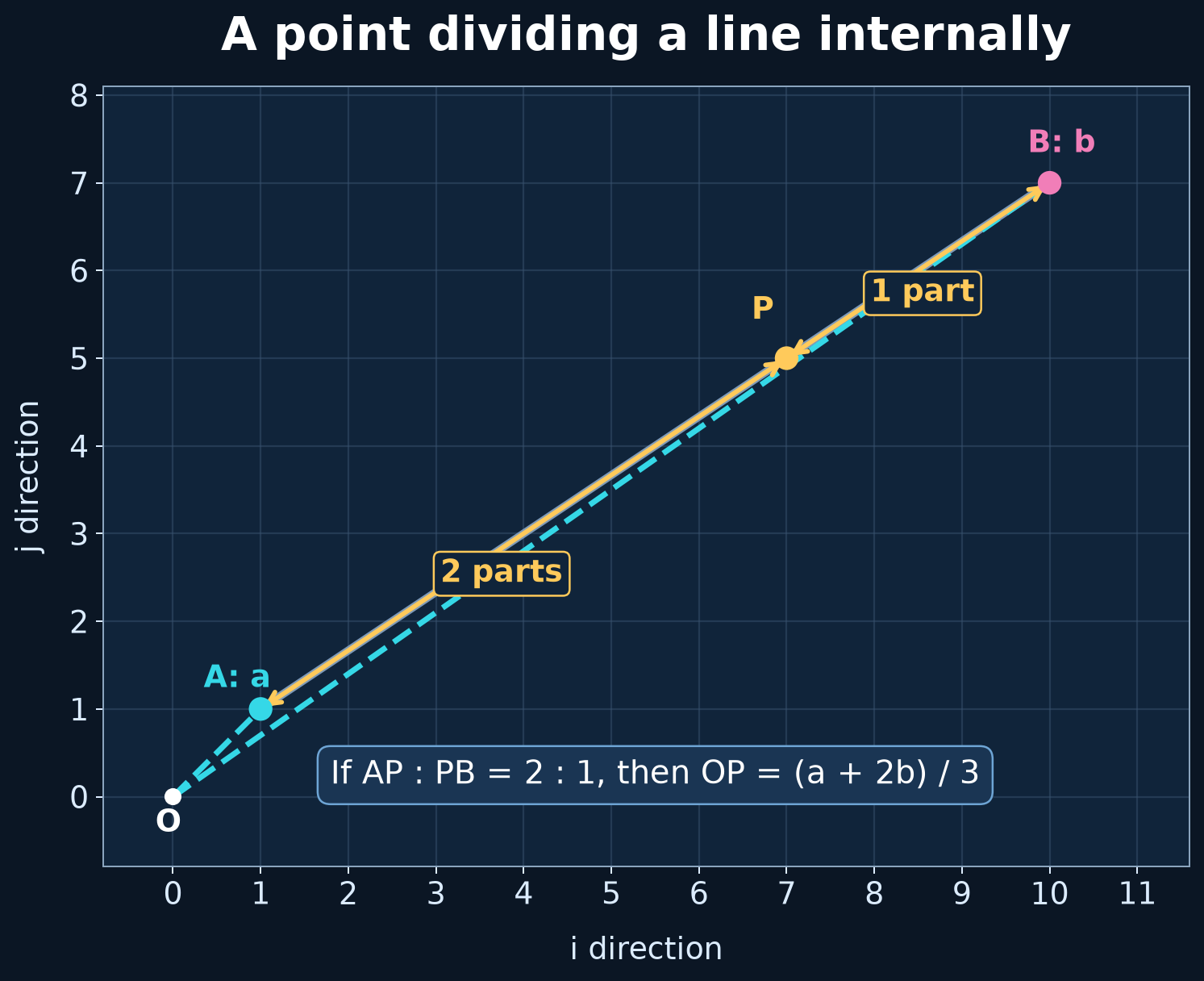
If P divides AB internally in the ratio (AP:PB=m:n), P is (m/(m+n)) of the way from A towards B. Starting from (\mathbf a),
[
\overrightarrow{OP}=\mathbf a+\frac{m}{m+n}(\mathbf b-\mathbf a)
=\frac{n\mathbf a+m\mathbf b}{m+n}.
]
Both forms are worth knowing. The first is safer because it tells the geometric story: starting position plus a fraction of the displacement. The second is fast when simplifying. Notice the “opposite weight” pattern: the coefficient of (\mathbf a) is (n), the ratio part next to B. This places P nearer to the endpoint with the smaller segment.

For (AP:PB=2:1), P is two thirds of the way from A to B, so P must be nearer B. This reasonableness check is powerful. If your result sits closer to A, your ratio has probably been inverted.
Mathematical relationships and formula status
7. Why the methods are reliable
Every vector calculation is really a statement about horizontal and vertical movement. Addition works component by component because horizontal movements combine independently of vertical movements. The same reason explains scalar multiplication: multiplying by (k) makes both the horizontal and vertical parts (k) times as large, so the arrow remains on the same line. Pythagoras works for magnitude because the two components form perpendicular sides of a right-angled triangle. This is not a collection of unrelated rules: it is one coordinate-grid model used in different ways.
Use that logic when a question is unfamiliar. If you forget a formula for a ratio point, construct it from the journey. Start at A, work out (\overrightarrow{AB}), then travel the required fraction. If you are unsure whether an answer is a distance or a vector, ask whether it describes movement or merely how long that movement is. This reasoning earns credit in explanation questions because it links algebra to the diagram rather than presenting an unmotivated rule.
8. Notation and accuracy marks
WJEC’s notation distinguishes (\overrightarrow{AB}), a directed vector, from (AB), its length. In typed work the arrow may be represented by bold notation or an explicit vector symbol; follow the notation in the question and be consistent. Similarly, (\mathbf a) is a vector whereas (|\mathbf a|) is its magnitude. The difference is not cosmetic. If a question asks for (\overrightarrow{AB}), an answer of 10 is incomplete; if it asks for (AB), an answer of (6\mathbf i+8\mathbf j) is incomplete. State both only when asked for a vector and hence a distance.
When simplifying, collect all i-terms and all j-terms separately. Write (7\mathbf i-6\mathbf j), not (7-6), and never merge unlike components. When a calculator gives a decimal magnitude, retain exact surd form unless the question tells you otherwise. A small bracket at the substitution stage is often worth more than a rushed final answer: it makes the direction of subtraction visible to the examiner and protects all later working.
| Relationship | Use | Formula-sheet status |
|---|---|---|
| (\mathbf a=x\mathbf i+y\mathbf j) | Components in the unit-vector basis | Must memorise |
| (\mathbf a+\mathbf b=(x_1+x_2)\mathbf i+(y_1+y_2)\mathbf j) | Addition | Must memorise |
| (k\mathbf a=kx\mathbf i+ky\mathbf j) | Scalar multiplication | Must memorise |
| ( | x\mathbf i+y\mathbf j | =\sqrt{x^2+y^2}) |
| (\overrightarrow{AB}=\mathbf b-\mathbf a) | Displacement from A to B | Must memorise |
| (AB= | \mathbf b-\mathbf a | ) |
| (\mathbf u=k\mathbf v) | Test for parallel non-zero vectors | Must memorise |
| (\overrightarrow{OP}=\mathbf a+\frac{m}{m+n}(\mathbf b-\mathbf a)) | Internal division, (AP:PB=m:n) | Must memorise |
There is no required practical for this pure-mathematics topic. Its “practical” value is modelling displacement: a route across a map, a drone’s horizontal and vertical movement, or a force diagram. In each case, components are useful because horizontal and vertical effects can be calculated independently and then recombined.
Graph and diagram skills
Sketching is not decorative. For addition, draw vectors head-to-tail or complete a parallelogram. For a ratio point, mark A and B first, split AB mentally into (m+n) equal parts, then place P after (m) parts from A. The sketch need not be to scale, but its direction should support your calculation. When plotting from components, use a consistent scale and label the origin. In an exam answer, a small labelled diagram can help explain a method but never replaces algebraic working where a calculation is asked for.
Examiner’s checklist
Before moving on, candidates should ask: Have I used end minus start? Did I square the negative component? Is a claimed parallel vector a single scalar multiple? Does the ratio point lie in the sensible place? Have I given a vector, a length, or both, exactly as requested? These checks take seconds and protect the accuracy marks that WJEC can credit independently of a final answer.
Visual Resources
2 diagrams and illustrations
Interactive Diagrams
2 interactive diagrams to visualise key concepts
Conceptual Flow Outline
Position vectors start at the origin; the displacement from A to B is end minus start, and P divides AB internally.
Conceptual Flow Outline
A decision path for selecting the correct vector method and answer type.
Worked Examples
3 worked examples — open one to explore the question and available guidance.
Practice Questions
Test your understanding — click to reveal model answers
Given (\mathbf p=4\mathbf i-3\mathbf j) and (\mathbf q=-2\mathbf i+5\mathbf j), calculate (\mathbf p+\mathbf q). [3 marks]
Hint: Add horizontal components together and vertical components together.
Find the magnitude of (5\mathbf i-12\mathbf j). [3 marks]
Hint: Make a right triangle whose horizontal and vertical sides are 5 and 12.
A and B have position vectors (-3\mathbf i+2\mathbf j) and (4\mathbf i-4\mathbf j). Find (\overrightarrow{AB}). [3 marks]
Hint: Say “end minus start” and use brackets.
Show that (\mathbf u=12\mathbf i-8\mathbf j) is parallel to (\mathbf v=-3\mathbf i+2\mathbf j). [4 marks]
Hint: Try multiplying \(\mathbf v\) by the same number for both components.
A has position vector (\mathbf a=\mathbf i+4\mathbf j) and B has position vector (\mathbf b=10\mathbf i-2\mathbf j). P divides AB in the ratio (AP:PB=1:2). Find (\overrightarrow{OP}). [5 marks]
Hint: P is one third of the way from A to B, not two thirds.
A, B and C have position vectors (\mathbf a), (\mathbf b) and (\mathbf c). Given (\overrightarrow{AB}=2\overrightarrow{AC}), express (\mathbf c) in terms of (\mathbf a) and (\mathbf b). [6 marks]
Hint: Replace each directed segment with end minus start before rearranging.