
Study Notes
Overview
Powers and Roots (WJEC specification point 1.7) is a fundamental pillar of GCSE Mathematics that underpins many other areas of the syllabus, from standard form to algebra and graphs. This topic explores the concept of indices (powers) as a shorthand for repeated multiplication and roots as their inverse operation. A solid grasp of this topic is essential as it is tested extensively across both Foundation and Higher tiers, particularly in the non-calculator Unit 1 paper where quick recall of square and cube numbers is vital. Examiners expect candidates to not only evaluate numerical powers and roots but also to confidently manipulate algebraic expressions using the laws of indices. This guide will cover everything from basic definitions to the more complex negative and fractional indices, providing clear explanations and exam-focused strategies to help you master this crucial area.
Key Concepts
Concept 1: Square Numbers, Cube Numbers, and their Roots
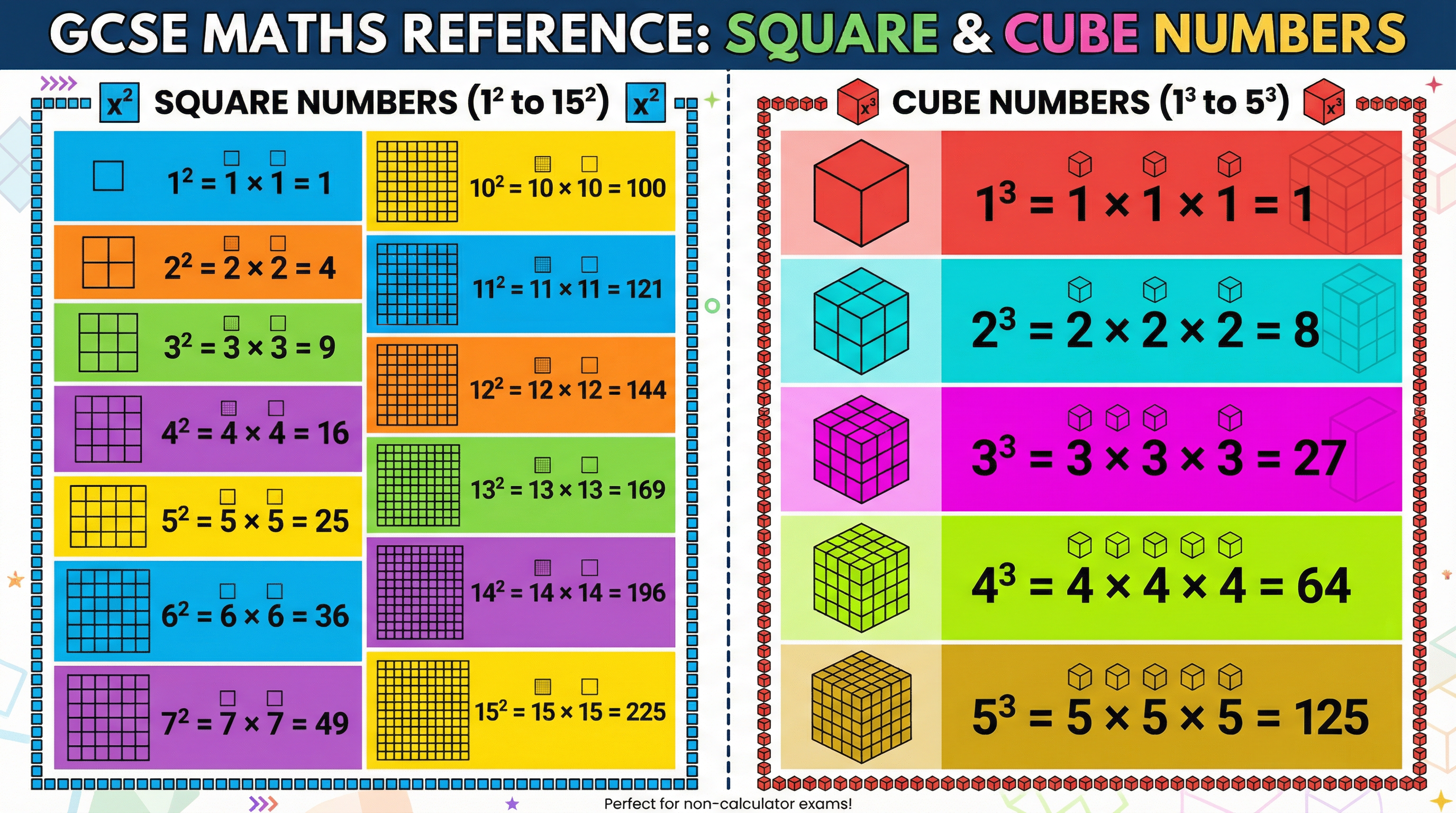
At its core, a power tells you how many times to multiply a number by itself. For example, 5³ (read as '5 cubed' or '5 to the power of 3') means 5 × 5 × 5, which equals 125. The number 5 is the base, and 3 is the index or power. For your exam, you must be able to instantly recall square numbers up to 15² and cube numbers up to 5³. This is not just about saving time; it shows the examiner you have a foundational understanding that allows you to access more complex problems.
Example: A common question might ask you to find the value of √144. A candidate who has memorised their square numbers will instantly know the answer is 12, saving valuable time. A root is the reverse of a power: it asks, "what number, when multiplied by itself a certain number of times, gives this value?" The symbol for a square root is √, and for a cube root, it is ∛.
Concept 2: The Laws of Indices
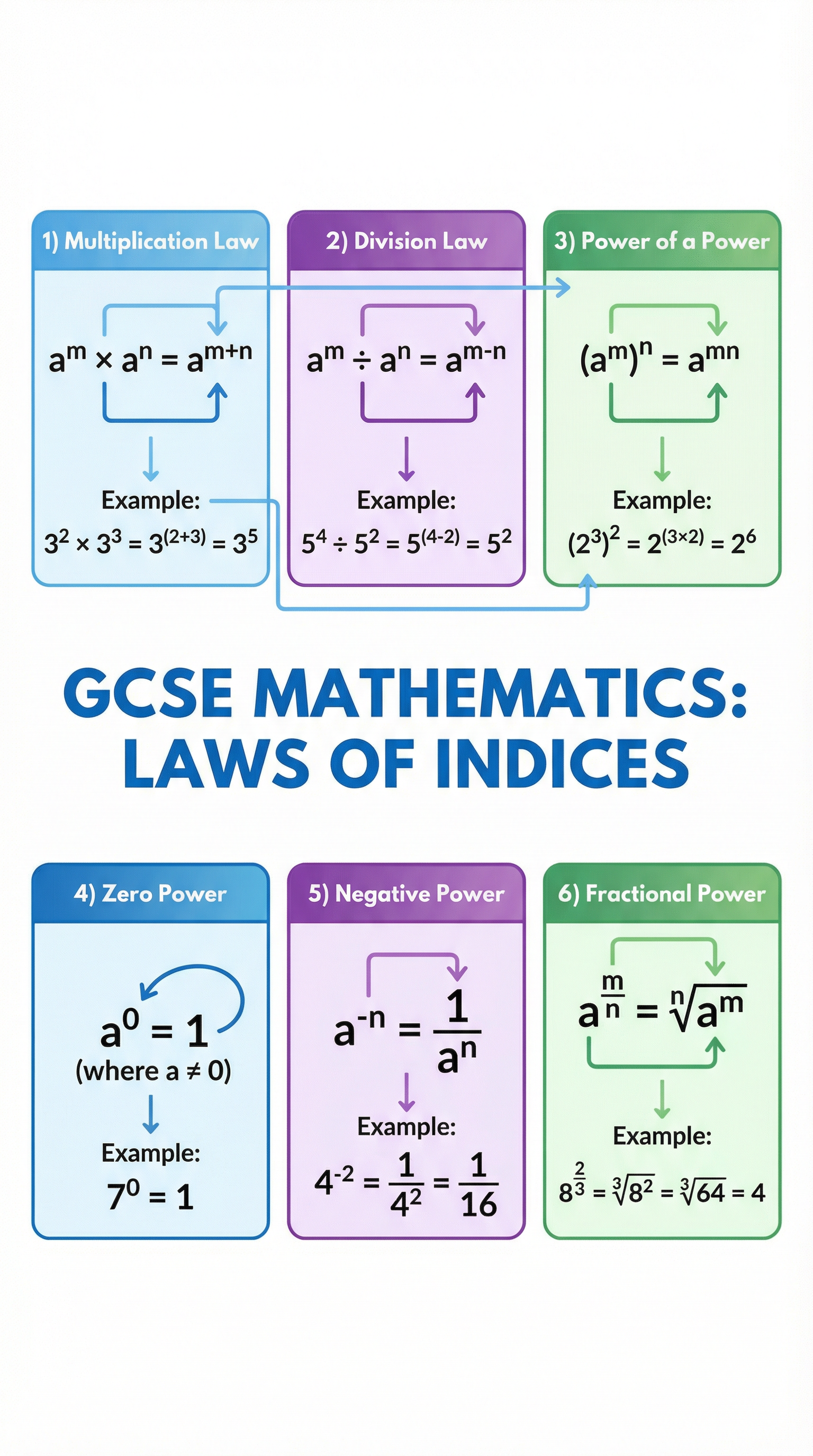
The laws of indices are the rules that govern how we manipulate powers. They are your toolkit for simplifying complex expressions. These laws only apply when the base number is the same.
- Multiplication Law: When multiplying terms with the same base, you add the powers.
- aᵐ × aⁿ = aᵐ⁺ⁿ
- Example: x⁴ × x⁵ = x⁴⁺⁵ = x⁹
- Division Law: When dividing terms with the same base, you subtract the powers.
- aᵐ ÷ aⁿ = aᵐ⁻ⁿ
- Example: y⁷ ÷ y³ = y⁷⁻³ = y⁴
- Power of a Power Law: When raising a power to another power, you multiply the powers.
- (aᵐ)ⁿ = aᵐⁿ
- Example: (p³)⁵ = p³ˣ⁵ = p¹⁵
Concept 3: Zero and Negative Indices
These two rules often cause confusion, but they are straightforward once you grasp the logic.
- The Zero Power Rule: Any number (except 0) raised to the power of zero is 1.
- a⁰ = 1
- Why? Consider x³ ÷ x³. Using the division law, this is x³⁻³ = x⁰. But we also know that any number divided by itself is 1. Therefore, x⁰ must equal 1.
- Example: 54⁰ = 1
- The Negative Power Rule: A negative power indicates a reciprocal. It means '1 over the positive version of the power'. It does not make the number negative.
- a⁻ⁿ = 1/aⁿ
- Example: 4⁻² = 1/4² = 1/16. A common wrong answer here is -8 or -16.
Concept 4: Fractional Indices (Higher Tier)
Fractional indices combine powers and roots. This concept is a gateway to higher-level mathematics and is a favourite of examiners for testing deeper understanding.
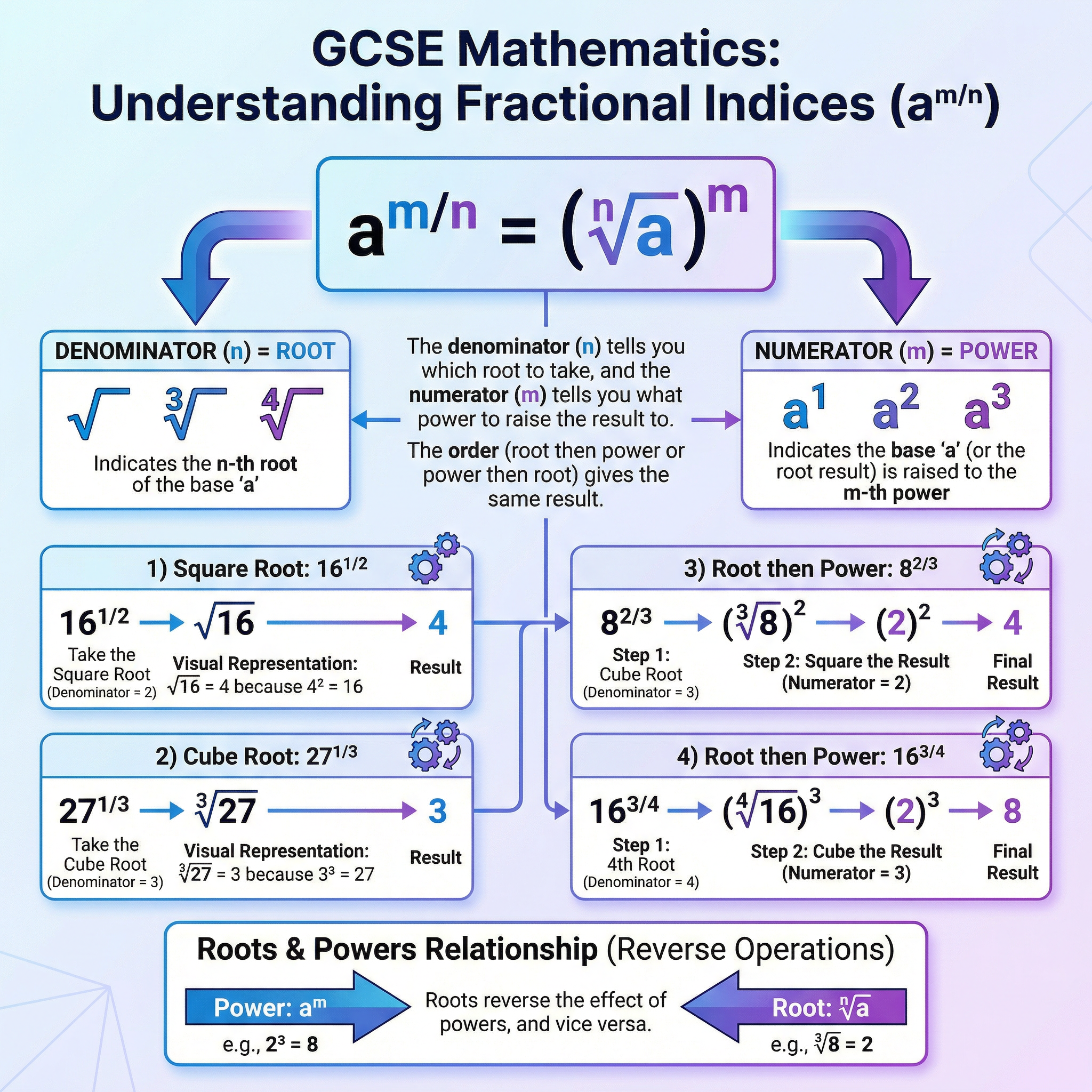
For a fractional index like aᵐ/ⁿ:
- The denominator (n) is the root.
- The numerator (m) is the power.
So, aᵐ/ⁿ = (ⁿ√a)ᵐ. You can apply the power then the root, or the root then the power. It is almost always easier to find the root first, as this makes the number smaller and easier to work with.
Example: Evaluate 27²/³.
- Root first: The denominator is 3, so we find the cube root of 27. ∛27 = 3.
- Then power: The numerator is 2, so we square our result. 3² = 9.
- Therefore, 27²/³ = 9.
Mathematical/Scientific Relationships
The core relationship is that powers and roots are inverse operations.
- If y = xⁿ, then x = ⁿ√y.
Formulas to Know:
| Formula | Description | Status |
|---|---|---|
| aᵐ × aⁿ = aᵐ⁺ⁿ | Multiplication Law of Indices | Must memorise |
| aᵐ ÷ aⁿ = aᵐ⁻ⁿ | Division Law of Indices | Must memorise |
| (aᵐ)ⁿ = aᵐⁿ | Power of a Power Law | Must memorise |
| a⁰ = 1 | Zero Index Law | Must memorise |
| a⁻ⁿ = 1/aⁿ | Negative Index Law | Must memorise |
| a¹/ⁿ = ⁿ√a | Fractional Index Law (Root) | Must memorise |
| aᵐ/ⁿ = (ⁿ√a)ᵐ | Fractional Index Law (Root and Power) | Must memorise |
Practical Applications
While often abstract, powers and roots have many real-world applications that help make them more memorable:
- Science (Standard Form): Powers of 10 are used to write very large or very small numbers, like the distance to the sun (1.5 x 10⁸ km) or the size of a bacterium (1 x 10⁻⁶ m). This is a direct application of index laws.
- Finance (Compound Interest): The formula for compound interest, A = P(1 + r)ⁿ, uses a power (n) to calculate how money grows over time. Each year, you multiply by the interest rate, which is repeated multiplication.
- Computing (Data Storage): Computer memory is measured in bytes, kilobytes (2¹⁰ bytes), megabytes (2²⁰ bytes), and gigabytes (2³⁰ bytes), all based on powers of 2.
- Geometry (Area and Volume): Finding the area of a square (l²) or the volume of a cube (l³) involves powers. Finding the side length from the area (√Area) or volume (∛Volume) requires roots.