AQA · A-Level · Media Studies
Course version: AQA-A-Level-Media-Studies · Version from Mar 2026
Close study products (CSPs)
Master the art of media analysis with this comprehensive guide to Close Study Products (CSPs). Learn how to apply the theoretical framework and five contexts to your set products, moving beyond simple description to secure top marks in your GCSE Media Studies exam.
- 6 min read
- 3 worked examples
- 5 practice questions
- 6 key terms
Study Notes
Overview
Close Study Products (CSPs) are the cornerstone of your GCSE Media Studies qualification. Selected by AQA, these are specific media products—ranging from television programmes and films to magazines, video games, and advertising campaigns—that you must study in depth. However, a common misconception is that the exam tests your memory of these products. It doesn't. The exam tests your ability to use these products as evidence to demonstrate your understanding of the Theoretical Framework and the contexts of media.
Examiners are looking for candidates who can dissect a media product, explain how it has been constructed to create meaning, and evaluate how it reflects the society and industry that produced it. This guide will provide you with the tools to analyse any CSP effectively, ensuring you move away from narrative description and towards high-level, critical analysis.
The Theoretical Framework
 Open full-size image (opens in a new tab)
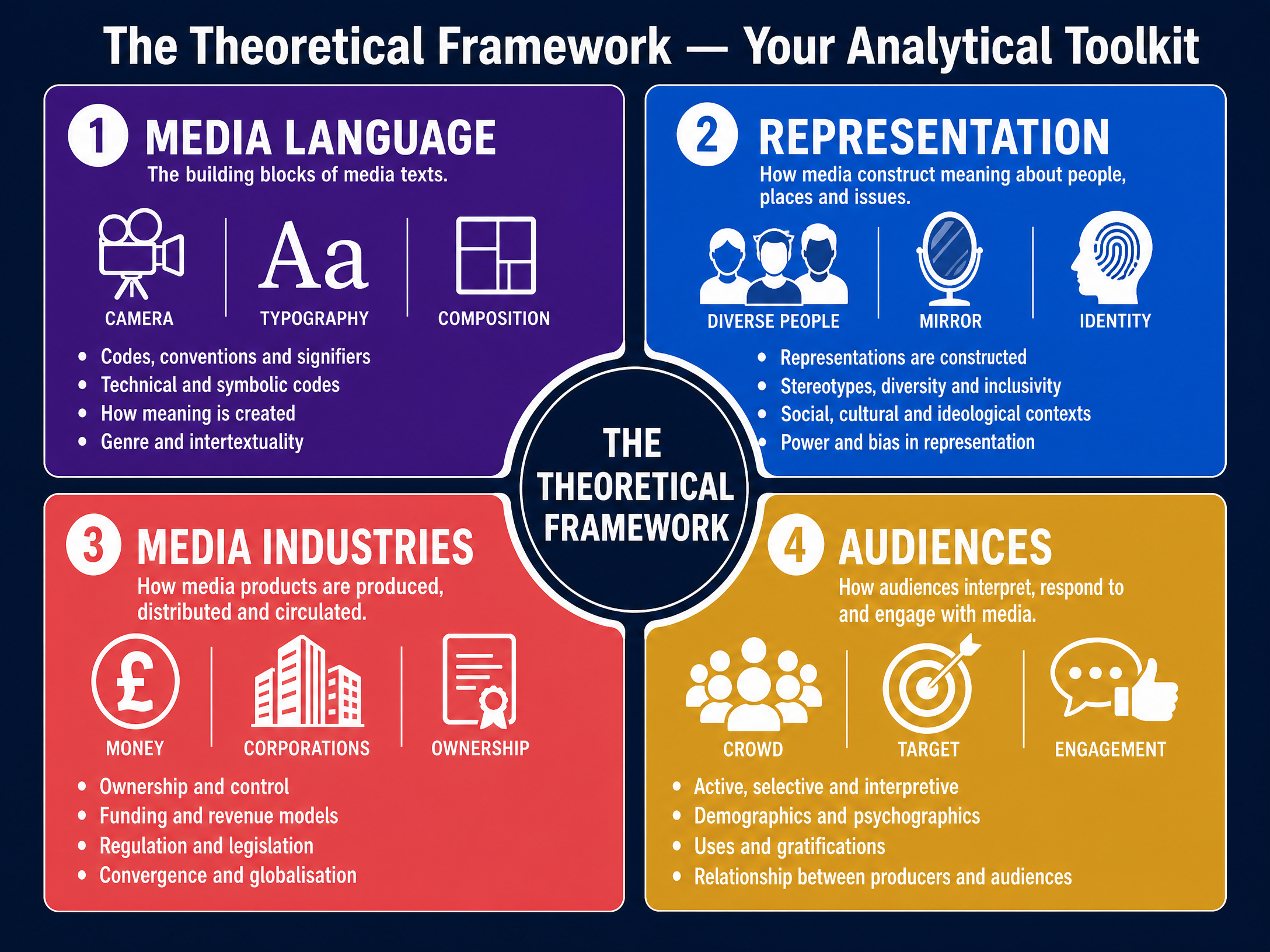
The Theoretical Framework is your analytical toolkit. Every point you make in an exam should connect back to one or more of these four pillars.
1. Media Language
What it is: The building blocks of media texts. How producers use technical, symbolic, and written codes to construct meaning.
Key Concepts:
- Technical Codes: Camera angles (e.g., low angle to show power), lighting (e.g., low-key lighting for tension), editing (e.g., fast-paced cuts for action), and sound (diegetic and non-diegetic).
- Symbolic Codes: Mise-en-scène, costume, props, setting, and colour palettes.
- Written Codes: Typography, headlines, captions, and copy.
- Semiotics: Roland Barthes' theory of signs (denotation and connotation).
Why it matters: Examiners want to see you explain how a specific choice creates a specific meaning for the audience.
2. Representation
What it is: How the media portrays people, places, events, and ideas. Representation is always a construction, not a window on reality.
Key Concepts:
- Stereotypes: Simplified representations that are easily recognised but often reductive.
- Under-representation and Misrepresentation: Who is missing from the media? Who is portrayed negatively?
- Ideology and Power: How representations reflect the beliefs of those who hold power in society.
- Stuart Hall: Theories of representation and the idea that meaning is produced through language and signs.
Why it matters: You must evaluate the impact of these representations. Do they reinforce or challenge societal norms?
3. Media Industries
What it is: The organisations that create, distribute, and regulate media products.
Key Concepts:
- Ownership and Control: Conglomerates vs. independent companies. How does ownership affect the content produced?
- Funding: How is the product paid for? (e.g., BBC licence fee vs. commercial advertising).
- Regulation: Organisations like Ofcom, IPSO, and the BBFC, and the challenges of regulating digital media.
- Curran and Seaton: Theories of power and media industries, suggesting the media is controlled by a small number of companies driven by profit.
Why it matters: Understanding the industry context explains why a product looks the way it does and targets a specific audience.
4. Audiences
What it is: How different groups of people consume, interpret, and respond to media.
Key Concepts:
- Target Audience: Demographics (age, gender, social class) and psychographics (values, attitudes, lifestyles).
- Active vs. Passive Audiences: Do audiences just absorb messages, or do they actively interpret them?
- Uses and Gratifications Theory: Blumler and Katz's idea that audiences use media for Information, Personal Identity, Social Interaction, and Entertainment.
- Stuart Hall's Reception Theory: Preferred, negotiated, and oppositional readings.
Why it matters: You must demonstrate that meaning is not fixed; it changes depending on who is consuming the product.
The Five Contexts
 Open full-size image (opens in a new tab)
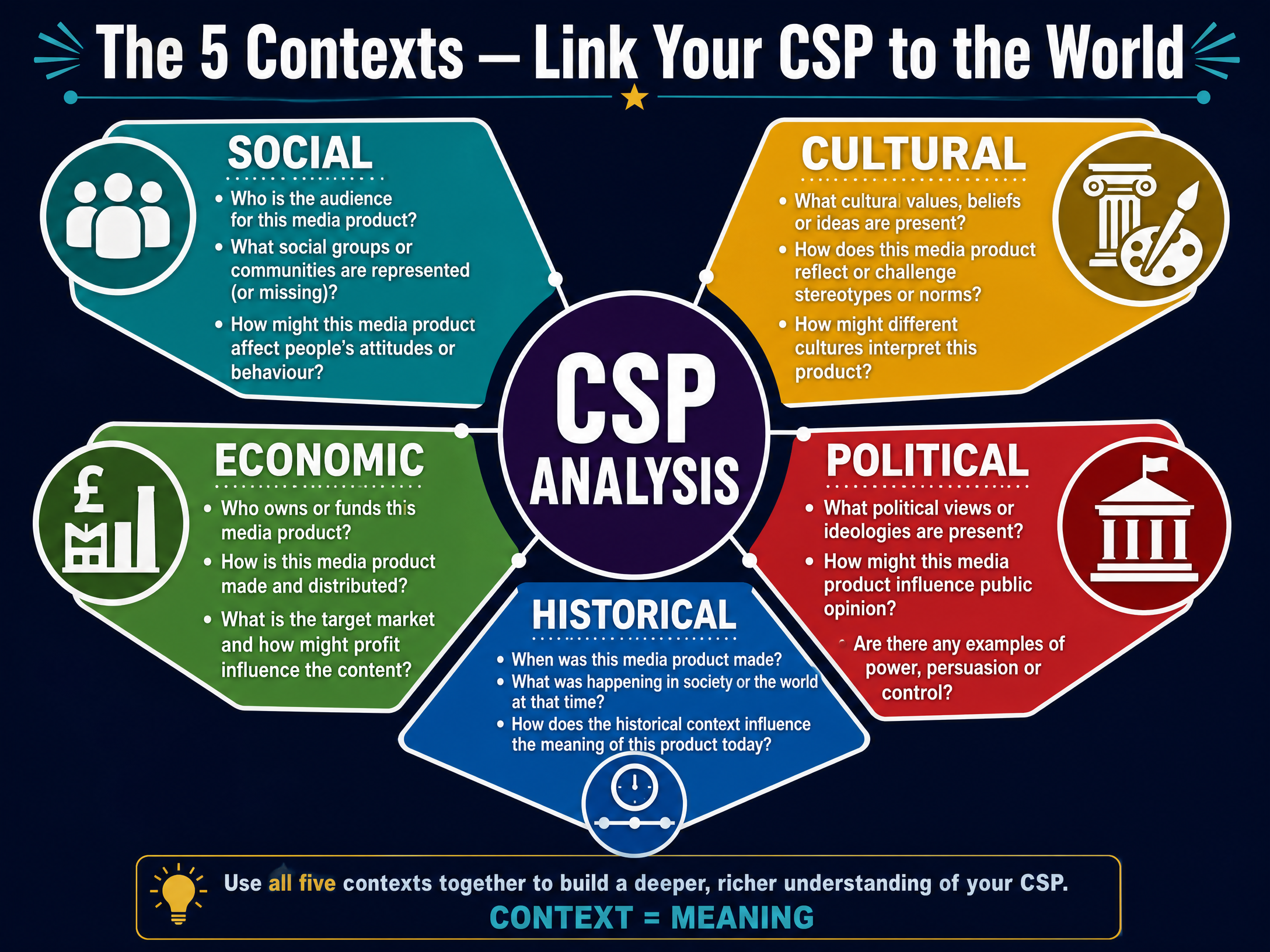
To achieve top marks, your analysis of the theoretical framework must be linked to the contexts in which the CSP was produced and consumed.
Social Context
How does the product reflect the society of its time? Consider issues of class, gender roles, ethnicity, and social mobility. For example, a 1950s advert will reflect very different social expectations of women compared to a modern campaign.
Cultural Context
What cultural values, beliefs, or traditions are evident? How does the product reflect the cultural landscape, including art, music, fashion, and shared national experiences?
Economic Context
How did financial pressures shape the product? Consider the budget, the need to attract advertisers, or the drive for global box office success.
Political Context
Does the product reflect political ideologies, government policies, or power struggles? This is particularly relevant for news media and politically charged dramas.
Historical Context
What was happening in the world when this product was made? Historical events (e.g., the Cold War, the rise of the internet, a global pandemic) deeply influence media production.
CSP Analysis Method
 Open full-size image (opens in a new tab)
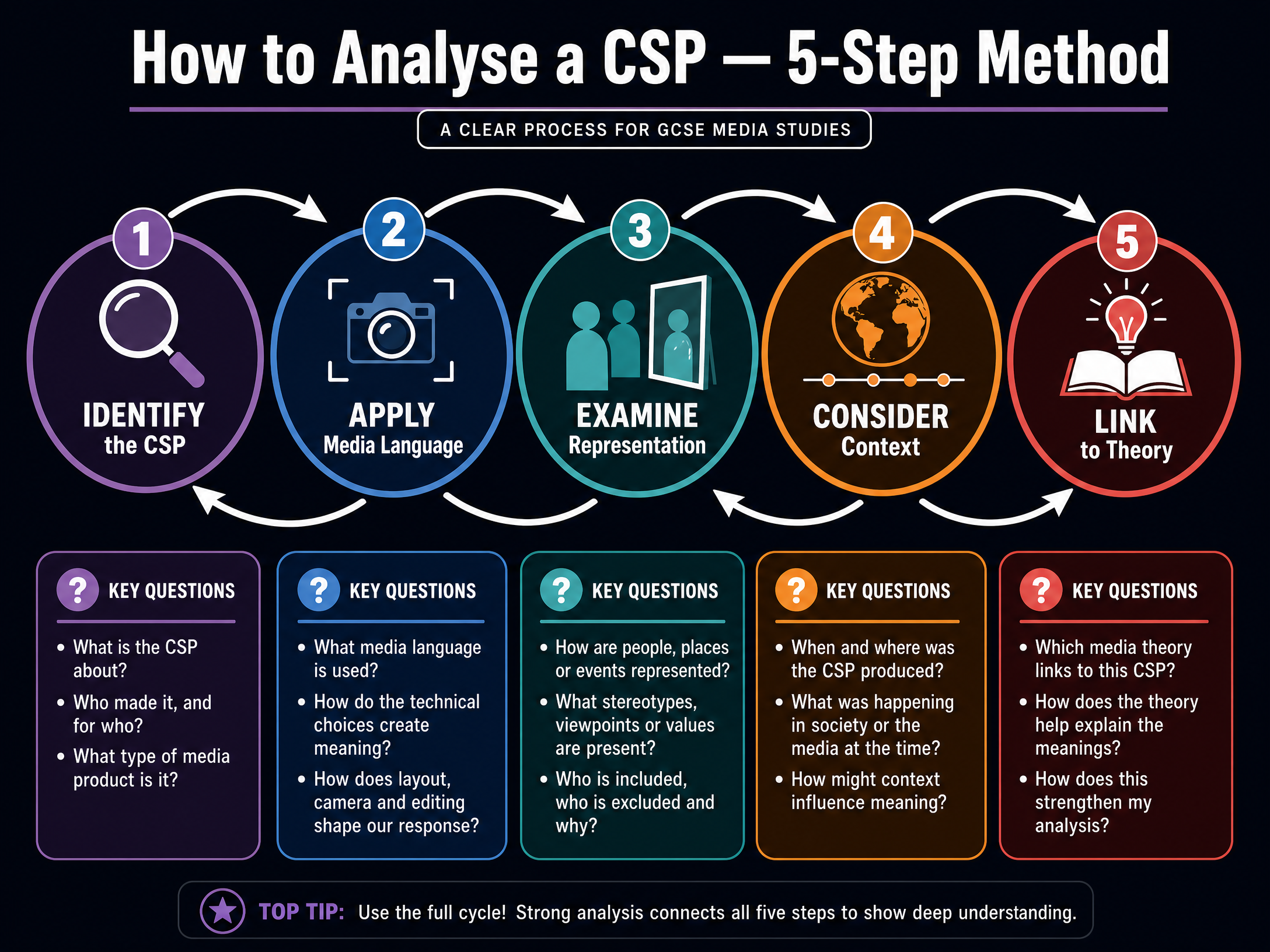
When revising your CSPs, apply this five-step method to ensure comprehensive coverage:
- Identify: What is the product, who made it, and who is it for?
- Apply Media Language: What specific technical/symbolic codes are used?
- Examine Representation: How are groups/ideas portrayed and why?
- Consider Context: How do the 5 contexts influence the meaning?
- Link to Theory: Which academic theories support your analysis?
Check what you remember
Read the wording for your board, then hide it and explain Denotation in your own words. Rough notes are fine. This is a self-check, with no mark or grade.
Reference: AQA
The literal, surface-level meaning of a sign or image (what you actually see).
Worked Examples
3 worked examples — open one to explore the question and available guidance.
Practice Questions
Try the question, then reveal an answer plan or example response
Compare how media language is used to construct representations of gender in two of your studied CSPs. (20 marks)
Hint: Don't just write about CSP 1 and then CSP 2. Use connective phrasing (e.g., 'Similarly', 'In stark contrast') to compare them constantly throughout your answer.
Explain how the political context influences the content of newspapers. Refer to your studied newspaper CSPs. (12 marks)
Hint: Focus on political affiliation, bias, and how the newspaper attempts to influence its readership.
Explore how your chosen video game CSP targets and appeals to its audience. (10 marks)
Hint: Think about Uses and Gratifications theory. Why do people play this specific game?
Explain how regulatory frameworks affect the distribution of film. Refer to your film CSP. (8 marks)
Hint: Focus on the BBFC (British Board of Film Classification) and how age ratings impact marketing and box office success.
Analyse the use of typography and layout in your studied magazine CSP. (10 marks)
Hint: Look at the font styles (serif/sans-serif), the size of the masthead, and how the cover lines are arranged around the main image.
Ready to test yourself interactively?
Active recall beats reading alone. Answer questions on Close study products (CSPs) with instant AI scoring and mark scheme guidance.
A week of Premium from your first lesson · Then the free plan continues · No card, no charge
Exam technique
How to turn what you know into marks
How to approach the question
Always identify the command word (e.g., Explain, Analyse, Evaluate), the focus of the theoretical framework required, and the specific CSP you must refer to.
How to structure your answer
- Essay questions
- Introduction stating your stance → 3-4 PEEL paragraphs exploring different angles (including a counter-argument if asked 'how far') → Strong concluding judgement.
- Analyse questions
- Focus heavily on Media Language. Identify the technique (denotation), explain the meaning (connotation), and link to representation or audience effect.
- Explain questions
- Use PEEL: Point, Evidence (specific detail from the CSP), Explanation (how it creates meaning), Link to context/theory.
Timing
Approximately 1 minute per mark, plus 5 minutes of planning time for 20-mark essay questions.
Common pitfalls
- Writing a narrative summary of the plot instead of analysing how the text is constructed.
- Listing camera angles or editing techniques without explaining *why* they were used or what meaning they create.
- Forgetting to link the analysis of the CSP back to the broader social, historical, or industry contexts.
What the command words want
- Analyse
- Separate information into components and identify their characteristics. (Deconstruct the media language).
- Explain
- Set out purposes or reasons / make the relationships between things evident. (Focus on 'how' and 'why').
- Describe
- Provide a detailed account of the features of a media product (requires specific knowledge of the CSP).
- Evaluate / How far do you agree
- Judge or calculate the quality, importance, amount, or value of something. Requires a balanced argument and a clear conclusion.
Watch or listen (optional)
Test your understanding of Close study products (CSPs)
Active recall beats re-reading. Take an instant quiz now to test what you’ve learned and lock it into long-term memory.
A week of Premium from your first lesson · Then the free plan continues · No card, no charge