AQA · A-Level · Media Studies
Media language
Narratology is the study of how stories are structured and told in media texts. Understanding theories like Todorov's narrative stages and Barthes' narrative codes gives you the analytical tools to explain how meaning is constructed and how audiences are positioned.
- 4 min read
- 3 worked examples
- 5 practice questions
- 6 key terms
Study Notes
Overview
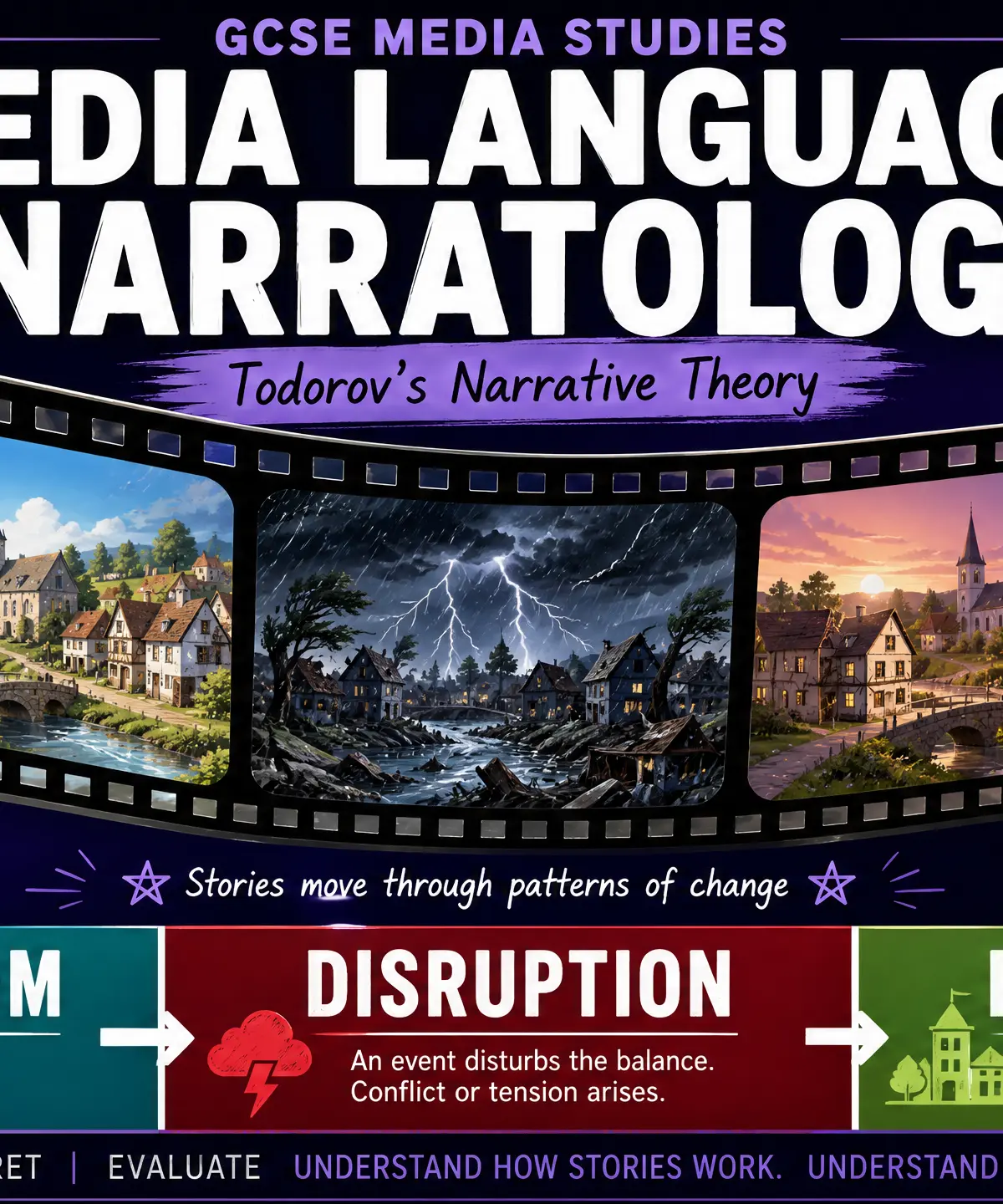
Narratology is a fundamental aspect of Media Language in GCSE Media Studies. It moves beyond simply describing what happens in a text (the plot) to analysing how the story is told (the narrative). Examiners expect candidates to use specific terminology and theoretical frameworks to explain how narrative choices construct meaning and position the audience. This guide covers key concepts including diegesis, causality, and character types, alongside essential theories from Tzvetan Todorov, Roland Barthes, and Vladimir Propp.
Listen to the revision podcast here:

Key Theories & Concepts
Todorov's Narrative Theory
The Concept: Tzvetan Todorov proposed that most narratives follow a linear three-stage structure.
The Stages:
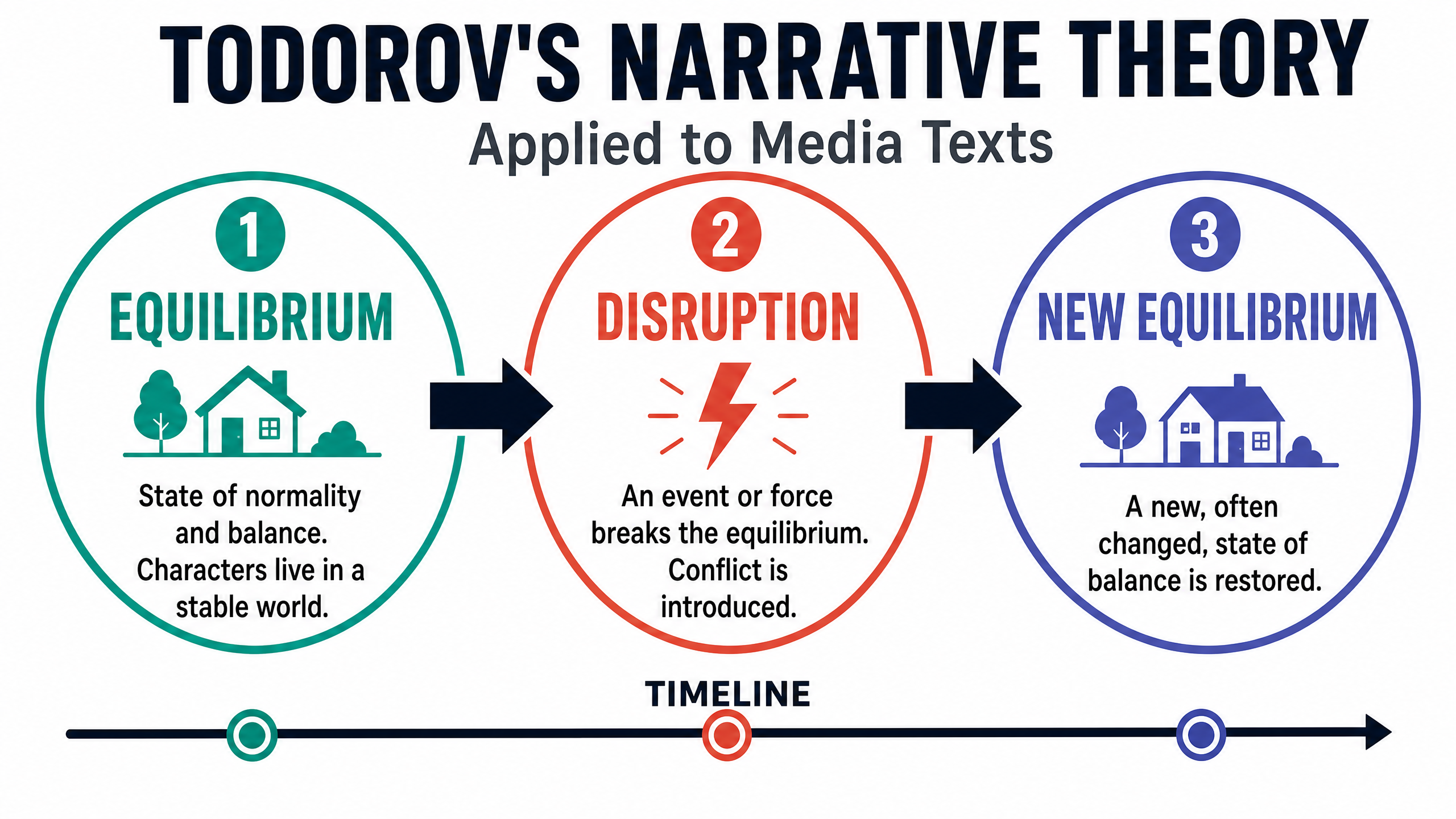
- Equilibrium: The opening state of normality where characters live in a stable world.
- Disruption: An event or force that breaks the equilibrium, introducing conflict and driving the narrative forward.
- New Equilibrium: A restored state of balance at the end of the narrative, often changed from the original state due to the events of the disruption.
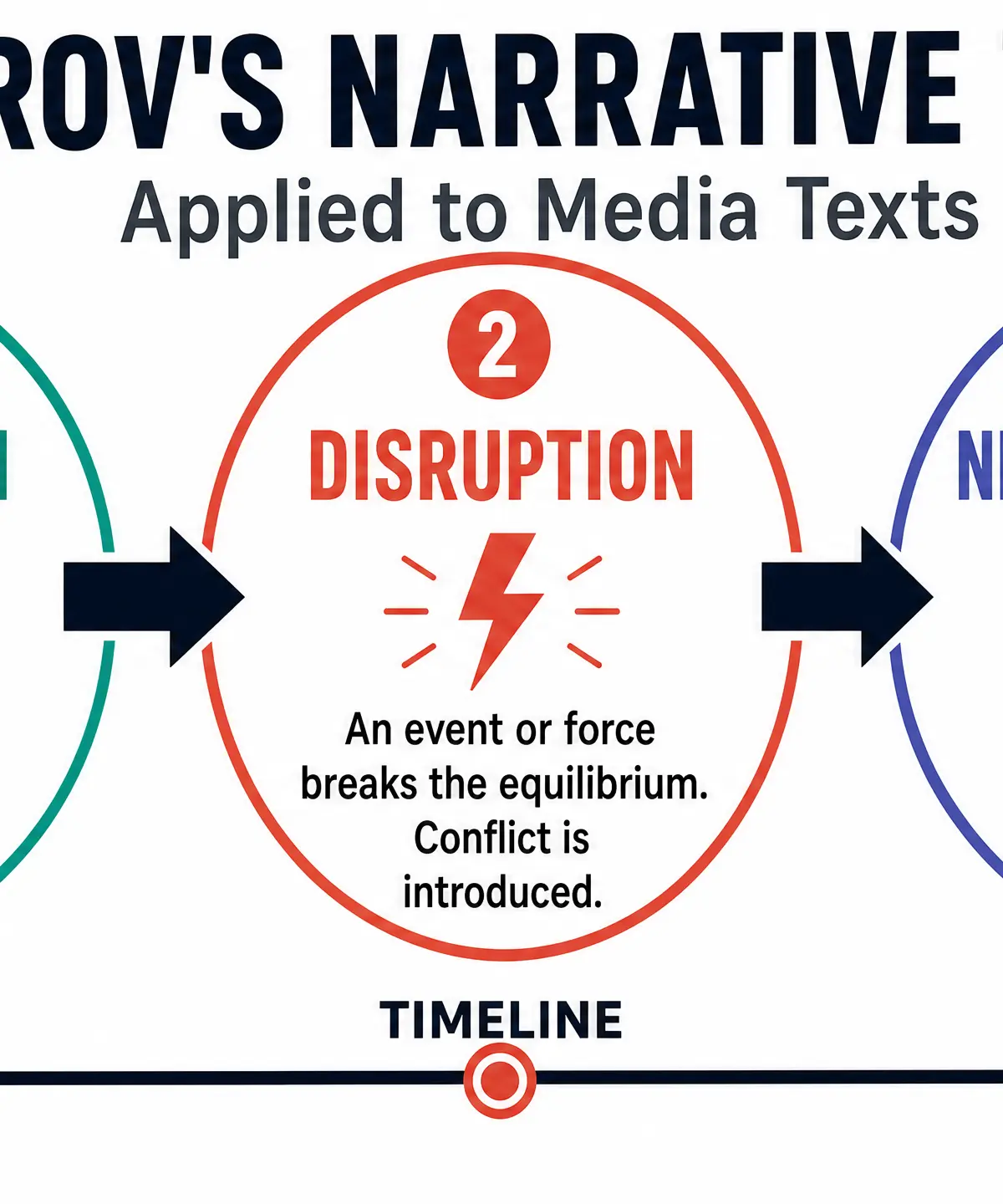
Exam Application: Don't just identify the stages. Explain how the equilibrium is established through media language (e.g., calm lighting, slow editing) and why the disruption engages the audience (e.g., creating tension or suspense).
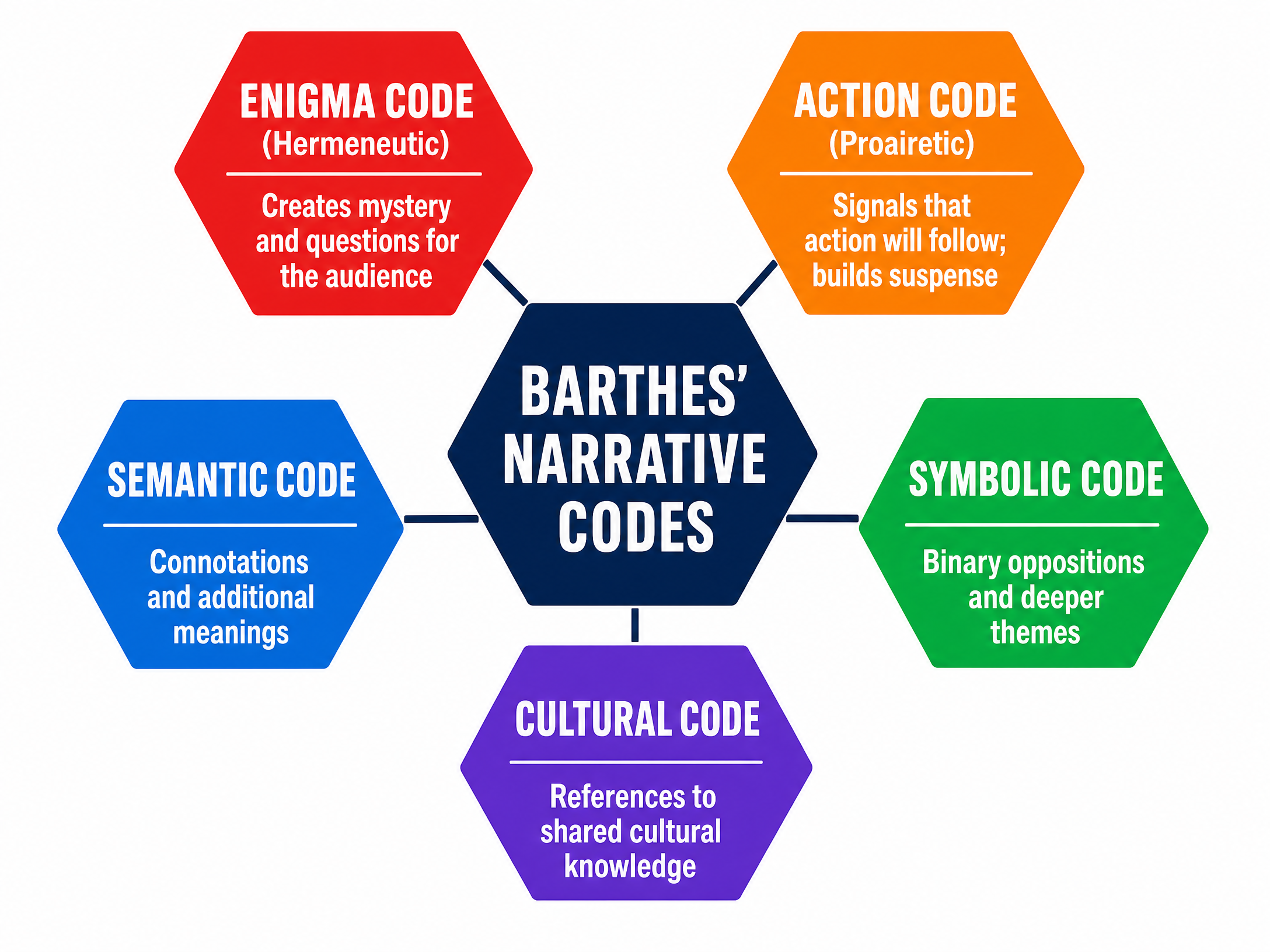
Barthes' Narrative Codes
The Concept: Roland Barthes identified five codes that operate within texts to create meaning.
The Codes:
- Enigma Code (Hermeneutic): Withholding information to create mystery and audience questions.
- Action Code (Proairetic): Actions that signal something is going to happen, building suspense.
- Semantic Code: Elements with connotations or additional meanings.
- Symbolic Code: Deeper meanings often based on binary oppositions (e.g., good vs. evil).
- Cultural Code: References to shared knowledge outside the text.
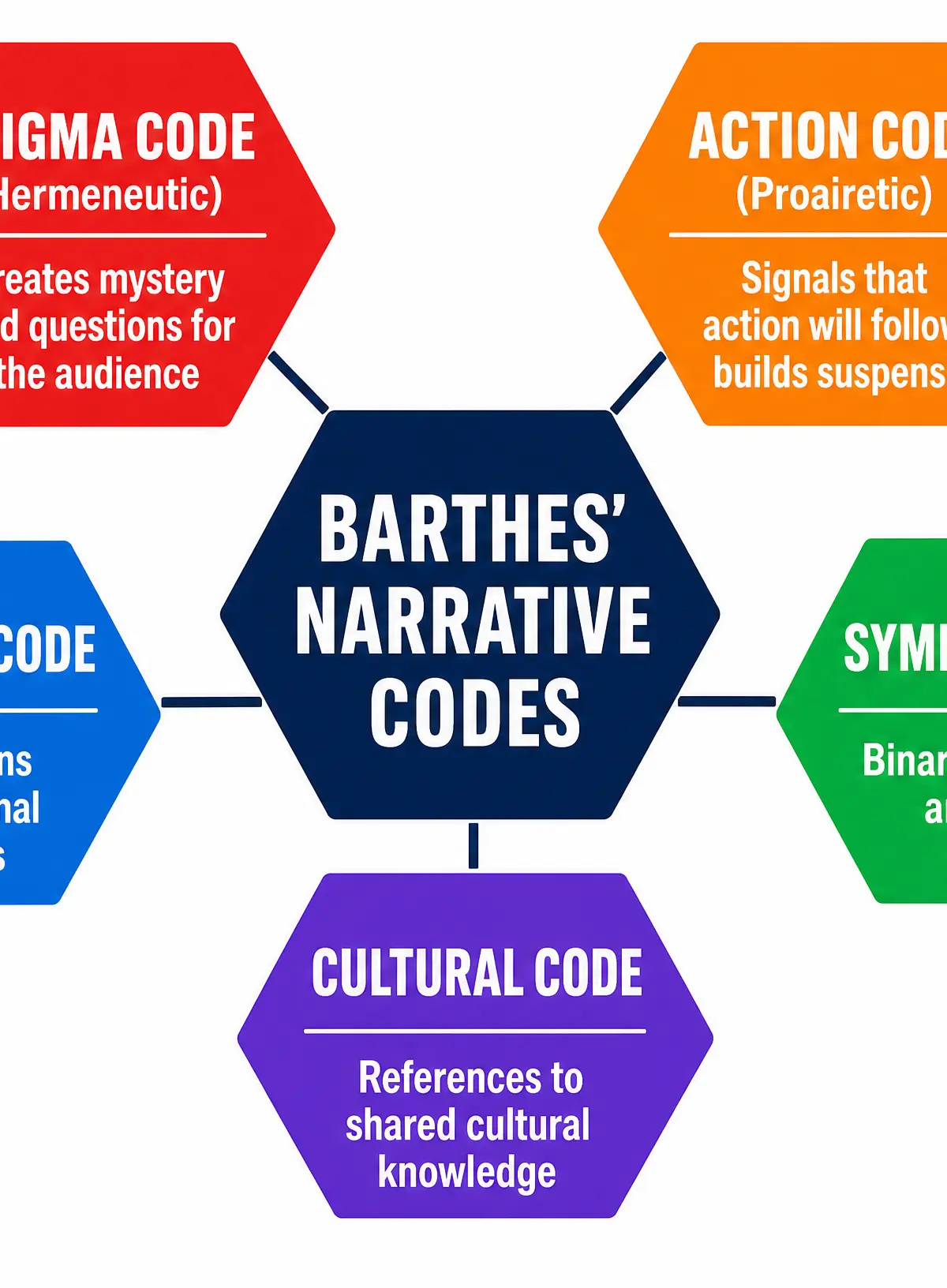
Exam Application: Identify specific codes in a text and explain how they construct meaning or position the audience. For example, 'The enigma code is used in the opening shot to position the audience to feel curious and keep watching.'
Propp's Character Theory
The Concept: Vladimir Propp identified recurring character roles (spheres of action) in narratives.
Key Roles:
- Hero: Drives the narrative forward.
- Villain: Opposes the hero and creates the disruption.
- Princess: The goal or reward.
- Donor: Provides the hero with something useful.
- Helper: Assists the hero.
- Dispatcher: Sends the hero on their quest.
- False Hero: Appears heroic but is deceptive.
Exam Application: In contemporary media, these roles are often subverted (e.g., a female protagonist acting as the hero rather than the princess). Discussing subversion shows higher-level analytical thinking.
Key Narrative Concepts
Diegesis and Narration
- Diegesis: The world of the narrative. Everything that exists within the story world.
- Diegetic Sound: Sound that characters in the story can hear (e.g., dialogue, footsteps).
- Non-Diegetic Sound: Sound added for the audience that characters cannot hear (e.g., a musical score, voiceover).
- Narration: How the story is told to the audience (e.g., first-person, third-person omniscient).
Causality
The chain of cause and effect that links events in a narrative. Events are not random; they follow a logical sequence that drives the plot from disruption to resolution.
Interactive Diagrams
1 interactive diagram to visualise key concepts
Conceptual Flow Outline
Todorov's Narrative Structure
Worked Examples
3 worked examples — open one to explore the question and available guidance.
Practice Questions
Test your understanding — click to reveal model answers
Analyse how the narrative of a media product you have studied positions the audience. (15 marks)
Hint: Choose a text with a clear narrative structure. Apply Todorov or Barthes and explicitly link their theories to how the audience is made to feel or react.
Explain the difference between diegetic and non-diegetic sound, using examples from a media text. (4 marks)
Hint: Define both terms clearly and give one specific example for each from a text you know.
How far do you agree that contemporary media texts no longer use traditional narrative structures? (20 marks)
Hint: This requires a balanced argument. Discuss texts that subvert tradition (e.g., non-linear narratives, anti-heroes) but also acknowledge that underlying structures (like Todorov's equilibrium/disruption) are often still present.
Describe two of Barthes' narrative codes and explain how they might be used in a film trailer. (8 marks)
Hint: Pick two distinct codes (e.g., Enigma and Action). Define them and explain their specific purpose in the context of marketing a film.
Analyse how Propp's character theory can be applied to a video game you have studied. (10 marks)
Hint: Identify the player character as the hero, and map out other NPCs (Non-Playable Characters) to roles like Villain, Donor, or Helper.