AQA · A-Level · Media Studies
Non-exam assessment
Mastering the rules around unassessed participants in your GCSE Media Studies NEA is crucial for protecting your marks. This guide breaks down exactly how to use the Candidate Record Form (CRF) to prove your creative direction and secure top-level marks.
- 4 min read
- 3 worked examples
- 5 practice questions
- 6 key terms
Study Notes
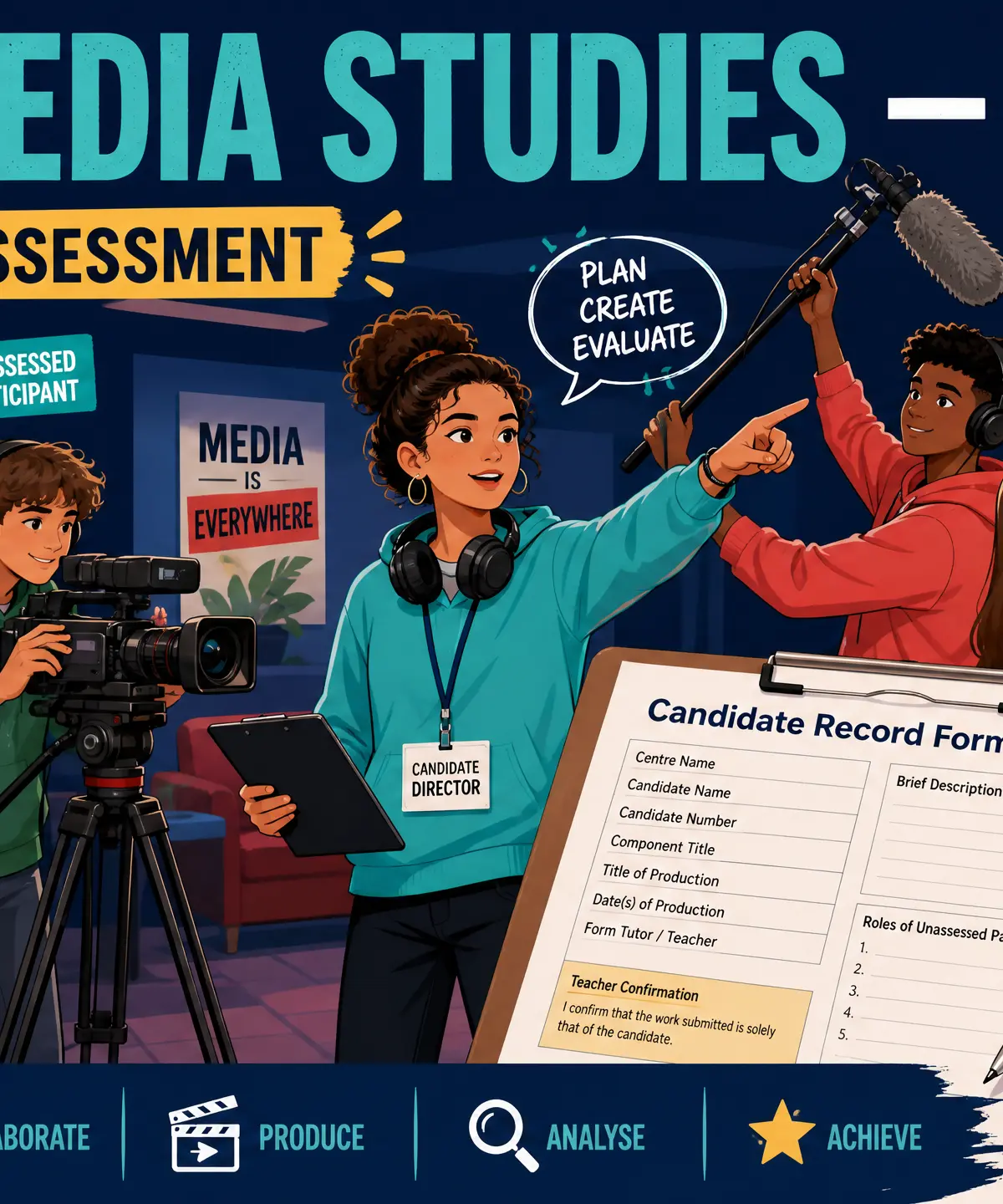
Overview
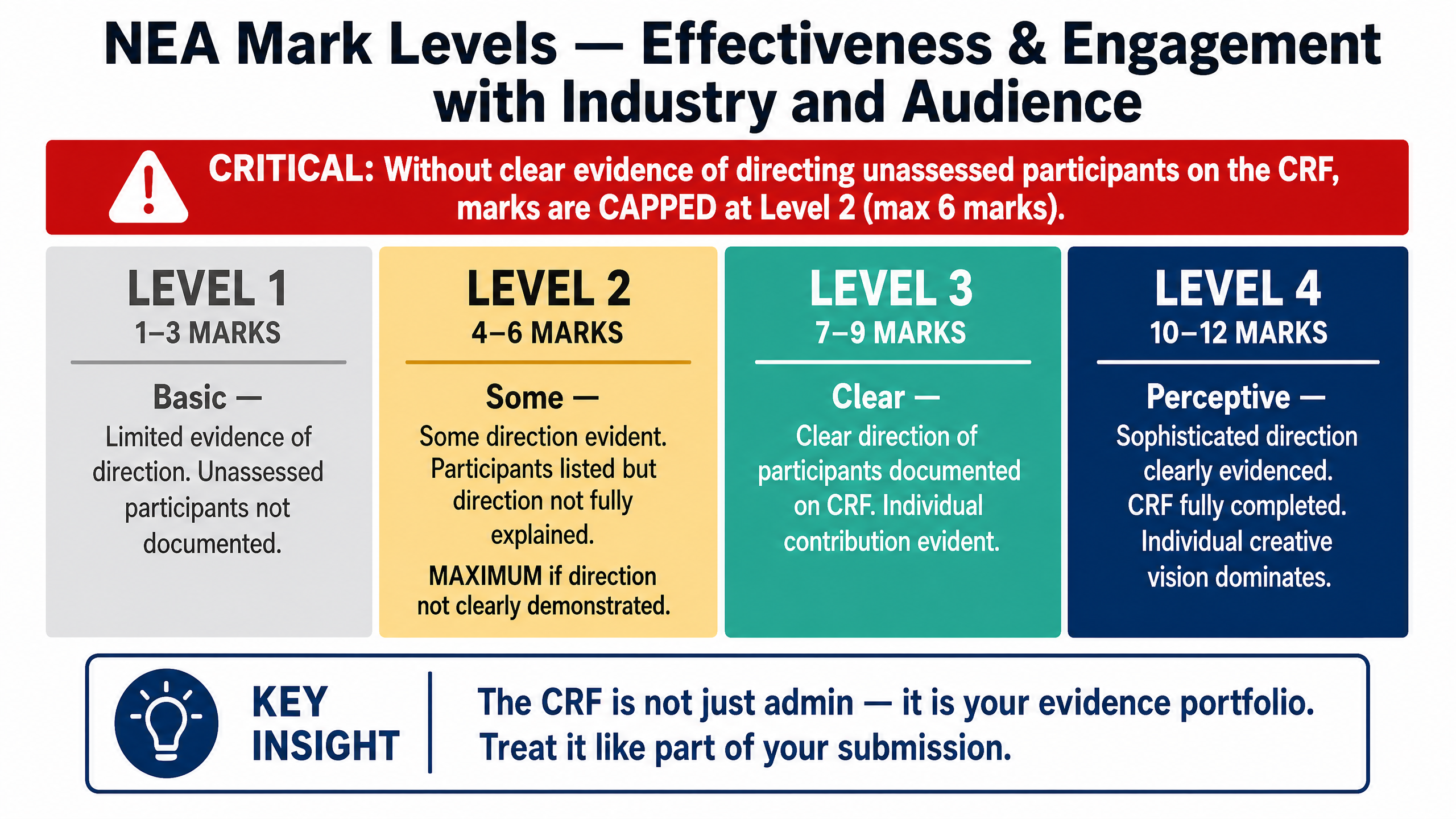
The Non-Exam Assessment (NEA) in GCSE Media Studies is your opportunity to showcase your creative skills through an individual cross-media production. However, a common area where candidates lose marks is the mismanagement of 'unassessed participants'. The fundamental rule is that the NEA is an individual task. While you are permitted to have others assist you, they must operate strictly under your direction. Examiners use the Candidate Record Form (CRF) to verify your creative control. Failing to document this direction clearly will result in your marks for 'Effectiveness and engagement with industry and audience' being severely capped.

Understanding Unassessed Participants
Who are they?
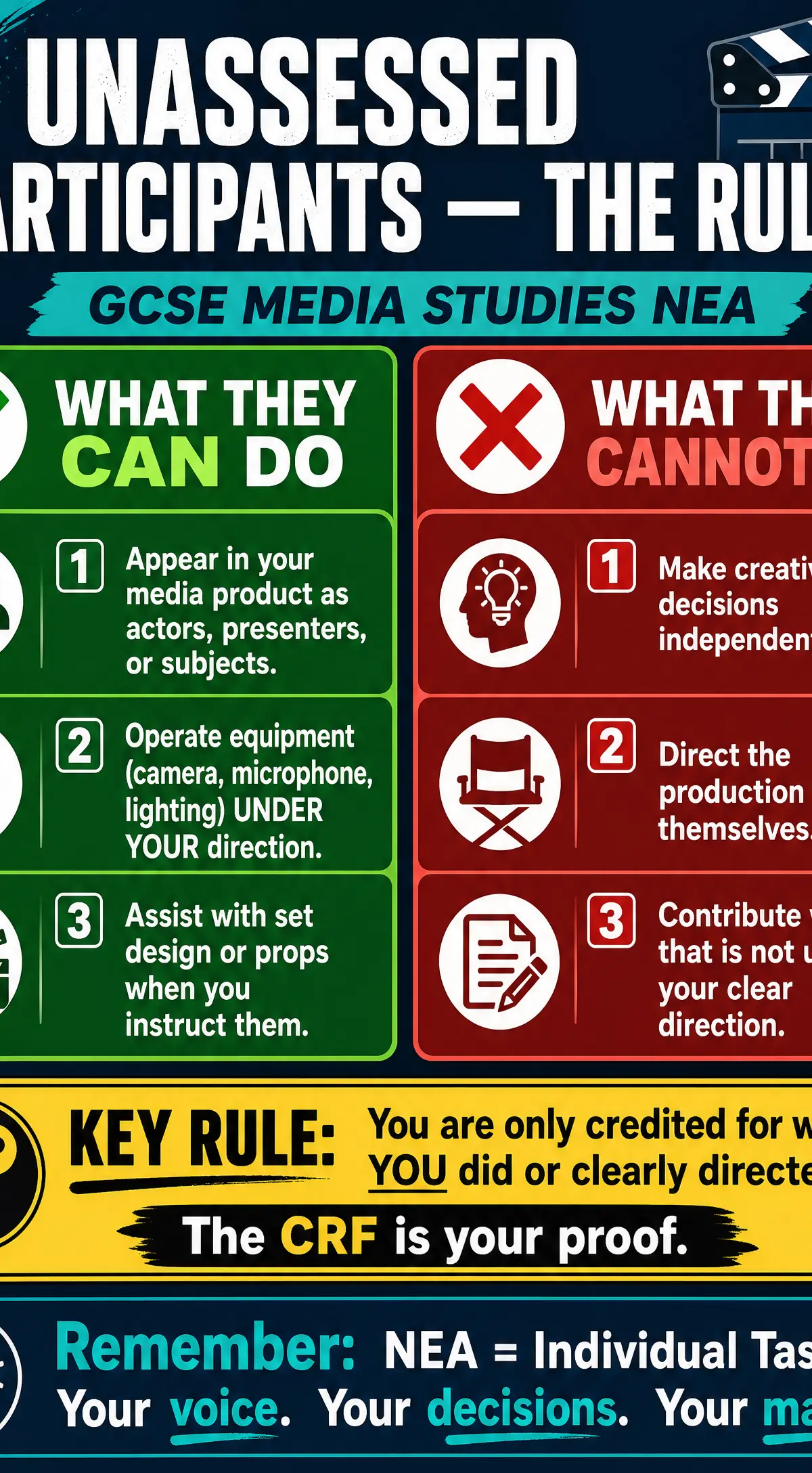
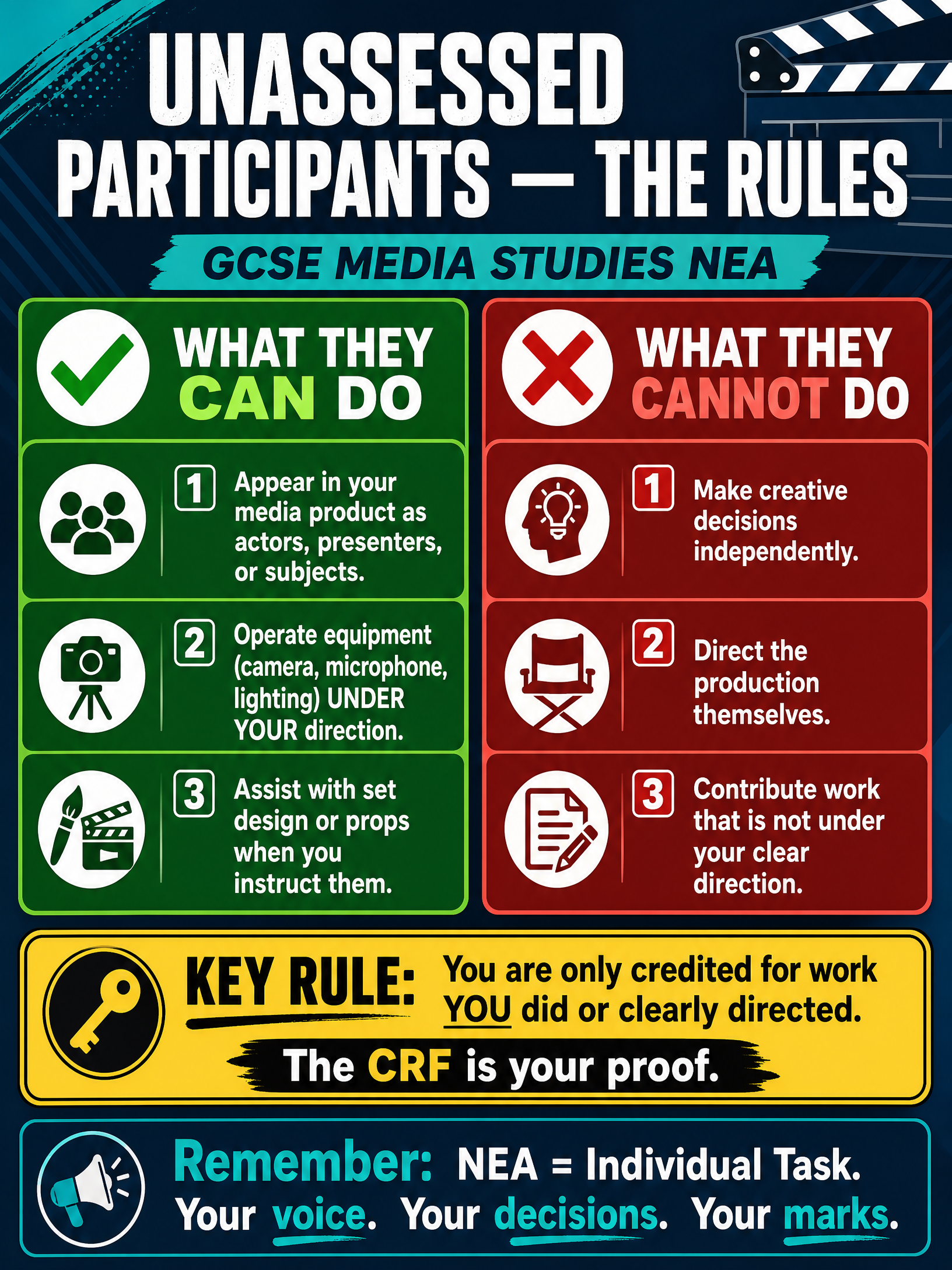
An unassessed participant is anyone who contributes to your production but is not being assessed for that specific work. This could be friends acting in your video, family members holding lighting equipment, or classmates assisting with props.
What they CAN do
- Appear in the product: They can act, present, or be the subject of your media product.
- Operate equipment: They can hold a camera, operate a boom mic, or manage lighting rigs.
- Assist with logistics: They can help set up props or manage the location.
What they CANNOT do
- Make creative decisions: They cannot decide on camera angles, lighting setups, or acting styles independently.
- Direct the production: They cannot take over the role of the director.
- Edit the product: Post-production editing must be entirely your own work.
The Candidate Record Form (CRF)
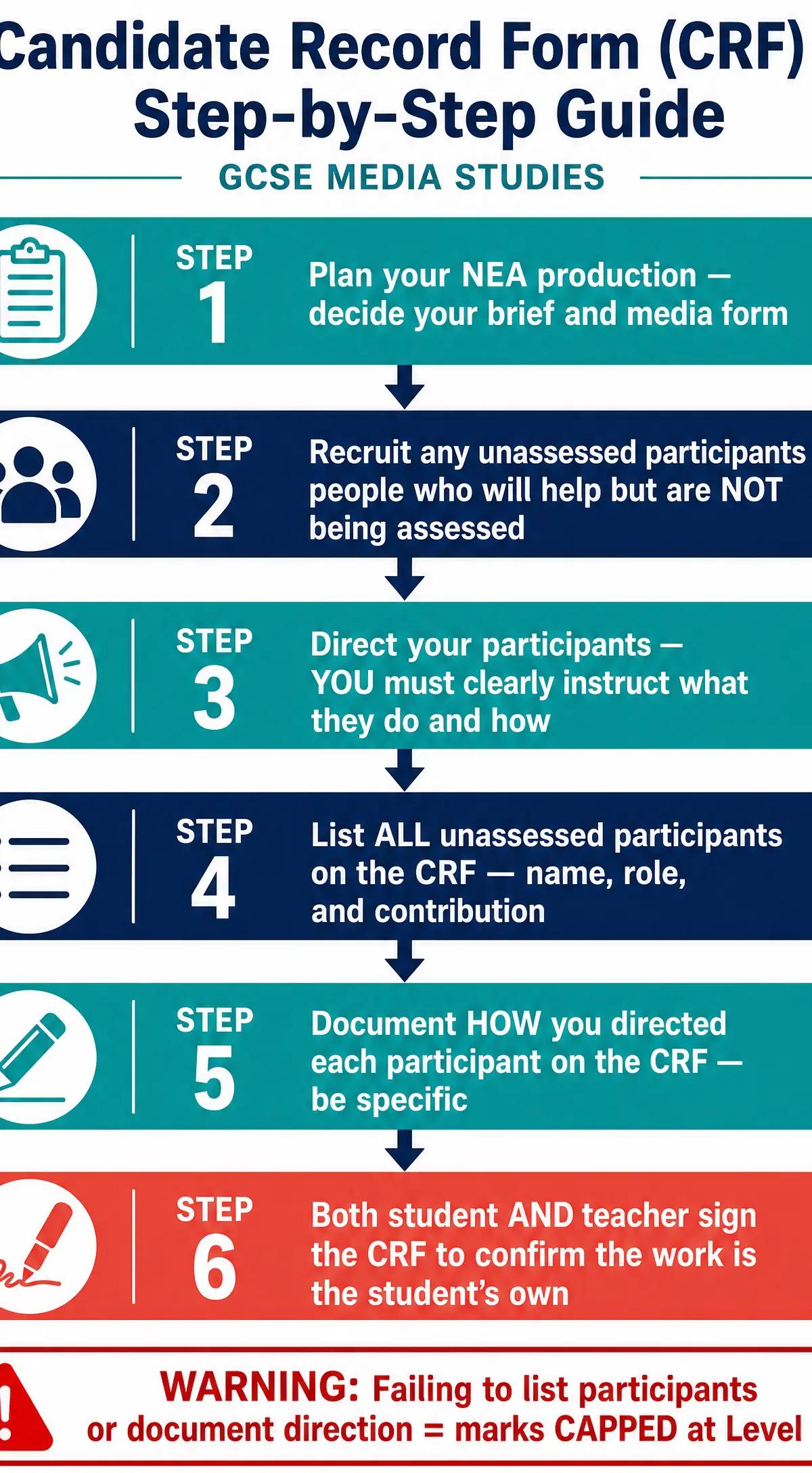
The CRF is your evidence portfolio. It is the official document where you declare that the work is your own, and where you must detail the involvement of any unassessed participants.
Mandatory Requirements
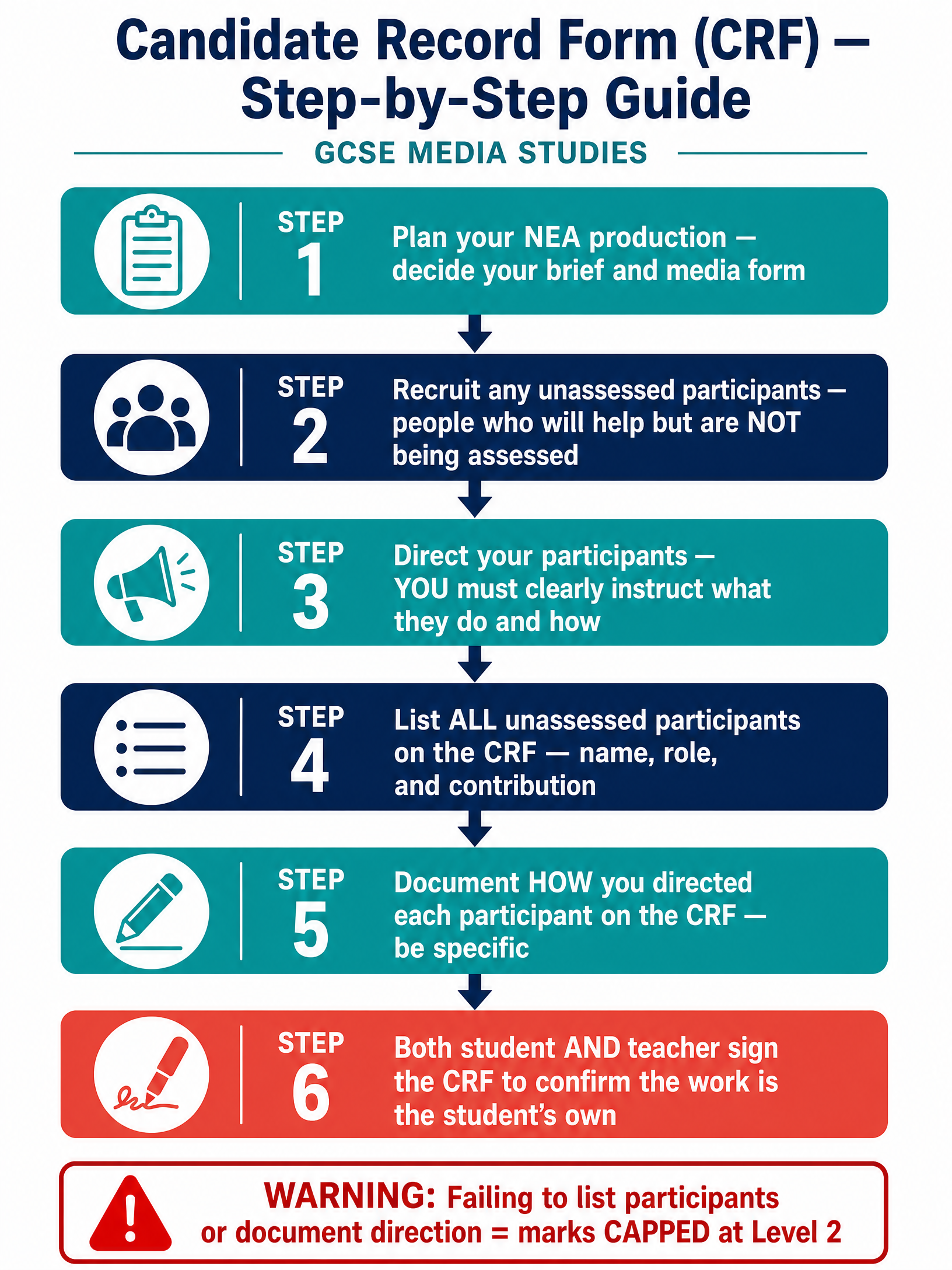
- List Everyone: Every single unassessed participant must be named on the CRF.
- Detail Contributions: You must specify exactly what role they played (e.g., 'Camera Operator', 'Actor').
- Demonstrate Direction: This is the most critical step. You must explicitly describe how you directed them. What instructions did you give? How did you communicate your creative vision?
Signatures
Both you (the candidate) and your teacher must sign the CRF. This signature confirms that the work submitted is solely yours and that any assistance was strictly under your direction.
The Penalty for Poor Documentation
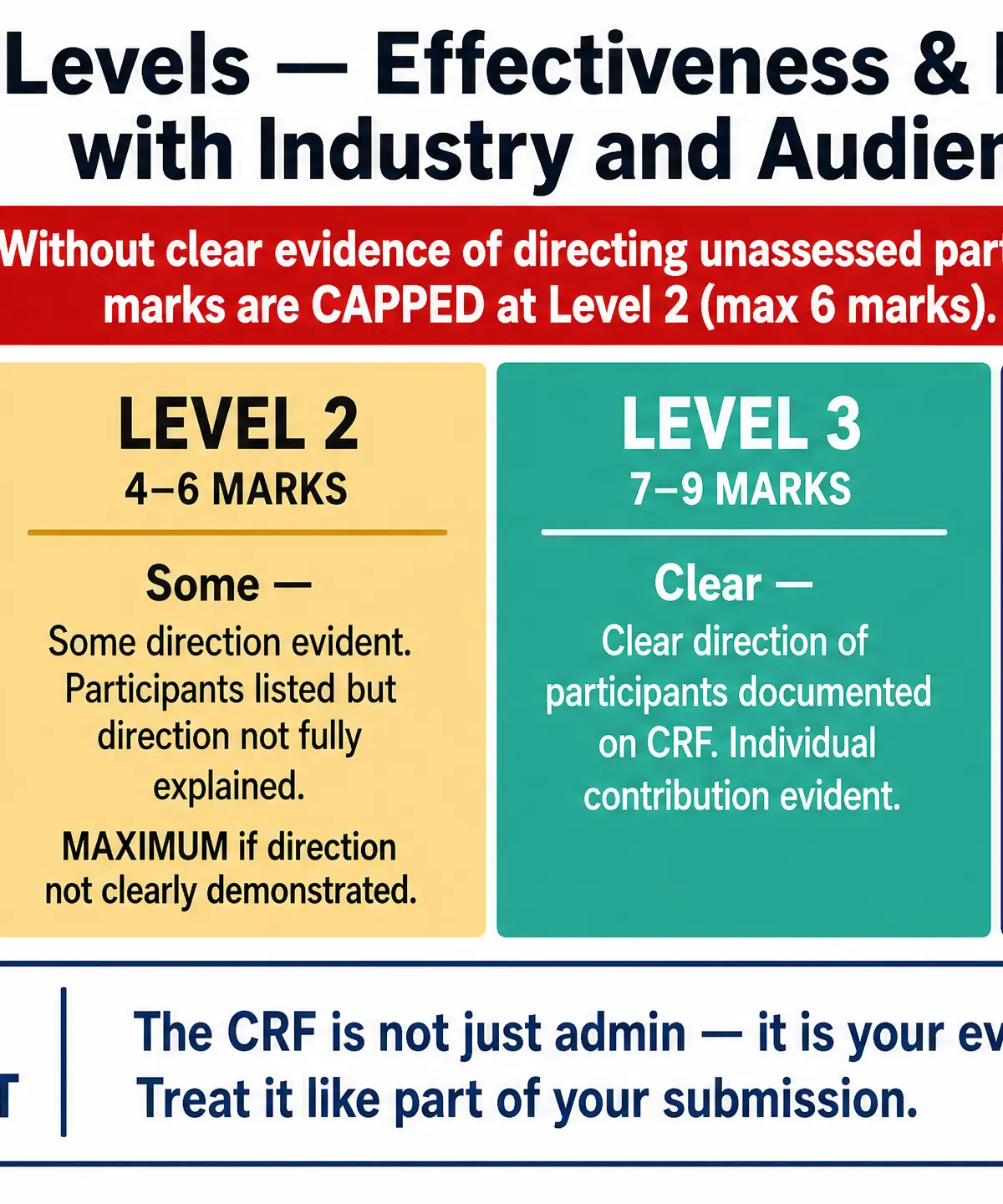
Examiners are strict on this rule. If you fail to clearly demonstrate how you directed the activity of unassessed participants on the CRF, your marks in the 'Effectiveness and engagement with industry and audience' section will be capped at Level 2 (maximum 6 marks out of 12). This cap applies regardless of how brilliant the final product is.
Visual Resources
3 diagrams and illustrations
Interactive Diagrams
1 interactive diagram to visualise key concepts
Conceptual Flow Outline
The NEA Production and CRF Workflow
Worked Examples
3 worked examples — open one to explore the question and available guidance.
Practice Questions
Test your understanding — click to reveal model answers
Read the following extract from a student's CRF: 'John was the actor in my film. He came up with the idea to wear a trench coat to look more mysterious, which I agreed was a good idea.' Explain why this entry is problematic for the candidate's marks. (4 marks)
Hint: Consider who is making the creative decisions in this scenario.
List three pieces of information that MUST be included on the Candidate Record Form regarding unassessed participants. (3 marks)
Hint: Think about identity, role, and evidence of control.
A student decides to edit their film with a friend who is 'really good at Premiere Pro'. The friend operates the editing software while the student tells them where to cut. Is this permitted? Explain your answer. (4 marks)
Hint: Think carefully about the difference between production (filming) and post-production (editing).
What is the maximum number of marks a candidate can achieve in the 'Effectiveness and engagement' section if they fail to document their direction of unassessed participants? (1 mark)
Hint: It's a specific number tied to a specific level.
Write an ideal CRF entry for a student who used their sister to operate a boom microphone during a dialogue scene. (4 marks)
Hint: Include name, role, and specific directional instructions.