Pearson Edexcel · GCSE · Music
Course version: 1MU0 · Version from Sept 2016
Musical vocabulary - Dynamics and performance matters: Each sound combines…
Full specification wording
Appendix 3: Musical vocabulary - Dynamics and performance matters: Each sound combines a fundamental and a series of much less clearly heard higher pitches called harmonics. With stringed instruments these can be sounded by lightly touching a string at particular points (rather than by normal ‘stopping’)
Every musical sound is a blend: a fundamental, the pitch we name, plus a ladder of fainter higher pitches called harmonics that colour the tone.
- Point 10 of 25
- 3 key terms
Study notes
From the teaching notes for this specification point.
The idea
Every musical sound is a blend: a fundamental, the pitch we name, plus a ladder of fainter higher pitches called harmonics that colour the tone. On a stringed instrument you normally shorten the string by pressing it against the fingerboard, which is called stopping, and that changes the fundamental. Harmonics work differently: the player lightly touches the string at a particular point, such as halfway along, without pressing it down, and the string vibrates in a pattern that makes a higher harmonic ring out clearly. The touch point decides which harmonic sounds. So the key contrast is light touch versus normal stopping, and the result is a pure, bell-like note rather than the usual stopped pitch.
What earns the marks
- A sound consists of a fundamental pitch plus a series of fainter higher pitches called harmonics.
- Harmonics are much less clearly heard than the fundamental in an ordinary note.
- On stringed instruments harmonics are produced by lightly touching a string at particular points.
- The touch point determines which higher harmonic is heard, giving a clear, pure tone.
Common mistakes and how to put them right
Thinking harmonics are separate instruments or extra notes added by the player.
Put it right by explaining they are higher pitches already present within a single sound.
Confusing harmonics with normal stopping.
Put it right by stressing that stopping presses the string down while harmonics use a light touch at a particular point.
Assuming the fundamental is the quietest part of the sound.
Put it right by noting the fundamental is the main heard pitch and harmonics are much fainter.
Exam tips
- Read the question for the words 'lightly touching' and link them straight to harmonics rather than stopping.
- If a distractor mentions pressing the string to the fingerboard, recognise that as stopping, not harmonics.
- Remember the fundamental is the named pitch and harmonics are the fainter higher pitches above it.
Try the lesson
The start of the Appendix 3: Musical vocabulary - Dynamics and performance matters: Each sound combines a fundamental and a series of much less clearly heard higher pitches called harmonics. With stringed instruments these can be sounded by lightly touching a string at particular points (rather than by normal ‘stopping’) lesson, made from teaching notes for this specification point.
Have a go first
Which term is used specifically for higher-pitched components whose frequencies are whole-number multiples of the fundamental frequency of a note?
Listen
Every musical sound is a blend: a fundamental, the pitch we name, plus a ladder of fainter higher pitches called harmonics that colour the tone. On a stringed instrument you normally shorten the string by pressing it against the fingerboard, which is called stopping, and that changes the fundamental. Harmonics work differently: the player lightly touches the string at a particular point, such as halfway along, without pressing it down, and the string vibrates in a pattern that makes a higher harmonic ring out clearly. The touch point decides which harmonic sounds. So the key contrast is light touch versus normal stopping, and the result is a pure, bell-like note rather than the usual stopped pitch. A strong answer earns marks for these points. A sound consists of a fundamental pitch plus a series of fainter higher pitches called harmonics. Harmonics are much less clearly heard than the fundamental in an ordinary note. On stringed instruments harmonics are produced by lightly touching a string at particular points. The touch point determines which higher harmonic is heard, giving a clear, pure tone. A common slip: Thinking harmonics are separate instruments or extra notes added by the player. Instead, explaining they are higher pitches already present within a single sound. Exam tip: Read the question for the words 'lightly touching' and link them straight to harmonics rather than stopping.
See it

Key words
Say what each word means before you turn the card.
Fundamental and harmonics
Try answering aloud or in your head before turning the card.
String technique: light touch versus stopping
Try answering aloud or in your head before turning the card.
Pure bell-like harmonic tone
Try answering aloud or in your head before turning the card.
See every definition
- Fundamental and harmonics
- Each sound combines a fundamental and a series of much less clearly heard higher pitches called harmonics.
- String technique: light touch versus stopping
- Harmonics can be sounded by lightly touching a string at particular points rather than by normal stopping.
- Pure bell-like harmonic tone
- The touch point determines which higher harmonic is heard, giving a clear, pure tone.
Label the diagram
Some boxes have lost their names. Pick the right name for each number.
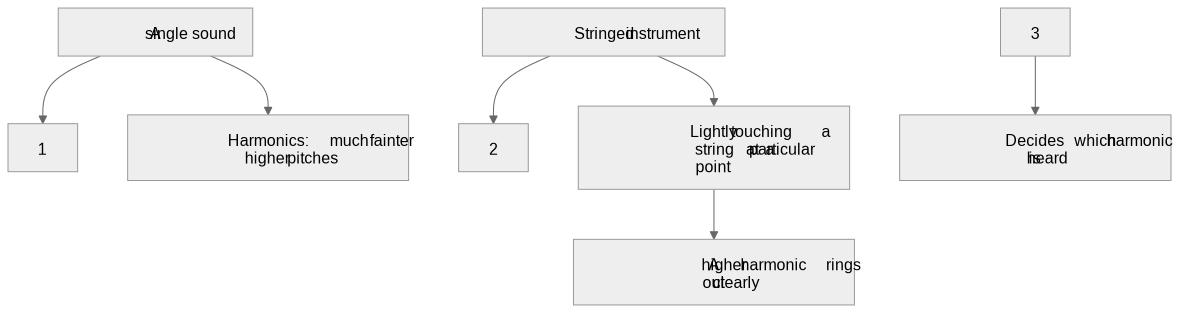
1Box 1
2Box 2
3Box 3
There is more to this lesson
The full lesson goes on to check your understanding and help you earn the marks. Create a free account to carry on, with your progress saved.
A week of Premium from your first lesson · Then the free plan continues · No card, no charge
Test your understanding of Appendix 3: Musical vocabulary - Dynamics and performance matters: Each sound combines a fundamental and a series of much less clearly heard higher pitches called harmonics. With stringed instruments these can be sounded by lightly touching a string at particular points (rather than by normal ‘stopping’)
Active recall beats re-reading. Take an instant quiz now to test what you’ve learned and lock it into long-term memory.
A week of Premium from your first lesson · Then the free plan continues · No card, no charge