Pearson Edexcel · GCSE · Music
Course version: 1MU0 · Version from Sept 2016
Musical vocabulary - Organisation of pitch: A flourish for brass…
Full specification wording
Appendix 3: Musical vocabulary - Organisation of pitch: A flourish for brass instruments (frequently with percussion) for ceremonial or celebratory effect, or simply any short passage for brass in an orchestral work
A fanfare is a flourish written for brass instruments, often reinforced by percussion, used to create a ceremonial or celebratory effect.
- Point 11 of 27
- 2 key terms
Study notes
From the teaching notes for this specification point.
The idea
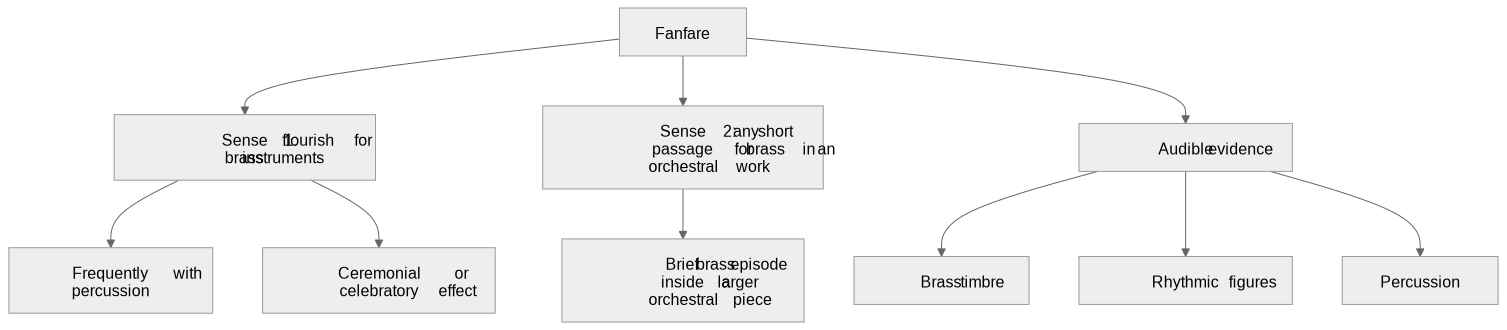
A fanfare is a flourish written for brass instruments, often reinforced by percussion, used to create a ceremonial or celebratory effect. The same word also covers any short passage for brass within an orchestral work, even where no ceremony is implied. To recognise one, listen for bright, brilliant brass timbres, often trumpets and horns, playing rhythmic, triadic figures at a confident dynamic; percussion such as timpani or side drum may add weight and pulse. The texture is usually homophonic and the mood is bold and public. In a listening question, decide which definition fits: a standalone ceremonial flourish, or a brief brass episode inside a larger orchestral piece. Link your identification to audible evidence such as instrumentation, rhythm and dynamics rather than guessing from the title alone.
What earns the marks
- Identifies a fanfare as a flourish for brass instruments, frequently with percussion.
- Recognises the ceremonial or celebratory effect as a defining purpose.
- Accepts the second sense: any short passage for brass in an orchestral work.
- Supports the choice with audible evidence such as brass timbre, rhythmic figures or percussion.
- Distinguishes a fanfare from a general orchestral tutti or a purely string passage.
Common mistakes and how to put them right
Assuming a fanfare must always include percussion.
Put it right: Percussion is frequent but not essential, and the core is the brass flourish.
Thinking a fanfare can only be a standalone ceremonial piece.
Put it right: The term also covers a short brass passage inside an orchestral work.
Confusing a fanfare with any loud passage.
Put it right: The defining feature is brass writing for ceremonial or celebratory effect, not volume alone.
Exam tips
- Read the whole option before choosing; check both the brass instrumentation and the ceremonial or orchestral context.
- Anchor your answer to what you actually hear: name the brass instruments and any percussion you can identify.
- If two options seem plausible, eliminate the one that describes strings, woodwind or a full tutti rather than a brass flourish.
Try the lesson
The start of the Appendix 3: Musical vocabulary - Organisation of pitch: A flourish for brass instruments (frequently with percussion) for ceremonial or celebratory effect, or simply any short passage for brass in an orchestral work lesson, made from teaching notes for this specification point.
Have a go first
A short passage for brass with percussion, played to mark a ceremonial occasion, is best described as which of the following?
Listen
A fanfare is a flourish written for brass instruments, often reinforced by percussion, used to create a ceremonial or celebratory effect. The same word also covers any short passage for brass within an orchestral work, even where no ceremony is implied. To recognise one, listen for bright, brilliant brass timbres, often trumpets and horns, playing rhythmic, triadic figures at a confident dynamic; percussion such as timpani or side drum may add weight and pulse. The texture is usually homophonic and the mood is bold and public. In a listening question, decide which definition fits: a standalone ceremonial flourish, or a brief brass episode inside a larger orchestral piece. Link your identification to audible evidence such as instrumentation, rhythm and dynamics rather than guessing from the title alone. A strong answer earns marks for these points. Identifies a fanfare as a flourish for brass instruments, frequently with percussion. Recognises the ceremonial or celebratory effect as a defining purpose. Accepts the second sense: any short passage for brass in an orchestral work. Supports the choice with audible evidence such as brass timbre, rhythmic figures or percussion. A common slip: Assuming a fanfare must always include percussion. Instead, percussion is frequent but not essential, and the core is the brass flourish. Exam tip: Read the whole option before choosing; check both the brass instrumentation and the ceremonial or orchestral context.
See it
Key words
Say what each word means before you turn the card.
Ceremonial and celebratory effect
Try answering aloud or in your head before turning the card.
Short brass passage in orchestral works
Try answering aloud or in your head before turning the card.
See every definition
- Ceremonial and celebratory effect
- The defining purpose of a flourish for brass instruments, frequently with percussion.
- Short brass passage in orchestral works
- The second sense of the term, covering any short passage for brass inside an orchestral work.
Label the diagram
Some boxes have lost their names. Pick the right name for each number.
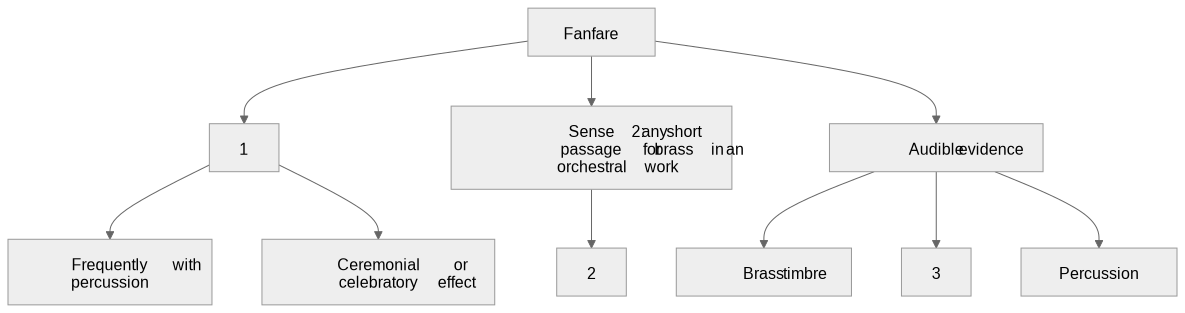
1Box 1
2Box 2
3Box 3
There is more to this lesson
The full lesson goes on to check your understanding and help you earn the marks. Create a free account to carry on, with your progress saved.
A week of Premium from your first lesson · Then the free plan continues · No card, no charge
Test your understanding of Appendix 3: Musical vocabulary - Organisation of pitch: A flourish for brass instruments (frequently with percussion) for ceremonial or celebratory effect, or simply any short passage for brass in an orchestral work
Active recall beats re-reading. Take an instant quiz now to test what you’ve learned and lock it into long-term memory.
A week of Premium from your first lesson · Then the free plan continues · No card, no charge