Pearson Edexcel · GCSE · Music
Course version: 1MU0 · Version from Sept 2016
Musical vocabulary - Organisation of pitch: A note (usually in the bass,…
Full specification wording
Appendix 3: Musical vocabulary - Organisation of pitch: A note (usually in the bass, and generally either the tonic or dominant of the key) which is sustained or repeated while chords change, often resulting in dissonance
A pedal (pedal point) is a single note held or reiterated while the harmony above it moves.
- Point 21 of 27
- 4 key terms
Study notes
From the teaching notes for this specification point.
The idea
A pedal (pedal point) is a single note held or reiterated while the harmony above it moves. It usually sits in the bass, and is generally the tonic or dominant of the key, so it anchors the ear to the home key even as chords change. Because the changing chords bring notes that clash with the fixed note, dissonance often results; the pedal then resolves when the harmony settles onto a chord that agrees with it. To identify one by ear, listen for a low note that stays constant while the chords above shift, then name it as tonic or dominant and describe the clash and its resolution.
What earns the marks
- Identifies a pedal as a note sustained or repeated while the chords above it change.
- Recognises that the pedal is usually in the bass.
- States that the pedal is generally the tonic or dominant of the key.
- Explains that the fixed note against changing chords often produces dissonance.
- Distinguishes a pedal from a moving bass line or from an ostinato pattern of changing notes.
Common mistakes and how to put them right
Confusing a pedal with any repeated bass rhythm.
Put it right: A pedal is a single sustained or repeated pitch, not a rhythmic figure moving between pitches.
Assuming a pedal must always be the tonic.
Put it right: It is generally the tonic or dominant, so the dominant is equally valid.
Claiming a pedal always sounds consonant.
Put it right: Dissonance often arises while chords change, resolving when harmony agrees with the pedal.
Exam tips
- When answering, name the pitch role (tonic or dominant) as well as calling it a pedal.
- Describe the dissonance and its resolution rather than only labelling the device.
- Check the bass line specifically, since the pedal is usually the lowest sounding note.
Try the lesson
The start of the Appendix 3: Musical vocabulary - Organisation of pitch: A note (usually in the bass, and generally either the tonic or dominant of the key) which is sustained or repeated while chords change, often resulting in dissonance lesson, made from teaching notes for this specification point.
Have a go first
In a piece in C major, a pedal point on G is sustained in the bass while the harmony moves through F major and A minor. What is the function of the pedal note G in the key?
Listen
A pedal (pedal point) is a single note held or reiterated while the harmony above it moves. It usually sits in the bass, and is generally the tonic or dominant of the key, so it anchors the ear to the home key even as chords change. Because the changing chords bring notes that clash with the fixed note, dissonance often results; the pedal then resolves when the harmony settles onto a chord that agrees with it. To identify one by ear, listen for a low note that stays constant while the chords above shift, then name it as tonic or dominant and describe the clash and its resolution. A strong answer earns marks for these points. Identifies a pedal as a note sustained or repeated while the chords above it change. Recognises that the pedal is usually in the bass. States that the pedal is generally the tonic or dominant of the key. Explains that the fixed note against changing chords often produces dissonance. A common slip: Confusing a pedal with any repeated bass rhythm. Instead, a pedal is a single sustained or repeated pitch, not a rhythmic figure moving between pitches. Exam tip: When answering, name the pitch role (tonic or dominant) as well as calling it a pedal.
See it
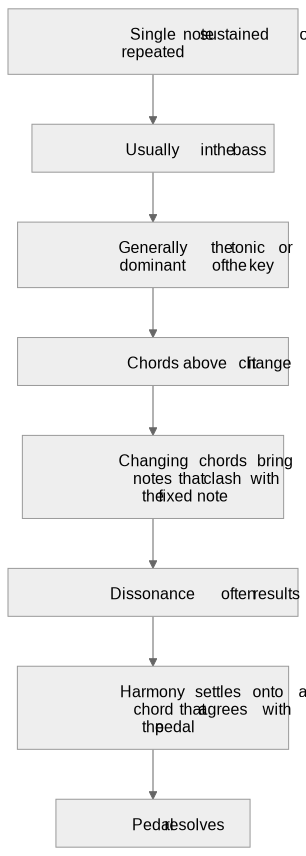
Put it in order
Put these steps in the order they happen.
- 1. Changing chords bring notes that clash with the fixed note
- 2. Pedal resolves
- 3. Dissonance often results
- 4. Single note sustained or repeated
- 5. Usually in the bass
- 6. Harmony settles onto a chord that agrees with the pedal
- 7. Generally the tonic or dominant of the key
- 8. Chords above it change
Key words
Say what each word means before you turn the card.
Pedal
Try answering aloud or in your head before turning the card.
Dissonance
Try answering aloud or in your head before turning the card.
Resolution
Try answering aloud or in your head before turning the card.
Bass line
Try answering aloud or in your head before turning the card.
See every definition
- Pedal
- A note, usually in the bass and generally either the tonic or dominant of the key, which is sustained or repeated while chords change.
- Dissonance
- A clash that often results when changing chords bring notes against a fixed note.
- Resolution
- What happens when the harmony settles onto a chord that agrees with the sustained or repeated note.
- Bass line
- The lowest sounding part, where the pedal usually sits; it must be distinguished from a moving bass line or an ostinato pattern of changing notes.
Label the diagram
Some boxes have lost their names. Pick the right name for each number.
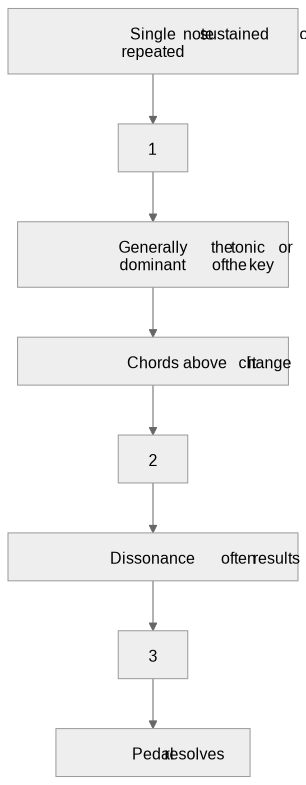
1Box 1
2Box 2
3Box 3
There is more to this lesson
The full lesson goes on to check your understanding and help you earn the marks. Create a free account to carry on, with your progress saved.
A week of Premium from your first lesson · Then the free plan continues · No card, no charge
Test your understanding of Appendix 3: Musical vocabulary - Organisation of pitch: A note (usually in the bass, and generally either the tonic or dominant of the key) which is sustained or repeated while chords change, often resulting in dissonance
Active recall beats re-reading. Take an instant quiz now to test what you’ve learned and lock it into long-term memory.
A week of Premium from your first lesson · Then the free plan continues · No card, no charge