Pearson Edexcel · GCSE · Music
Course version: 1MU0 · Version from Sept 2016
Musical vocabulary - Organisation of pitch: Synonym for ‘stepwise’
Full specification wording
Appendix 3: Musical vocabulary - Organisation of pitch: Synonym for ‘stepwise’
This vocabulary item asks you to recognise a word meaning the same as ‘stepwise’.
- Point 6 of 27
- 3 key terms
Study notes
From the teaching notes for this specification point.
The idea
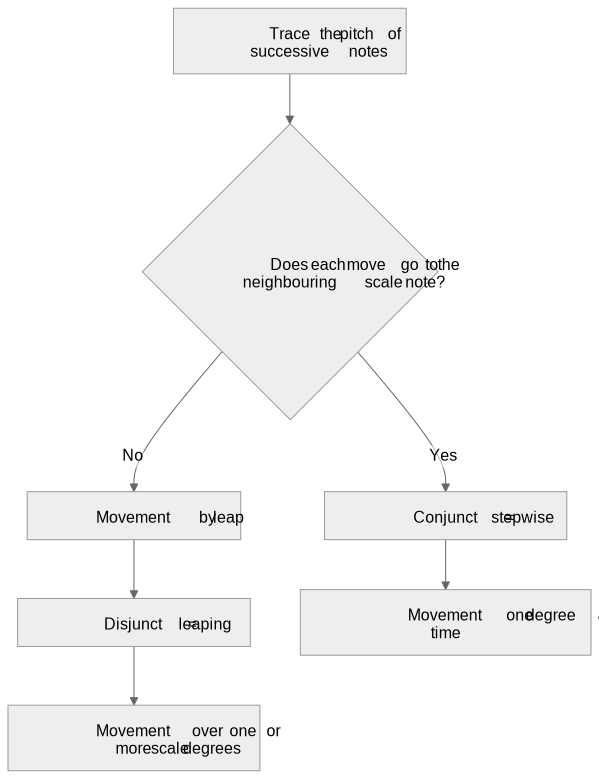
This vocabulary item asks you to recognise a word meaning the same as ‘stepwise’. Stepwise motion moves by adjacent notes of a scale, one degree at a time, as in the opening of a scale or a passing figure such as C–D–E. The synonym used in this specification is ‘conjunct’. Contrast it with ‘disjunct’, which describes movement by leaps over one or more scale degrees, for example C up to G. In a listening or score question, trace the pitch of successive notes: if each move is to the neighbouring scale note the motion is conjunct, that is, stepwise. Use the term accurately when describing a melodic line and distinguish it from leaping motion.
What earns the marks
- Recognises ‘conjunct’ as the synonym for ‘stepwise’.
- Defines stepwise motion as movement to an adjacent note of the scale, one degree at a time.
- Contrasts conjunct (stepwise) motion with disjunct (leaping) motion.
- Applies the term to a short melodic extract, identifying whether the line moves mainly by step or by leap.
Common mistakes and how to put them right
Treating ‘conjunct’ as meaning leaping motion.
Put it right by linking conjunct firmly to stepwise movement between adjacent notes.
Confusing stepwise motion with repeated notes.
Put it right by noting a repeated note stays on the same pitch, whereas stepwise motion changes to the neighbouring scale degree.
Describing any smooth-sounding tune as stepwise without checking.
Put it right by tracing each interval to confirm movement by a single scale step.
Exam tips
- Memorise the pairing conjunct = stepwise and disjunct = leaping so you can match either term quickly.
- When describing a melody, trace two or three successive notes to confirm whether the movement is by step or by leap before answering.
- If a question gives the term ‘conjunct’, translate it immediately to ‘stepwise’ to avoid hesitation.
Try the lesson
The start of the Appendix 3: Musical vocabulary - Organisation of pitch: Synonym for ‘stepwise’ lesson, made from teaching notes for this specification point.
Have a go first
In a GCSE Music analysis, a candidate writes: 'The melody in bars 1-4 is mainly stepwise.' Which alternative term would be equally correct to describe this melodic movement?
Listen
This vocabulary item asks you to recognise a word meaning the same as ‘stepwise’. Stepwise motion moves by adjacent notes of a scale, one degree at a time, as in the opening of a scale or a passing figure such as C–D–E. The synonym used in this specification is ‘conjunct’. Contrast it with ‘disjunct’, which describes movement by leaps over one or more scale degrees, for example C up to G. In a listening or score question, trace the pitch of successive notes: if each move is to the neighbouring scale note the motion is conjunct, that is, stepwise. Use the term accurately when describing a melodic line and distinguish it from leaping motion. A strong answer earns marks for these points. Recognises ‘conjunct’ as the synonym for ‘stepwise’. Defines stepwise motion as movement to an adjacent note of the scale, one degree at a time. Contrasts conjunct (stepwise) motion with disjunct (leaping) motion. Applies the term to a short melodic extract, identifying whether the line moves mainly by step or by leap. A common slip: Treating ‘conjunct’ as meaning leaping motion. Instead, linking conjunct firmly to stepwise movement between adjacent notes. Exam tip: Memorise the pairing conjunct = stepwise and disjunct = leaping so you can match either term quickly.
See it
Key words
Say what each word means before you turn the card.
Conjunct
Try answering aloud or in your head before turning the card.
Stepwise motion
Try answering aloud or in your head before turning the card.
Disjunct
Try answering aloud or in your head before turning the card.
See every definition
- Conjunct
- A synonym for ‘stepwise’, describing motion that moves by adjacent notes of a scale, one degree at a time.
- Stepwise motion
- Movement to an adjacent note of the scale, one degree at a time, as in a passing figure such as C–D–E.
- Disjunct
- Describes movement by leaps over one or more scale degrees, for example C up to G, and contrasts with conjunct motion.
There is more to this lesson
The full lesson goes on to check your understanding and help you earn the marks. Create a free account to carry on, with your progress saved.
A week of Premium from your first lesson · Then the free plan continues · No card, no charge
Test your understanding of Appendix 3: Musical vocabulary - Organisation of pitch: Synonym for ‘stepwise’
Active recall beats re-reading. Take an instant quiz now to test what you’ve learned and lock it into long-term memory.
A week of Premium from your first lesson · Then the free plan continues · No card, no charge