Pearson Edexcel · GCSE · Music
Course version: 1MU0 · Version from Sept 2016
Musical vocabulary - Organisation of pitch: Use of the same pitch…
Full specification wording
Appendix 3: Musical vocabulary - Organisation of pitch: Use of the same pitch repeatedly in a melodic part
This vocabulary item describes a melodic part that keeps returning to one pitch, so the same note is sounded again and again rather than moving up or down.
- Point 18 of 27
- 4 key terms
Study notes
From the teaching notes for this specification point.
The idea
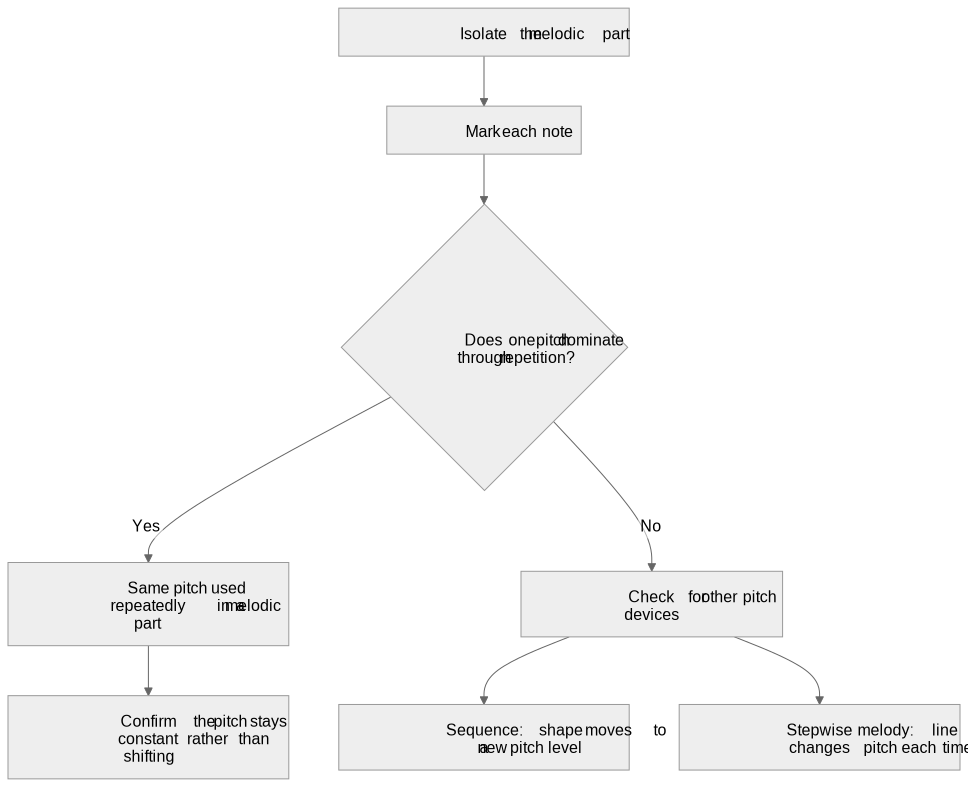
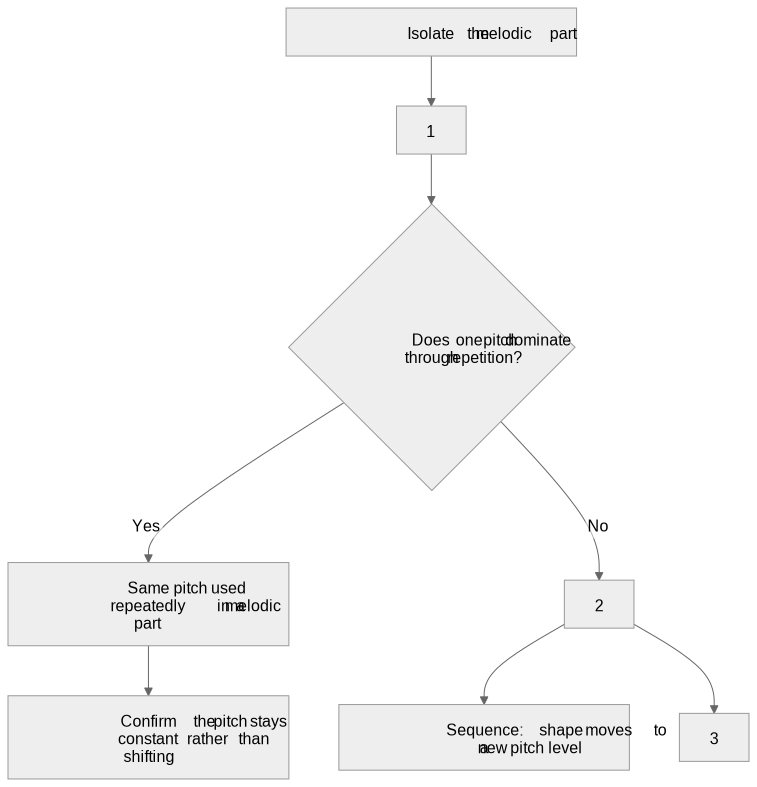
This vocabulary item describes a melodic part that keeps returning to one pitch, so the same note is sounded again and again rather than moving up or down. It is a pitch device within a single part, so the focus is on what that line does, not on how the whole texture is built. A useful method is to isolate the part, mark each note, and check whether one pitch dominates through repetition. Contrast it with a sequence, where the shape moves to a new pitch level, and with a stepwise melody, where the line changes pitch each time. In a listening question, track the repeated note by ear and confirm it stays the same rather than shifting. The answer is the term for repeated use of one pitch in a melodic part.
What earns the marks
- Recognises the device as repeated use of the same pitch within a melodic part.
- Confirms the pitch stays constant rather than moving to a new level, distinguishing it from a sequence.
- Locates the repetition in a single line rather than describing the complete texture.
- Applies the term to an extract by tracking one part and identifying the recurring note.
Common mistakes and how to put them right
Confusing repeated pitch with a repeated rhythmic pattern.
Put it right by checking whether the actual note height stays the same.
Mistaking a sequence for repeated pitch.
Put it right by noting a sequence changes pitch level while keeping the shape.
Describing the whole texture when the device concerns one part.
Put it right by focusing on the single melodic line.
Exam tips
- Listen for one note that keeps returning while other parts may move.
- Rule out options that describe changing pitch levels, such as sequence.
- Check the wording 'in a melodic part' to confirm the focus is a single line.
Try the lesson
The start of the Appendix 3: Musical vocabulary - Organisation of pitch: Use of the same pitch repeatedly in a melodic part lesson, made from teaching notes for this specification point.
Have a go first
Which of the following is a common compositional effect of repeating the same pitch in a melody?
Listen
This vocabulary item describes a melodic part that keeps returning to one pitch, so the same note is sounded again and again rather than moving up or down. It is a pitch device within a single part, so the focus is on what that line does, not on how the whole texture is built. A useful method is to isolate the part, mark each note, and check whether one pitch dominates through repetition. Contrast it with a sequence, where the shape moves to a new pitch level, and with a stepwise melody, where the line changes pitch each time. In a listening question, track the repeated note by ear and confirm it stays the same rather than shifting. The answer is the term for repeated use of one pitch in a melodic part. A strong answer earns marks for these points. Recognises the device as repeated use of the same pitch within a melodic part. Confirms the pitch stays constant rather than moving to a new level, distinguishing it from a sequence. Locates the repetition in a single line rather than describing the complete texture. Applies the term to an extract by tracking one part and identifying the recurring note. A common slip: Confusing repeated pitch with a repeated rhythmic pattern. Instead, checking whether the actual note height stays the same. Exam tip: Listen for one note that keeps returning while other parts may move.
See it
Key words
Say what each word means before you turn the card.
Repeated pitch
Try answering aloud or in your head before turning the card.
Melodic part
Try answering aloud or in your head before turning the card.
Single line focus
Try answering aloud or in your head before turning the card.
Organisation of pitch
Try answering aloud or in your head before turning the card.
See every definition
- Repeated pitch
- Use of the same pitch repeatedly in a melodic part, so the same note is sounded again and again rather than moving up or down.
- Melodic part
- A single line in which the pitch device occurs, so the focus is on what that line does rather than on how the whole texture is built.
- Single line focus
- Locating the repetition in a single line rather than describing the complete texture.
- Organisation of pitch
- The musical vocabulary section covering this pitch device within a single part.
Label the diagram
Some boxes have lost their names. Pick the right name for each number.
1Box 1
2Box 2
3Box 3
There is more to this lesson
The full lesson goes on to check your understanding and help you earn the marks. Create a free account to carry on, with your progress saved.
A week of Premium from your first lesson · Then the free plan continues · No card, no charge
Test your understanding of Appendix 3: Musical vocabulary - Organisation of pitch: Use of the same pitch repeatedly in a melodic part
Active recall beats re-reading. Take an instant quiz now to test what you’ve learned and lock it into long-term memory.
A week of Premium from your first lesson · Then the free plan continues · No card, no charge