Pearson Edexcel · GCSE · Music
Course version: 1MU0 · Version from Sept 2016
Instrumental Music 1700–1820: J S Bach: 3rd Movement from Brandenburg…
Full specification wording
Area of Study 1: Instrumental Music 1700–1820: J S Bach: 3rd Movement from Brandenburg Concerto no. 5 in D major
This set work is the third movement of Bach’s Brandenburg Concerto no.
- Point 1 of 2
- 4 key terms
Study notes
From the teaching notes for this specification point.
The idea
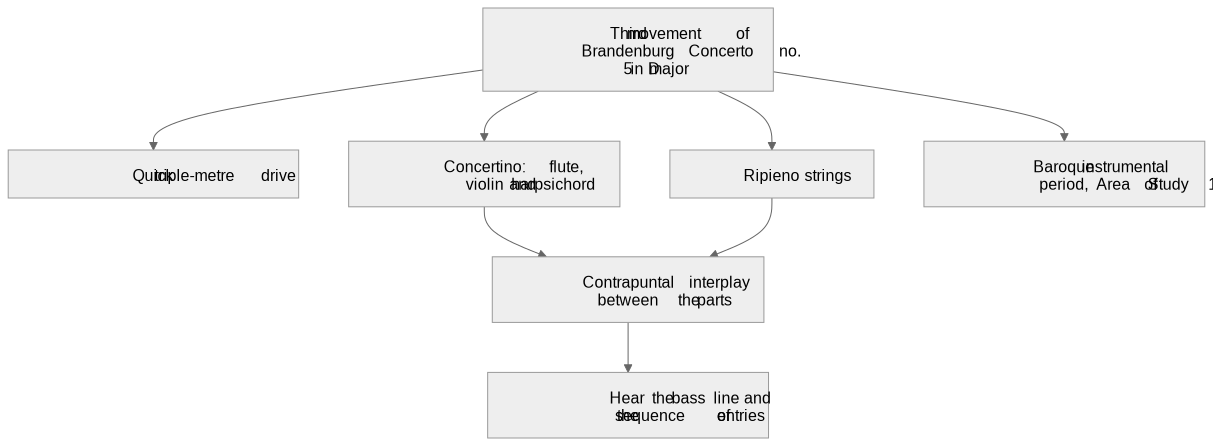
This set work is the third movement of Bach’s Brandenburg Concerto no. 5 in D major, studied within Area of Study 1: Instrumental Music 1700–1820. Focus on the movement itself: its quick triple-metre drive, the concertino of flute, violin and harpsichord set against the ripieno strings, and the contrapuntal interplay between the parts. Note that the famous extended harpsichord cadenza belongs to the first movement, not this one, so do not attach it here. Learn to hear the bass line, the sequence of entries and the way the harpsichord is integrated into the ensemble in this movement. Answer multiple-choice questions by matching options to features you can identify in the third movement specifically.
What earns the marks
- Identifies the movement as the third movement of Brandenburg Concerto no. 5 in D major by J S Bach.
- Recognises the concertino grouping of flute, violin and harpsichord against the ripieno strings.
- Describes contrapuntal texture and the interplay of parts within this movement.
- Places the work within the Baroque instrumental period covered by Area of Study 1.
Common mistakes and how to put them right
Attributing the extended harpsichord cadenza to the third movement.
Put it right: That cadenza belongs to the first movement, so keep the third movement description separate.
Confusing the concertino and ripieno roles.
Put it right: The flute, violin and harpsichord form the concertino, so describe the strings as the accompanying ripieno.
Placing the work outside the Baroque period.
Put it right: It belongs to Area of Study 1, Instrumental Music 1700–1820, so keep the stylistic description within that boundary.
Exam tips
- Check which movement the question names before selecting an answer.
- Eliminate options that describe features belonging to a different movement of the concerto.
- Use what you can hear in the third movement — metre, texture, instrumental roles — as your evidence.
Try the lesson
The start of the Area of Study 1: Instrumental Music 1700–1820: J S Bach: 3rd Movement from Brandenburg Concerto no. 5 in D major lesson, made from teaching notes for this specification point.
Listen
This set work is the third movement of Bach’s Brandenburg Concerto no. 5 in D major, studied within Area of Study 1: Instrumental Music 1700–1820. Focus on the movement itself: its quick triple-metre drive, the concertino of flute, violin and harpsichord set against the ripieno strings, and the contrapuntal interplay between the parts. Note that the famous extended harpsichord cadenza belongs to the first movement, not this one, so do not attach it here. Learn to hear the bass line, the sequence of entries and the way the harpsichord is integrated into the ensemble in this movement. Answer multiple-choice questions by matching options to features you can identify in the third movement specifically. A strong answer earns marks for these points. Identifies the movement as the third movement of Brandenburg Concerto no. 5 in D major by J S Bach. Recognises the concertino grouping of flute, violin and harpsichord against the ripieno strings. Describes contrapuntal texture and the interplay of parts within this movement. Places the work within the Baroque instrumental period covered by Area of Study 1. Exam tip: Check which movement the question names before selecting an answer.
See it
Key words
Say what each word means before you turn the card.
Third movement of Brandenburg Concerto no. 5
Try answering aloud or in your head before turning the card.
Concertino and ripieno forces
Try answering aloud or in your head before turning the card.
Baroque contrapuntal texture
Try answering aloud or in your head before turning the card.
Placing features in the correct movement
Try answering aloud or in your head before turning the card.
See every definition
- Third movement of Brandenburg Concerto no. 5
- The set work is the third movement of Bach's Brandenburg Concerto no. 5 in D major, with a quick triple-metre drive.
- Concertino and ripieno forces
- The concertino is the grouping of flute, violin and harpsichord, set against the ripieno strings, which are the accompanying forces.
- Baroque contrapuntal texture
- The movement features contrapuntal texture, the interplay of parts, and the harpsichord is integrated into the ensemble.
- Placing features in the correct movement
- The famous extended harpsichord cadenza belongs to the first movement, not the third, so keep the third movement description separate.
Label the diagram
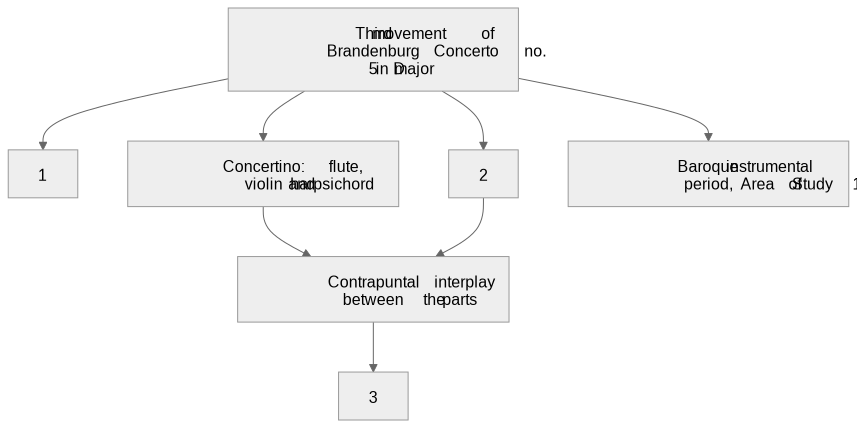
Some boxes have lost their names. Pick the right name for each number.
1Box 1
2Box 2
3Box 3
There is more to this lesson
The full lesson goes on to check your understanding and help you earn the marks. Create a free account to carry on, with your progress saved.
A week of Premium from your first lesson · Then the free plan continues · No card, no charge
Test your understanding of Area of Study 1: Instrumental Music 1700–1820: J S Bach: 3rd Movement from Brandenburg Concerto no. 5 in D major
Active recall beats re-reading. Take an instant quiz now to test what you’ve learned and lock it into long-term memory.
A week of Premium from your first lesson · Then the free plan continues · No card, no charge