Pearson Edexcel · GCSE · Music
Course version: 1MU0 · Version from Sept 2016
Fusions: Some fusions have become genres in their own right such as…
Full specification wording
Area of Study 4: Fusions: Some fusions have become genres in their own right such as Bhangra and Salsa.
This statement asks you to recognise that some fusions have become established genres in their own right, and it names Bhangra and Salsa as examples.
- Point 1 of 3
- 4 key terms
Study notes
From the teaching notes for this specification point.
The idea
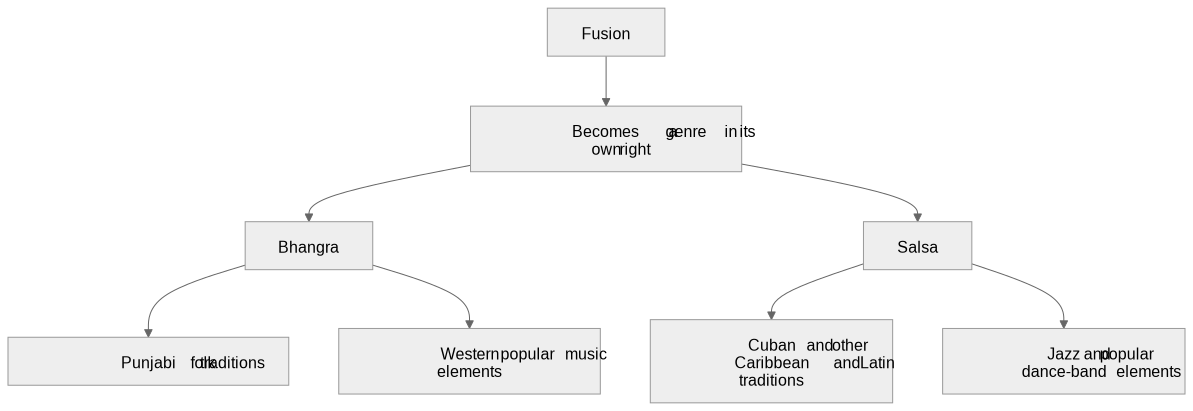
This statement asks you to recognise that some fusions have become established genres in their own right, and it names Bhangra and Salsa as examples. Learn what each example fuses and why it now counts as a genre rather than a one-off blend. Bhangra grew from Punjabi folk traditions (dhol rhythms, sung verse) combined with Western popular music elements such as drum kit, bass and electronic production, and it now has its own recognised style, artists and audiences. Salsa developed from Cuban and other Caribbean and Latin traditions combined with jazz and popular dance-band elements, and it too is now a named genre with its own conventions.
What earns the marks
- Recognises that some fusions have become genres in their own right rather than remaining one-off blends.
- Identifies Bhangra as a named example of a fusion that has become a genre.
- Identifies Salsa as a named example of a fusion that has become a genre.
- Links each named genre to the musical cultures it combines, for example Punjabi folk with Western popular elements for Bhangra, and Cuban and other Latin traditions with jazz and dance-band elements for Salsa.
- Distinguishes a genre with its own conventions and audience from a single track that merely borrows from another culture.
Common mistakes and how to put them right
Thinking fusion always stays a one-off experiment.
Put it right: Some fusions, such as Bhangra and Salsa, become established genres with their own conventions.
Confusing the cultural roots of the named genres.
Put it right: Check which traditions each genre grew from before selecting an answer.
Assuming a fusion genre has only one parent culture.
Put it right: Each named genre combines at least two traditions, and the answer should reflect that combination.
Treating the named examples as interchangeable.
Put it right: Bhangra and Salsa have different roots and different musical features, so match the specific genre to its description.
Exam tips
- Read the stem carefully to see whether it asks for a named genre, a cultural root or the idea of fusion becoming a genre.
- Eliminate options that describe a single tradition rather than a combination of cultures.
- Revise the named examples with one line each on their roots and typical features so you can match them quickly.
Try the lesson
The start of the Area of Study 4: Fusions: Some fusions have become genres in their own right such as Bhangra and Salsa. lesson, made from teaching notes for this specification point.
Have a go first
Which of the following statements best describes the development of Bhangra as a musical genre?
Listen
This statement asks you to recognise that some fusions have become established genres in their own right, and it names Bhangra and Salsa as examples. Learn what each example fuses and why it now counts as a genre rather than a one-off blend. Bhangra grew from Punjabi folk traditions (dhol rhythms, sung verse) combined with Western popular music elements such as drum kit, bass and electronic production, and it now has its own recognised style, artists and audiences. Salsa developed from Cuban and other Caribbean and Latin traditions combined with jazz and popular dance-band elements, and it too is now a named genre with its own conventions. A strong answer earns marks for these points. Recognises that some fusions have become genres in their own right rather than remaining one-off blends. Identifies Bhangra as a named example of a fusion that has become a genre. Identifies Salsa as a named example of a fusion that has become a genre. Links each named genre to the musical cultures it combines, for example Punjabi folk with Western popular elements for Bhangra, and Cuban and other Latin traditions with jazz and dance-band elements for Salsa. A common slip: Thinking fusion always stays a one-off experiment. Instead, some fusions, such as Bhangra and Salsa, become established genres with their own conventions. Exam tip: Read the stem carefully to see whether it asks for a named genre, a cultural root or the idea of fusion becoming a genre.
See it
Key words
Say what each word means before you turn the card.
Fusion becoming an established genre
Try answering aloud or in your head before turning the card.
Bhangra as a named fusion genre
Try answering aloud or in your head before turning the card.
Salsa as a named fusion genre
Try answering aloud or in your head before turning the card.
Cultural roots and combination of traditions
Try answering aloud or in your head before turning the card.
See every definition
- Fusion becoming an established genre
- Some fusions have become genres in their own right, with their own conventions and audience, rather than remaining one-off blends.
- Bhangra as a named fusion genre
- A named genre that grew from Punjabi folk traditions combined with Western popular music elements, and now has its own recognised style, artists and audiences.
- Salsa as a named fusion genre
- A named genre that developed from Cuban and other Caribbean and Latin traditions combined with jazz and popular dance-band elements, and now has its own conventions.
- Cultural roots and combination of traditions
- Each named genre combines at least two traditions, so match the specific genre to the musical cultures it combines.
Label the diagram
Some boxes have lost their names. Pick the right name for each number.
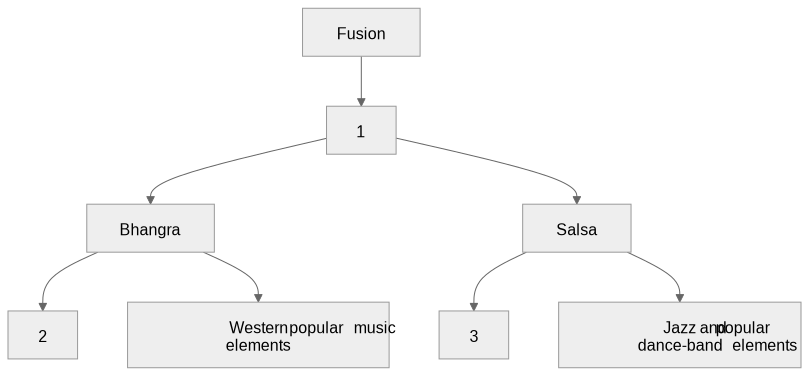
1Box 1
2Box 2
3Box 3
There is more to this lesson
The full lesson goes on to check your understanding and help you earn the marks. Create a free account to carry on, with your progress saved.
A week of Premium from your first lesson · Then the free plan continues · No card, no charge
Test your understanding of Area of Study 4: Fusions: Some fusions have become genres in their own right such as Bhangra and Salsa.
Active recall beats re-reading. Take an instant quiz now to test what you’ve learned and lock it into long-term memory.
A week of Premium from your first lesson · Then the free plan continues · No card, no charge