Pearson Edexcel · GCSE · Music
Course version: 1MU0 · Version from Sept 2016
Appraising - Musical elements: organisation of pitch (melodically and…
Full specification wording
Component 3: Appraising - Musical elements: organisation of pitch (melodically and harmonically), including simple chord progressions, for example perfect and imperfect cadences, and basic melodic devices
Pitch organisation means how high and low sounds are arranged.
- Point 1 of 7
- 4 key terms
Study notes
From the teaching notes for this specification point.
The idea
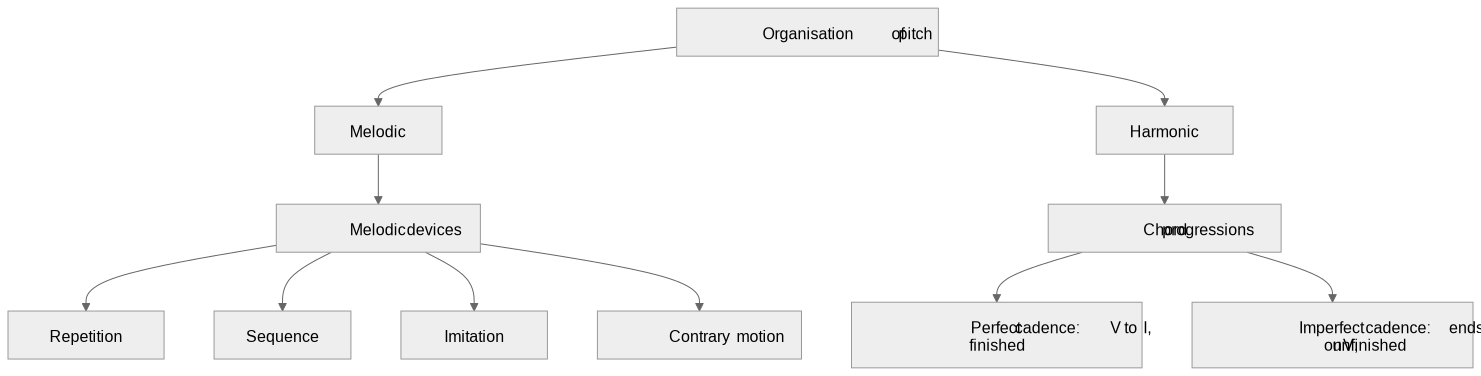
Pitch organisation means how high and low sounds are arranged. Melodically, you track the shape of a line: whether it steps or leaps, rises or falls, repeats a motif, sequences a phrase higher or lower, or inverts a contour. Harmonically, you identify the chords built on scale degrees and how they follow one another. A simple progression such as I–IV–V–I in C major uses C major, F major, G major then C major. Cadences close phrases: a perfect cadence moves from chord V to chord I and sounds finished; an imperfect cadence ends on chord V and sounds unfinished. Basic melodic devices include repetition, sequence, imitation and contrary motion between parts. In a multiple-choice question, compare each option against what you actually hear or see in the score, checking both the melodic behaviour and the harmonic support before choosing.
What earns the marks
- Identifies that pitch organisation covers both melodic contour and harmonic chord choice.
- Recognises a perfect cadence as a progression from chord V to chord I giving a finished sound.
- Recognises an imperfect cadence as one that ends on chord V, leaving the phrase open.
- Distinguishes basic melodic devices such as repetition, sequence, imitation and contrary motion.
- Applies chord progression labels to a short extract, for example I–IV–V–I in a named key.
Common mistakes and how to put them right
Confusing perfect and imperfect cadences.
Put it right: A perfect cadence ends V–I and sounds closed, while an imperfect cadence ends on V and sounds open.
Treating any repeated note as a sequence.
Put it right: A sequence restates a motif at a different pitch level, whereas repetition keeps the same pitch.
Assuming chords are chosen at random.
Put it right: Progressions follow scale-degree functions such as tonic, subdominant and dominant.
Exam tips
- Read all options before deciding, then eliminate those that contradict the cadence or contour you hear.
- Hum the bass line to locate the closing chord of a phrase, which usually settles the cadence question.
- Check the key signature first so chord labels such as I and V are anchored to the right tonic.
Try the lesson
The start of the Component 3: Appraising - Musical elements: organisation of pitch (melodically and harmonically), including simple chord progressions, for example perfect and imperfect cadences, and basic melodic devices lesson, made from teaching notes for this specification point.
Have a go first
Which cadence is formed by the chord progression V–I?
Listen
Pitch organisation means how high and low sounds are arranged. Melodically, you track the shape of a line: whether it steps or leaps, rises or falls, repeats a motif, sequences a phrase higher or lower, or inverts a contour. Harmonically, you identify the chords built on scale degrees and how they follow one another. A simple progression such as I–IV–V–I in C major uses C major, F major, G major then C major. Cadences close phrases: a perfect cadence moves from chord V to chord I and sounds finished; an imperfect cadence ends on chord V and sounds unfinished. Basic melodic devices include repetition, sequence, imitation and contrary motion between parts. In a multiple-choice question, compare each option against what you actually hear or see in the score, checking both the melodic behaviour and the harmonic support before choosing. A strong answer earns marks for these points. Identifies that pitch organisation covers both melodic contour and harmonic chord choice. Recognises a perfect cadence as a progression from chord V to chord I giving a finished sound. Recognises an imperfect cadence as one that ends on chord V, leaving the phrase open. Distinguishes basic melodic devices such as repetition, sequence, imitation and contrary motion. A common slip: Confusing perfect and imperfect cadences. Instead, a perfect cadence ends V–I and sounds closed, while an imperfect cadence ends on V and sounds open. Exam tip: Read all options before deciding, then eliminate those that contradict the cadence or contour you hear.
See it
Key words
Say what each word means before you turn the card.
Melodic contour and devices
Try answering aloud or in your head before turning the card.
Harmonic chord progressions
Try answering aloud or in your head before turning the card.
Cadence types and their effect
Try answering aloud or in your head before turning the card.
Relating aural and score evidence
Try answering aloud or in your head before turning the card.
See every definition
- Melodic contour and devices
- The shape of a melodic line, whether it steps or leaps, rises or falls, and basic devices such as repetition, sequence, imitation and contrary motion between parts.
- Harmonic chord progressions
- Chords built on scale degrees and how they follow one another, such as I–IV–V–I in C major using C major, F major, G major then C major.
- Cadence types and their effect
- A perfect cadence moves from chord V to chord I and sounds finished, while an imperfect cadence ends on chord V and sounds unfinished.
- Relating aural and score evidence
- Comparing each option against what you actually hear or see in the score, checking both the melodic behaviour and the harmonic support before choosing.
Label the diagram
Some boxes have lost their names. Pick the right name for each number.
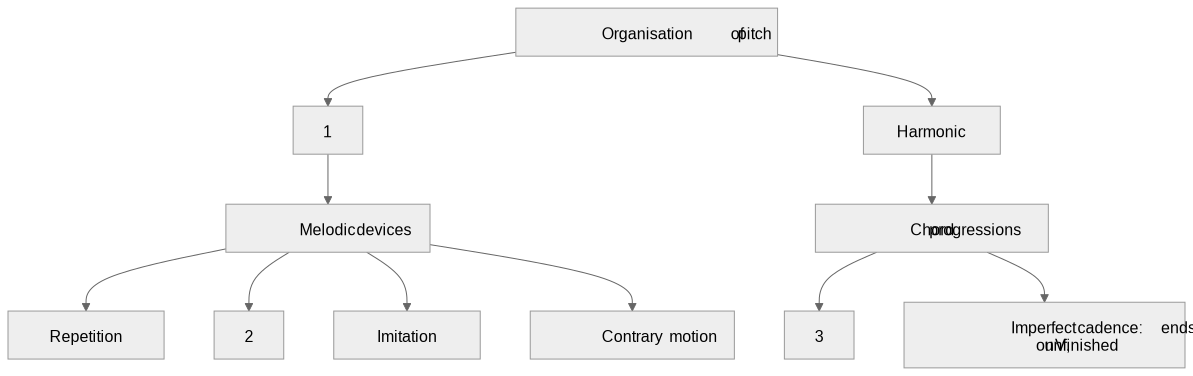
1Box 1
2Box 2
3Box 3
There is more to this lesson
The full lesson goes on to check your understanding and help you earn the marks. Create a free account to carry on, with your progress saved.
A week of Premium from your first lesson · Then the free plan continues · No card, no charge
Test your understanding of Component 3: Appraising - Musical elements: organisation of pitch (melodically and harmonically), including simple chord progressions, for example perfect and imperfect cadences, and basic melodic devices
Active recall beats re-reading. Take an instant quiz now to test what you’ve learned and lock it into long-term memory.
A week of Premium from your first lesson · Then the free plan continues · No card, no charge