Pearson Edexcel · GCSE · Music
Course version: 1MU0 · Version from Sept 2016
Appraising - Set works: Afro Celt Sound System: Release (from the album…
Full specification wording
Component 3: Appraising - Set works: Afro Celt Sound System: Release (from the album ‘Volume 2: Release’)
This set work is 'Release' by Afro Celt Sound System, taken from the album Volume 2: Release.
- Point 7 of 8
- 4 key terms
Study notes
From the teaching notes for this specification point.
The idea
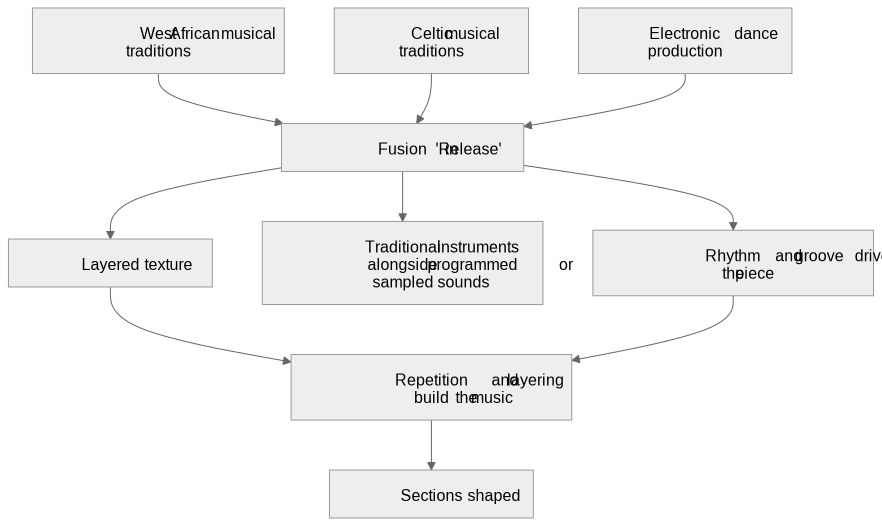
This set work is 'Release' by Afro Celt Sound System, taken from the album Volume 2: Release. The group fuses West African and Celtic musical traditions with electronic dance production, so your listening must pick out both acoustic and technology-based elements. Learn to recognise the layers of the texture, the use of traditional instruments alongside programmed or sampled sounds, and the way rhythm and groove drive the piece. Notice how melodic ideas from different traditions are combined and how the music builds through repetition and layering. Practise identifying sections, tempo and metre changes, and the balance between live-sounding and electronic timbres, describing only what you can actually hear.
What earns the marks
- Identifies the work as 'Release' by Afro Celt Sound System from the album Volume 2: Release.
- Recognises the fusion of West African and Celtic traditions with electronic dance elements in the texture and timbres.
- Describes layered textures, including traditional instruments combined with programmed or sampled sounds.
- Explains how rhythm, groove, repetition and layering build the piece and shape its sections.
- Uses accurate vocabulary for instrumentation, texture, tempo, metre and production features heard in the extract.
Common mistakes and how to put them right
Describing the piece as purely acoustic folk music.
Put it right by noting the electronic and production elements alongside traditional instruments.
Assuming every extract contains all the layers.
Put it right by describing only the layers audible in that extract.
Using vague words like 'drums' without distinguishing traditional percussion from programmed beats.
Put it right by naming the type of sound heard.
Exam tips
- Listen for changes in texture and layering and note where new ideas enter.
- Distinguish acoustic timbres from electronic or processed sounds when describing instrumentation.
- Learn the album title and group name precisely so identification questions are answered accurately.
Try the lesson
The start of the Component 3: Appraising - Set works: Afro Celt Sound System: Release (from the album ‘Volume 2: Release’) lesson, made from teaching notes for this specification point.
Have a go first
Which combination of musical traditions is fused in 'Release' by Afro Celt Sound System?
Listen
This set work is 'Release' by Afro Celt Sound System, taken from the album Volume 2: Release. The group fuses West African and Celtic musical traditions with electronic dance production, so your listening must pick out both acoustic and technology-based elements. Learn to recognise the layers of the texture, the use of traditional instruments alongside programmed or sampled sounds, and the way rhythm and groove drive the piece. Notice how melodic ideas from different traditions are combined and how the music builds through repetition and layering. Practise identifying sections, tempo and metre changes, and the balance between live-sounding and electronic timbres, describing only what you can actually hear. A strong answer earns marks for these points. Identifies the work as 'Release' by Afro Celt Sound System from the album Volume 2: Release. Recognises the fusion of West African and Celtic traditions with electronic dance elements in the texture and timbres. Describes layered textures, including traditional instruments combined with programmed or sampled sounds. Explains how rhythm, groove, repetition and layering build the piece and shape its sections. A common slip: Describing the piece as purely acoustic folk music. Instead, noting the electronic and production elements alongside traditional instruments. Exam tip: Listen for changes in texture and layering and note where new ideas enter.
See it
Key words
Say what each word means before you turn the card.
Fusion of West African and Celtic traditions
Try answering aloud or in your head before turning the card.
Electronic production and programmed sounds
Try answering aloud or in your head before turning the card.
Layered texture and repetition
Try answering aloud or in your head before turning the card.
Rhythm, groove and metre
Try answering aloud or in your head before turning the card.
See every definition
- Fusion of West African and Celtic traditions
- The group combines West African and Celtic musical traditions with electronic dance production, so listening must pick out both acoustic and technology-based elements.
- Electronic production and programmed sounds
- Traditional instruments are used alongside programmed or sampled sounds, and the balance between live-sounding and electronic timbres should be described.
- Layered texture and repetition
- The layers of the texture should be recognised, and the music builds through repetition and layering as melodic ideas from different traditions are combined.
- Rhythm, groove and metre
- Rhythm and groove drive the piece, and sections, tempo and metre changes should be identified.
Label the diagram
Some boxes have lost their names. Pick the right name for each number.
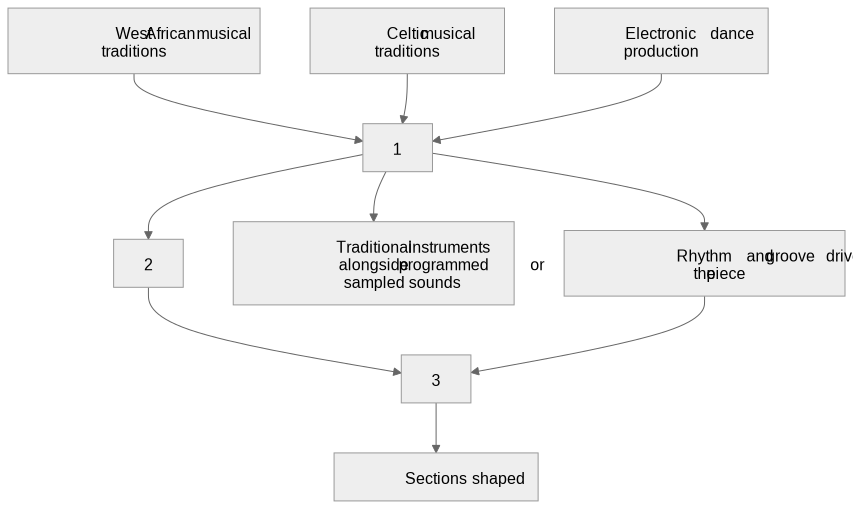
1Box 1
2Box 2
3Box 3
There is more to this lesson
The full lesson goes on to check your understanding and help you earn the marks. Create a free account to carry on, with your progress saved.
A week of Premium from your first lesson · Then the free plan continues · No card, no charge
Test your understanding of Component 3: Appraising - Set works: Afro Celt Sound System: Release (from the album ‘Volume 2: Release’)
Active recall beats re-reading. Take an instant quiz now to test what you’ve learned and lock it into long-term memory.
A week of Premium from your first lesson · Then the free plan continues · No card, no charge