AQA · A-Level · Philosophy
Epistemology
Dive into the fundamental questions of Epistemology: what is knowledge, and how do we get it? This study guide covers the crucial distinction between types of knowledge, the classic Tripartite (JTB) definition, and the devastating challenge posed by Gettier cases — essential concepts for top marks in your GCSE Philosophy exam.
- 4 min read
- 3 worked examples
- 5 practice questions
- 6 key terms
Study Notes
Overview
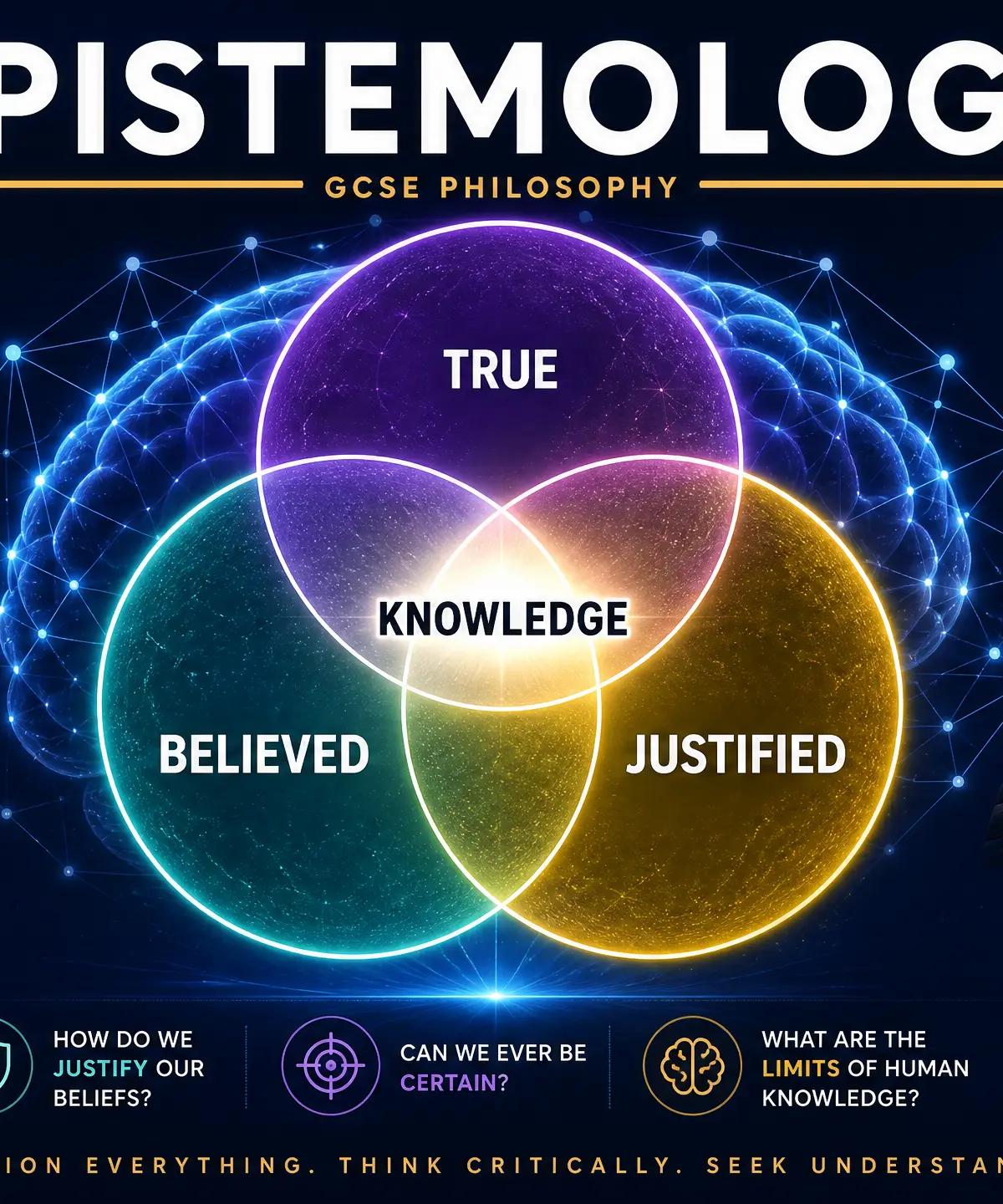
Epistemology is the branch of philosophy concerned with the theory of knowledge. It asks fundamental questions: What is knowledge? How is it acquired? Can we ever be certain of anything? For GCSE Philosophy, examiners expect you to master the definitions of different types of knowledge and critically evaluate the traditional definition of propositional knowledge as 'Justified True Belief' (JTB).
Historically, the JTB account dates back to Plato and stood largely unchallenged for over two millennia. However, in 1963, Edmund Gettier published a brief paper that completely upended this consensus by demonstrating that JTB is not sufficient for knowledge. Understanding this debate — the definition, the conditions, and the counter-examples — is critical for success in this topic.
Key Concepts & Developments
The Three Types of Knowledge
Acquaintance KnowledgeKnowledge by direct experience or perception (e.g., 'I know what the colour red looks like' or 'I know the smell of coffee'). It does not involve propositions or facts; it is a direct, personal familiarity with a person, place, or sensation.
**Ability Knowledge (Know-How)**Knowledge of how to do something (e.g., 'I know how to ride a bike'). This is practical knowledge. Crucially, a person can possess ability knowledge without being able to articulate the theory behind it.
Propositional KnowledgeKnowledge that something is the case (e.g., 'I know that Paris is the capital of France'). This is the primary focus of epistemology. It is expressed as a proposition (a statement that can be true or false). Philosophers express this formally as: S knows that p (where S is the subject and p is the proposition).
The Tripartite Definition (JTB)
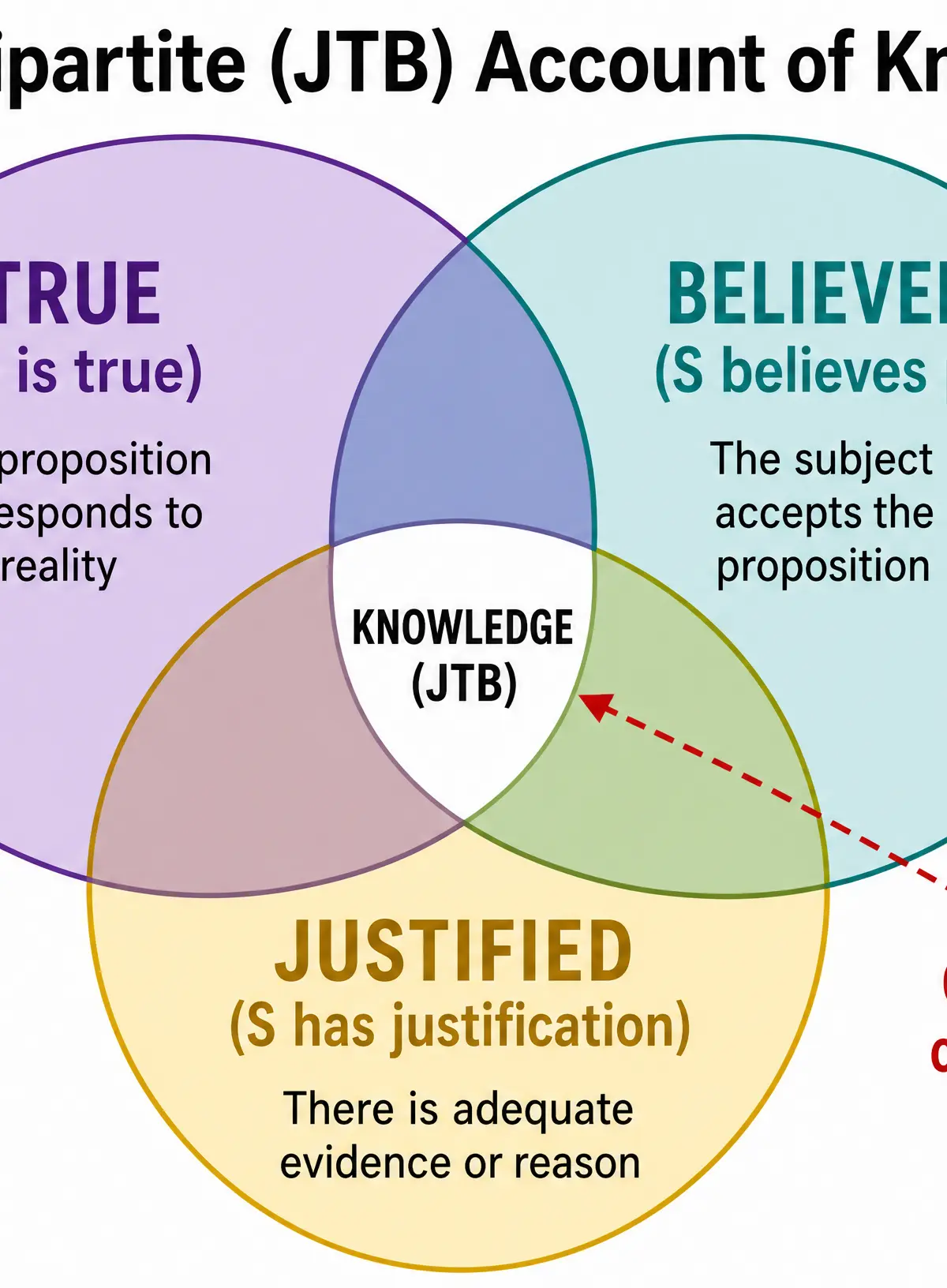
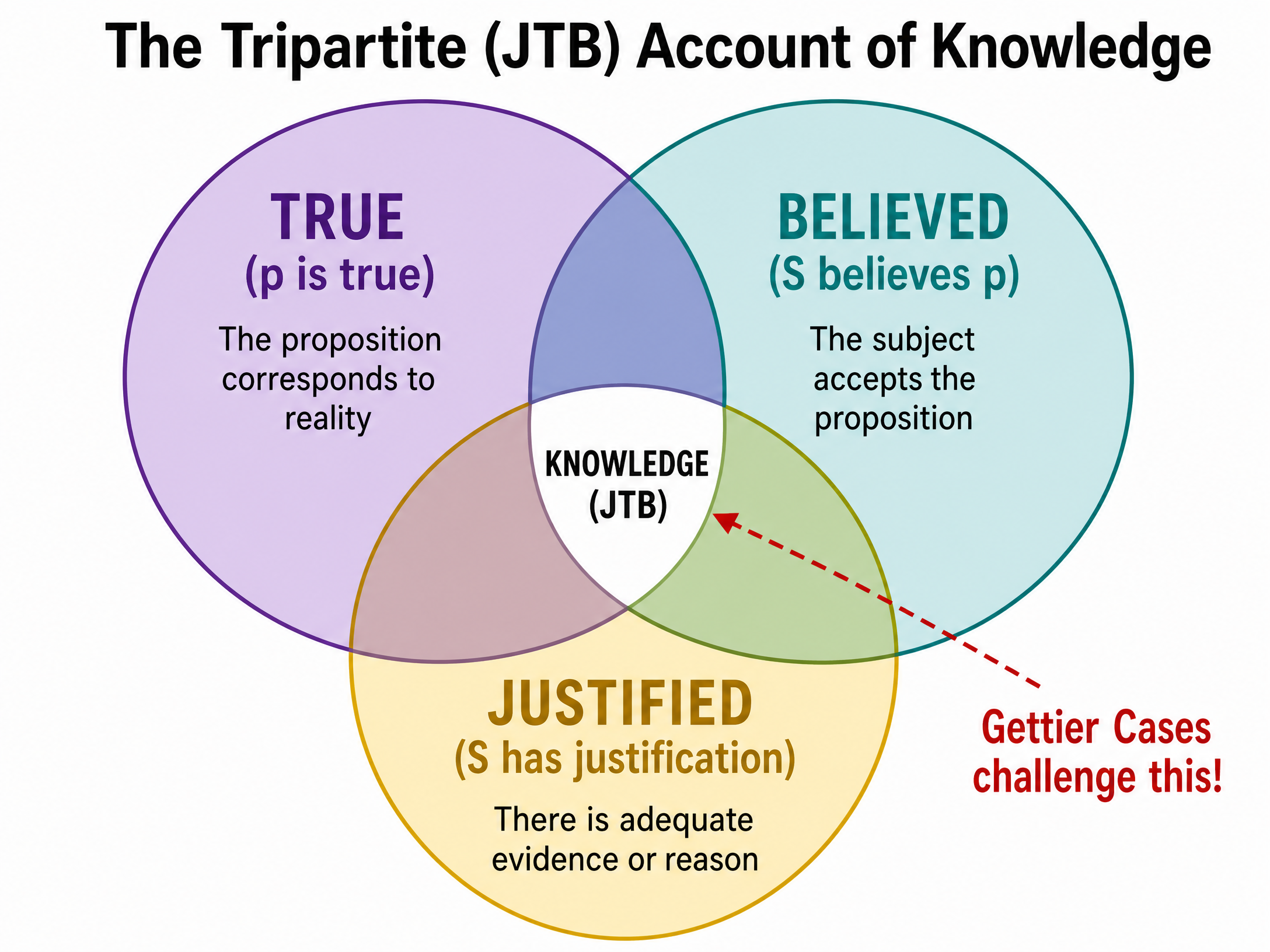
Traditionally, propositional knowledge is defined as Justified True Belief. This account argues that knowledge is composed of three conditions that are individually necessary and jointly sufficient:
- Truth (p is true): You cannot know something that is false. The proposition must correspond to reality.
- Belief (S believes p): You must mentally assent to the proposition. You cannot know something if you don't believe it.
- Justification (S is justified in believing p): You must have adequate evidence or rational grounds for your belief. This separates knowledge from a lucky guess.
The Gettier Challenge (1963)
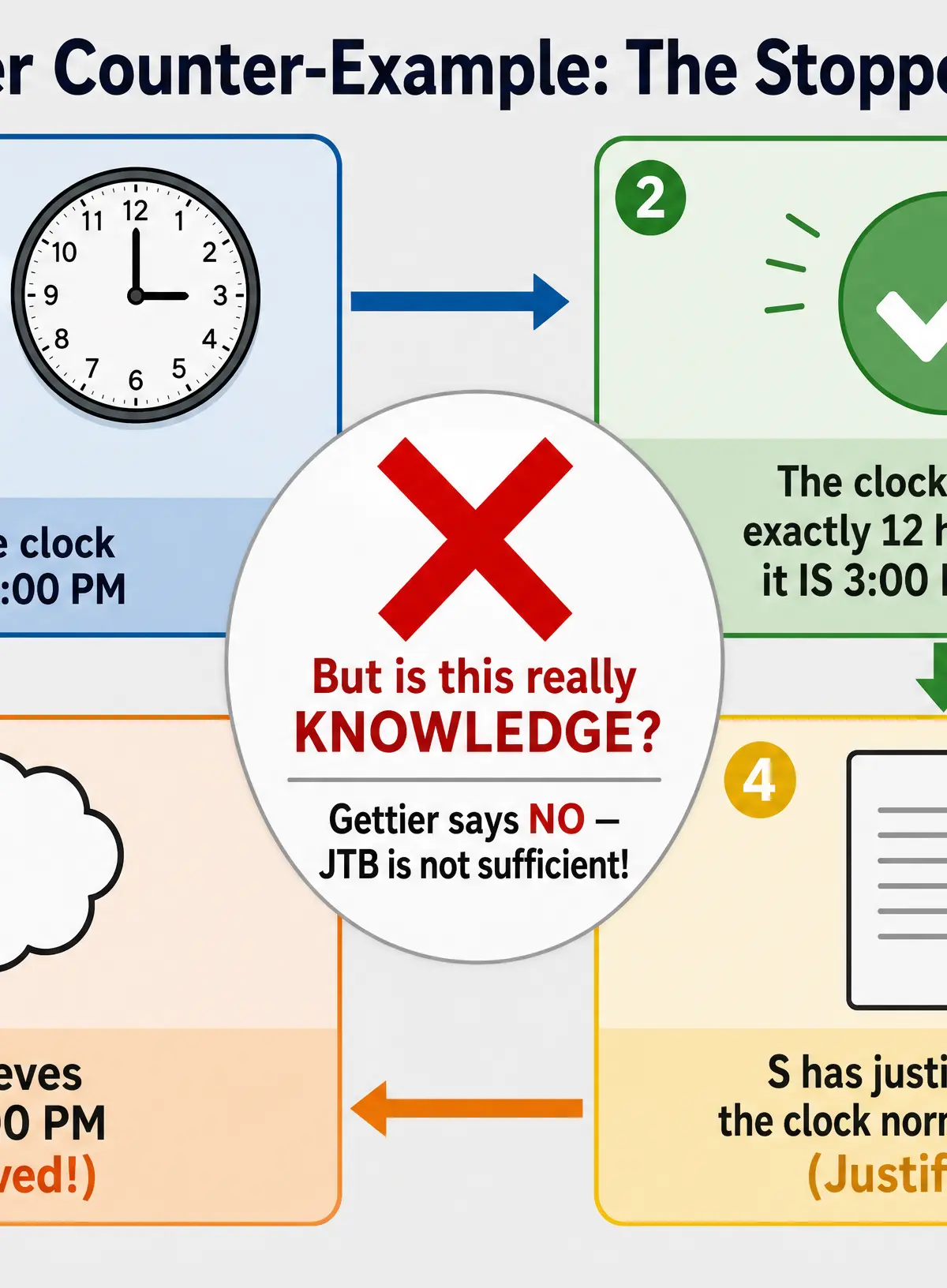
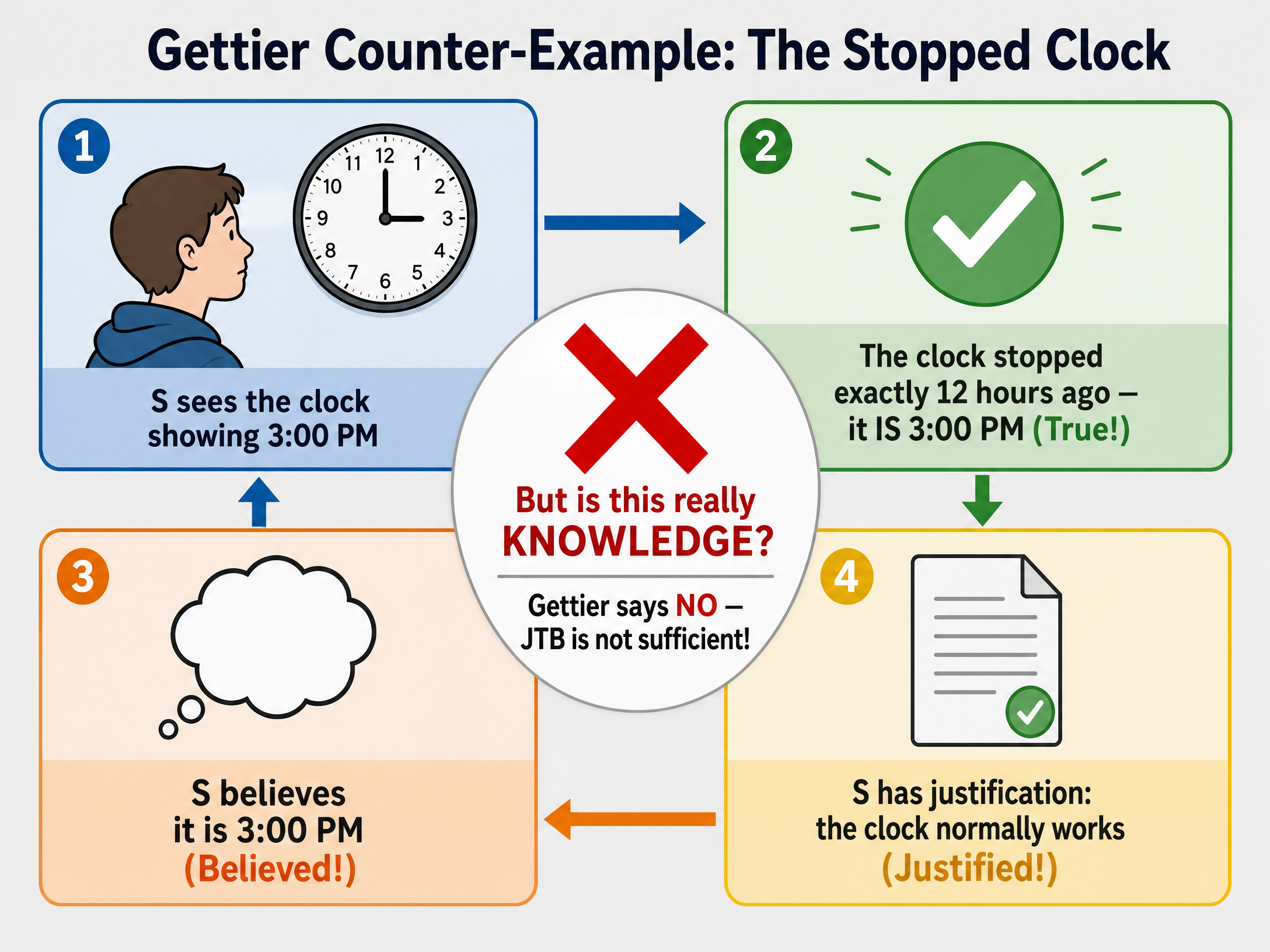
Edmund Gettier challenged the JTB account by providing counter-examples where a person has a justified true belief, but we would intuitively say they do not have knowledge.
The Core Argument: Gettier cases demonstrate that the three conditions of JTB are not jointly sufficient. You can meet all three conditions and still lack knowledge, usually because the connection between the justification and the truth is purely accidental (epistemic luck).
The Nature of Definition (Linda Zagzebski)
Philosopher Linda Zagzebski argued that the problem with JTB is structural. Any definition of knowledge that treats truth and justification as separate, independent components will always be vulnerable to Gettier-style counter-examples. Because justification doesn't guarantee truth, there will always be a gap where luck can intervene.
Podcast Episode
Listen to this 10-minute audio guide covering the core concepts, common mistakes, and a quick-fire recall quiz.
Visual Resources
2 diagrams and illustrations
Interactive Diagrams
1 interactive diagram to visualise key concepts
Conceptual Flow Outline
The logical structure of the JTB account and the Gettier challenge.
Worked Examples
3 worked examples — open one to explore the question and available guidance.
Practice Questions
Test your understanding — click to reveal model answers
Outline what is meant by 'acquaintance knowledge'. (3 marks)
Hint: Think about direct experience and give an example.
Explain the claim that justification is a necessary condition for knowledge. (5 marks)
Hint: Why isn't a true belief enough? What role does evidence play?
Are the conditions of Justified True Belief jointly sufficient for knowledge? Evaluate this claim. (12 marks)
Hint: Structure this as a debate: explain JTB, then use Gettier cases to evaluate its sufficiency.
Explain Linda Zagzebski's argument regarding the nature of definition in epistemology. (5 marks)
Hint: Think about the structural gap between justification and truth.
Read the following scenario: John believes the capital of Australia is Sydney because his geography teacher told him so. It turns out the capital is Canberra. Using the JTB account, explain why John does not have knowledge. (3 marks)
Hint: Which of the three conditions is missing?
Test your understanding of Epistemology
Active recall beats re-reading. Take an instant quiz now to test what you’ve learned and lock it into long-term memory.
7 days Premium · Then free forever · No card, no charge