AQA · A-Level · Philosophy
Metaphysics of mind
Dive into the Metaphysics of Mind, one of philosophy's most profound topics. Explore whether you are just a physical body or if you possess an irreducible, non-physical mind, mastering the key arguments of dualism to secure top marks in your GCSE Philosophy exam.
- 5 min read
- 3 worked examples
- 5 practice questions
- 6 key terms
Study Notes
Overview
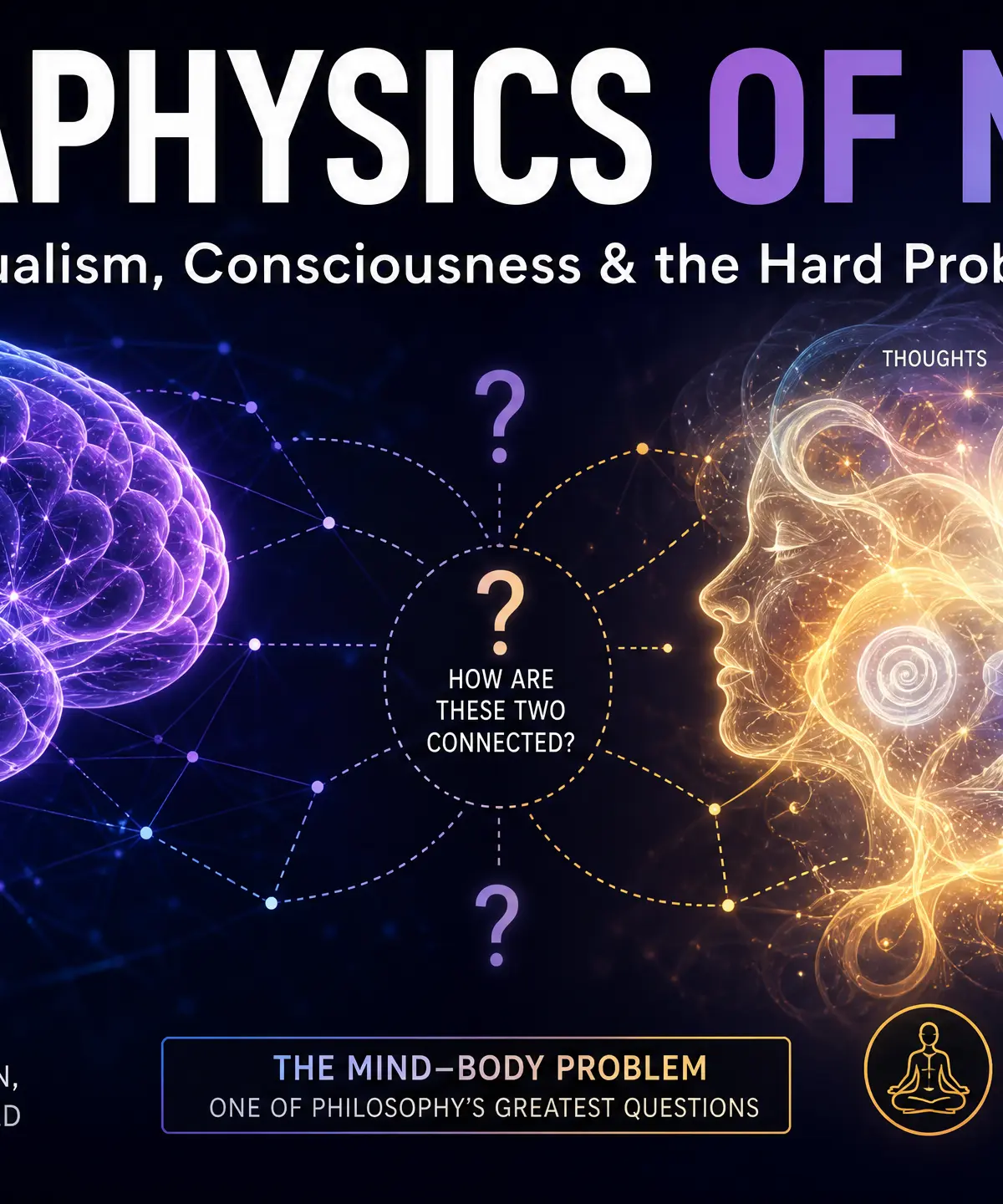
The Metaphysics of Mind explores the fundamental nature of consciousness and its relationship to the physical body. This study guide covers the core dualist theories: Substance Dualism and Property Dualism. Historically, this debate was ignited by René Descartes in the 17th century and remains one of the most vigorously debated areas in modern philosophy and cognitive science. Examiners expect candidates to not only define these theories accurately but to critically evaluate the arguments for and against them. You must demonstrate a clear understanding of key concepts such as indivisibility, conceivability, philosophical zombies, and qualia, while applying precise philosophical terminology to achieve the highest marks.
Listen to the Podcast
Key Theories & Arguments
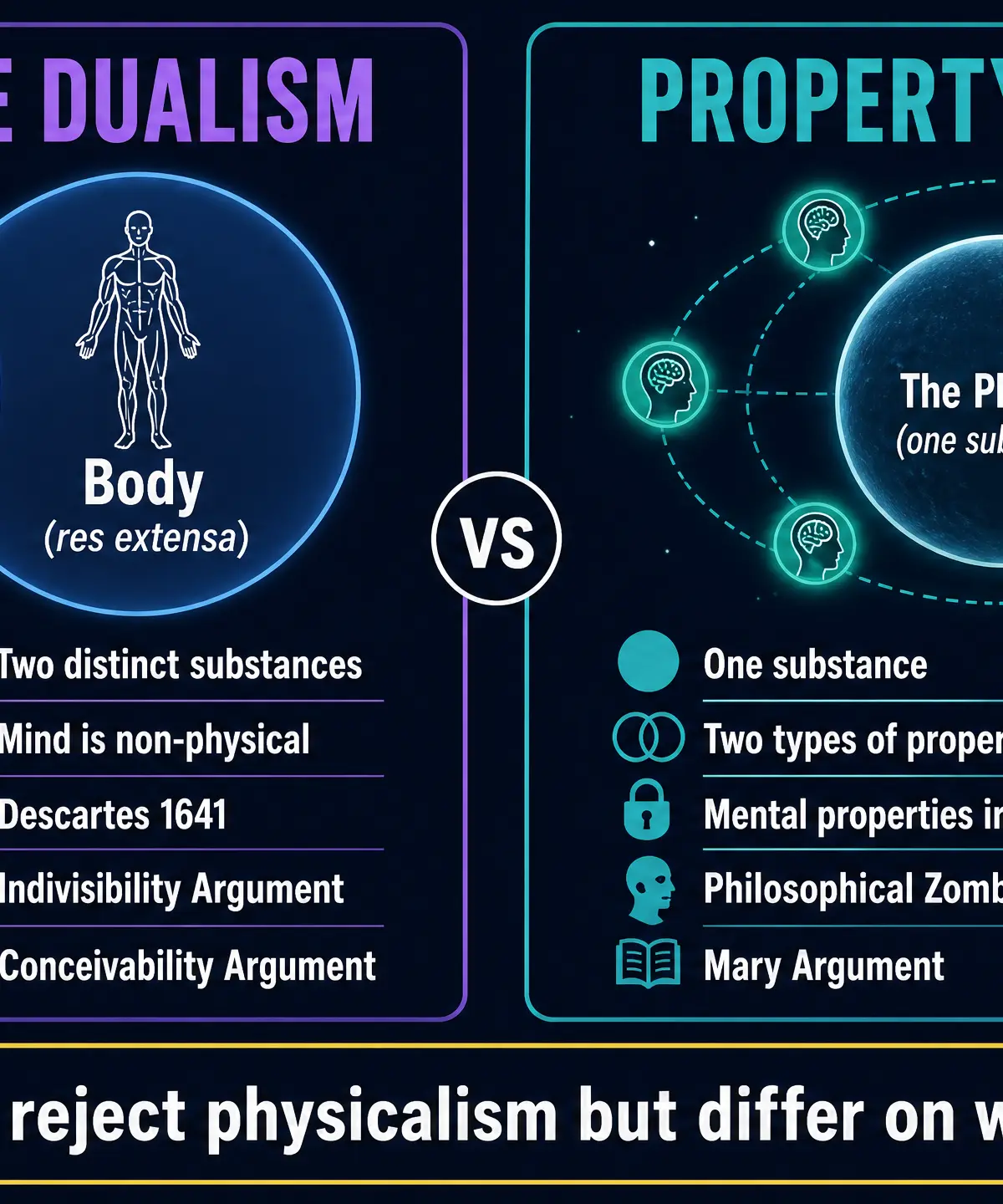
Substance Dualism
Proponent: René Descartes (1641)
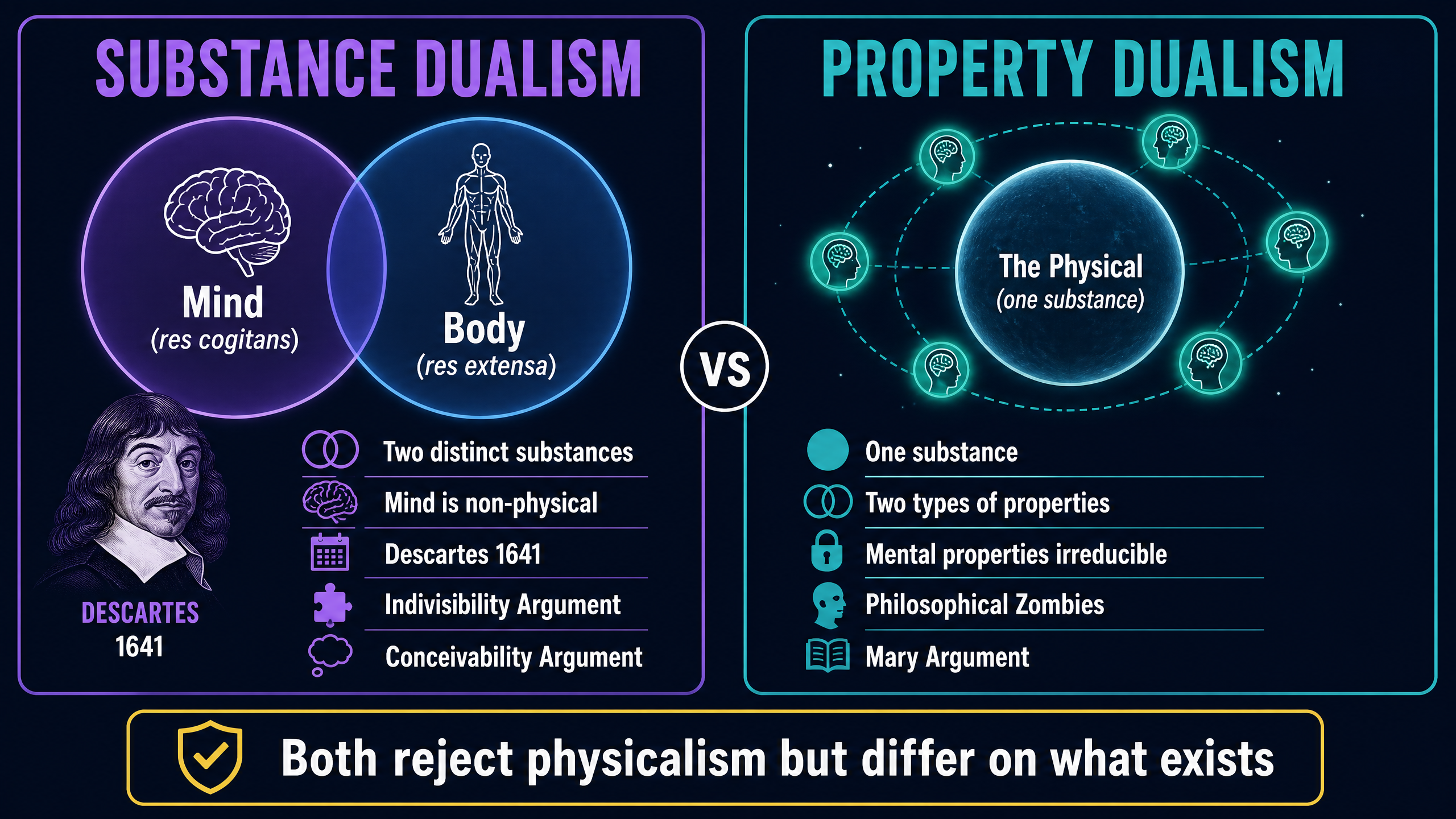
What it is: The view that minds and bodies are two fundamentally distinct kinds of substance. The mind (res cogitans) is a non-physical, thinking thing. The body (res extensa) is a physical, extended thing. The mind is not identical to the body, nor any part of it.
Why it matters: It provides the classic formulation of the mind-body problem. Examiners will test your ability to explain Descartes' two main arguments for this position.
Specific Knowledge:
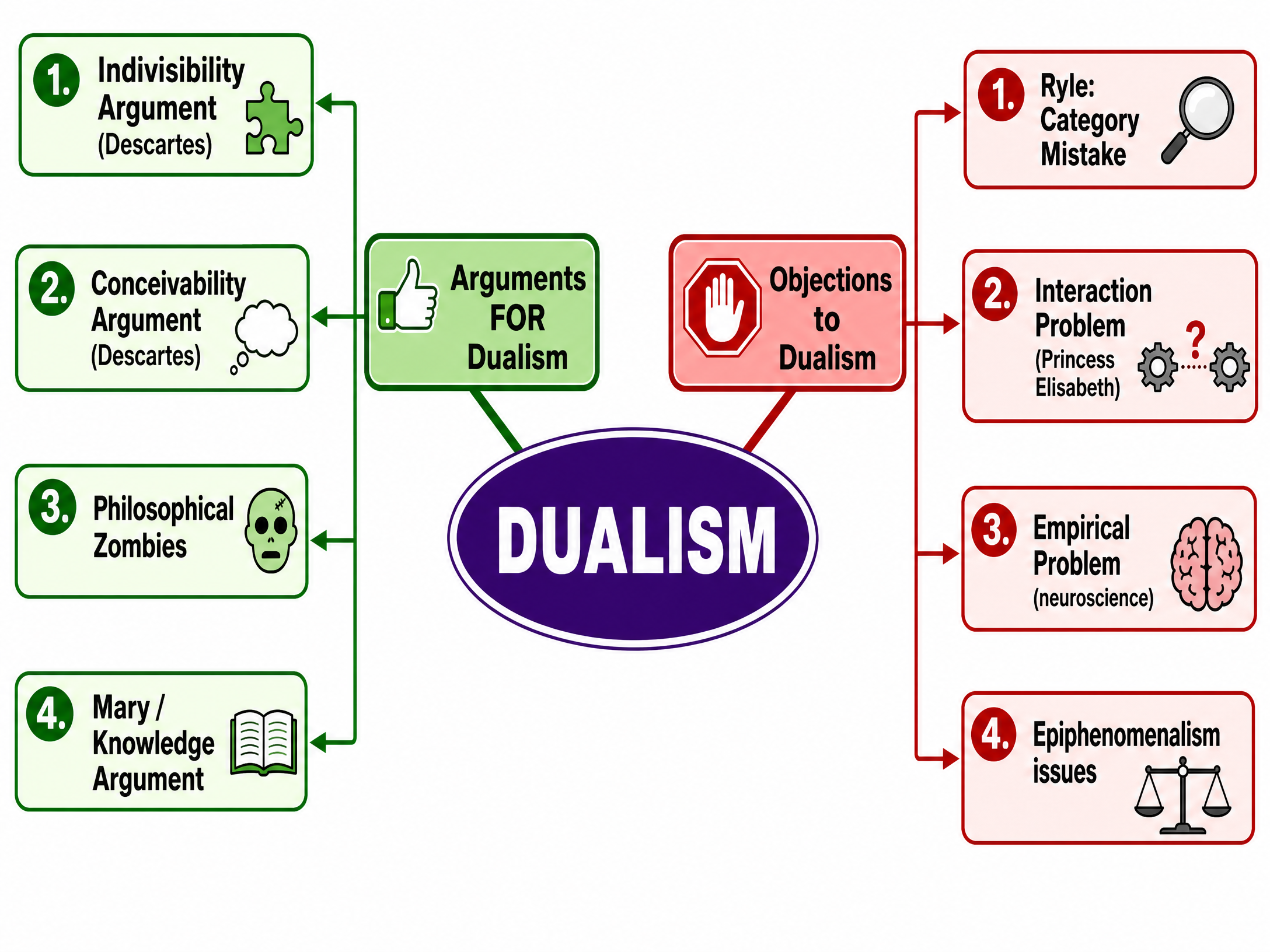
- Indivisibility Argument: The body is spatially extended and therefore divisible (you can lose a limb). The mind is not extended and seems indivisible (you cannot have half a consciousness). By Leibniz's Law, if they have different properties, they must be distinct substances.
- Conceivability Argument: Descartes argued he could clearly and distinctly conceive of his mind existing without his body, but not vice versa. Therefore, it is metaphysically possible for them to exist separately, meaning they are distinct substances.
Property Dualism
Proponents: David Chalmers, Frank Jackson
What it is: The view that there is only one kind of substance (the physical), but it can possess two distinct kinds of properties: physical properties and mental properties. Mental properties (qualia) are irreducible to and do not supervene purely upon physical properties.
Why it matters: It represents a modern response to physicalism, attempting to account for the subjective 'feel' of consciousness without positing a non-physical soul.
Specific Knowledge:
- Philosophical Zombies Argument (Chalmers): We can conceive of a being physically identical to a human but entirely lacking conscious experience (qualia). Since this is conceivable, it is metaphysically possible, proving that consciousness is not identical to physical properties.
- Knowledge/Mary Argument (Jackson): Mary knows all physical facts about colour vision but has never seen colour. When she sees a red tomato, she learns something new (what it is like to see red). Therefore, physical facts do not exhaust all facts; mental facts exist.
Key Objections & Responses
The Problem of Other Minds
If the mind is non-physical or private, how do we know other people have minds?
- Argument from Analogy: I know my mental states cause my behaviour. I see others behaving similarly, so I infer they have similar mental states. (Weakness: relies on a single case).
- Best Hypothesis: The existence of other minds is the best explanation for the complex, flexible behaviour of other human beings.
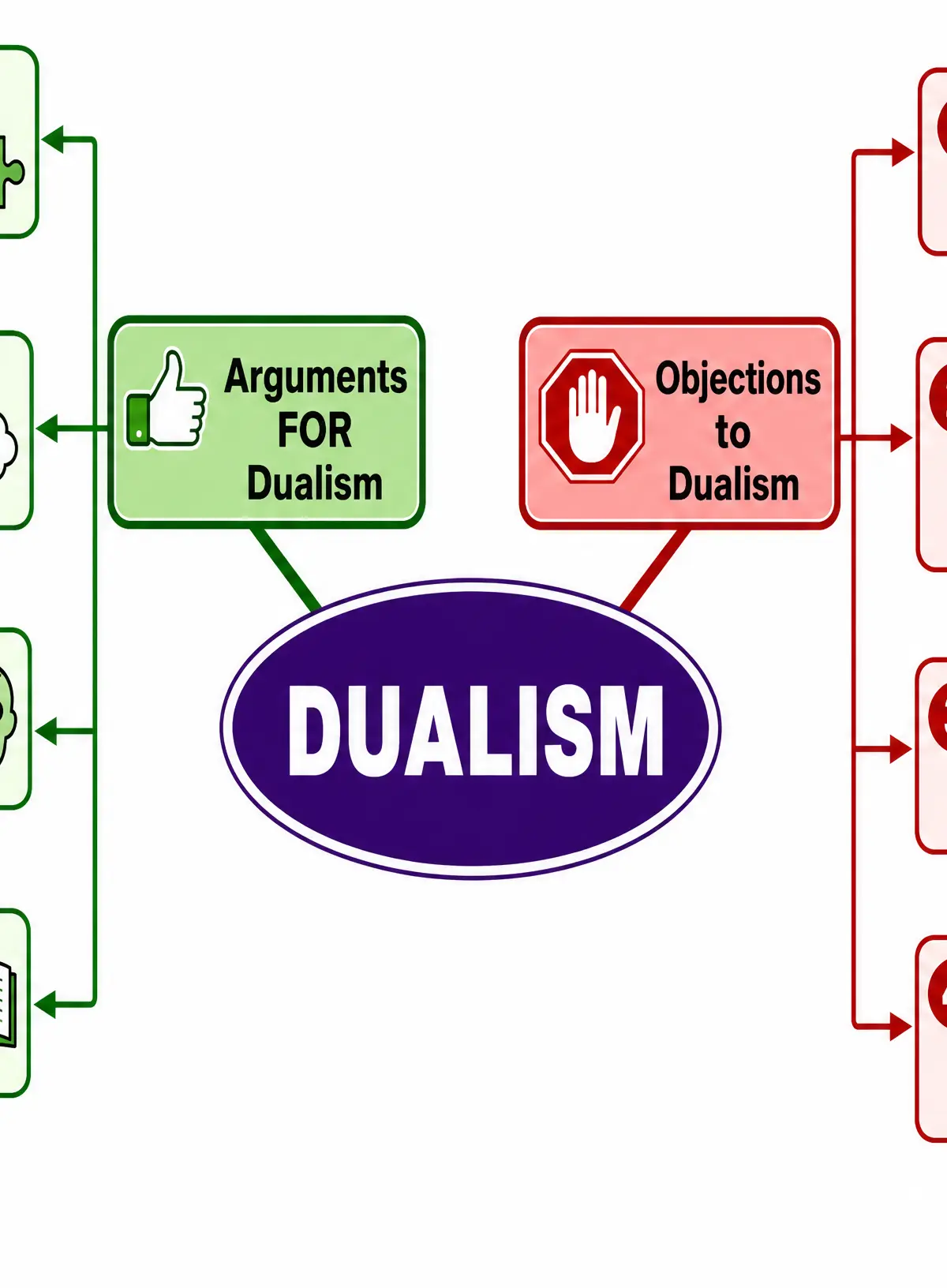
Objections to Dualism
- Category Mistake (Gilbert Ryle, 1949): Ryle argued substance dualists wrongly treat the mind as a separate 'thing' alongside the body, rather than understanding mental terms as referring to behavioural dispositions. Crucial Note: This targets Substance Dualism, not Property Dualism.
- Interaction Problem (Princess Elisabeth, 1643): How can a non-physical mind with no spatial location causally interact with a physical body? (Conceptual problem). Furthermore, neuroscience shows tight correlations between brain events and mental events, contradicting the idea of independence (Empirical problem).
- Epiphenomenalism Challenges: If mental states are caused by the brain but cause nothing themselves (epiphenomenalism), how do we have introspective knowledge of them? And why would evolution select for consciousness if it has no causal power?
Source Skills
When tackling extract-based questions in philosophy, identify the core argument immediately. Is the author arguing for or against dualism? Look for premise-conclusion structures. For example, if an extract discusses 'conceivability', identify whether it is Descartes' argument for substance dualism or Chalmers' zombie argument for property dualism.
Visual Resources
2 diagrams and illustrations
Interactive Diagrams
1 interactive diagram to visualise key concepts
Conceptual Flow Outline
The Two Forms of Dualism
Worked Examples
3 worked examples — open one to explore the question and available guidance.
Practice Questions
Test your understanding — click to reveal model answers
Evaluate the claim that the mind is a separate substance from the body. (12 marks)
Hint: Focus on Substance Dualism. Use Descartes' arguments and counter them with Ryle or Elisabeth of Bohemia.
Outline Ryle's 'category mistake' objection. (5 marks)
Hint: Use the university analogy.
Explain Frank Jackson's Knowledge Argument (Mary's Room). (5 marks)
Hint: Focus on what Mary knows before leaving the room and what she learns after.
Explain the difference between Substance Dualism and Property Dualism. (3 marks)
Hint: Focus on the number of substances versus the number of properties.
Outline the 'best hypothesis' response to the problem of other minds. (3 marks)
Hint: Think about abductive reasoning and scientific explanations.
Test your understanding of Metaphysics of mind
Active recall beats re-reading. Take an instant quiz now to test what you’ve learned and lock it into long-term memory.
7 days Premium · Then free forever · No card, no charge