AQA · A-Level · Physical Education
Course version: 7582 · Version from Sept 2016
Achievement motivation theory: Atkinson’s Model of achievement motivation.
Atkinson's model explains achievement motivation as the tendency to strive for success and to avoid failure.
Checked against the AQA 7582 specification (opens in a new tab) on .
- Point 1 of 8
- 4 key terms
Study notes
From the checked teaching notes for this specification point.
The idea
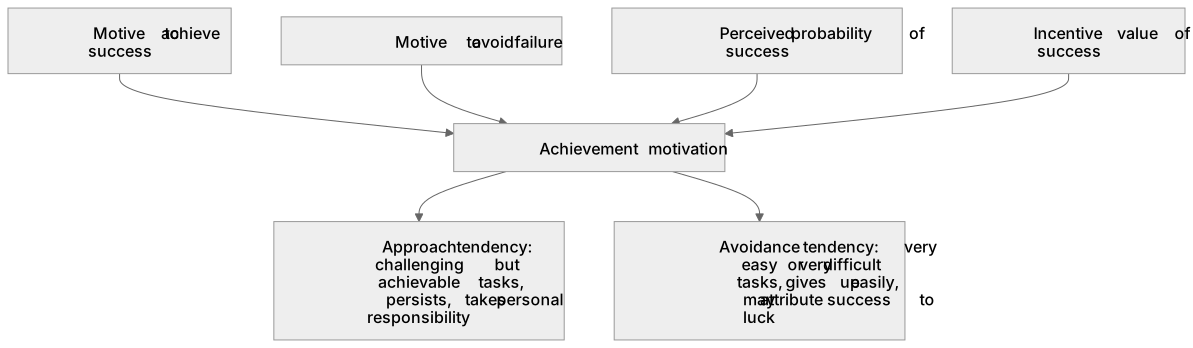
Atkinson's model explains achievement motivation as the tendency to strive for success and to avoid failure. It combines two opposing motives: the motive to achieve success and the motive to avoid failure. These interact with the perceived probability of success and the incentive value of success. A performer with a high motive to achieve success tends to choose challenging but achievable tasks, persists when difficulty arises and takes personal responsibility for outcomes. A performer with a high motive to avoid failure tends to choose very easy or very difficult tasks, gives up easily when challenged and may attribute success to luck. The model helps explain why some athletes seek competition while others avoid it, and how coaches can set tasks to develop approach tendencies.
What earns the marks
- Atkinson's model describes achievement motivation as the product of the motive to achieve success and the motive to avoid failure.
- The tendency to approach success is influenced by the perceived probability of success and the incentive value of that success.
- A performer with a high motive to achieve success (approach tendency) tends to select challenging but attainable tasks and persists in the face of difficulty.
- A performer with a high motive to avoid failure (avoidance tendency) tends to select very easy or very difficult tasks and may give up easily when challenged.
- The model predicts that individuals with a strong approach tendency are more likely to take personal responsibility for their performance and to seek competitive situations.
- Coaches can use the model by setting realistic but challenging goals and providing success experiences to strengthen the motive to achieve success.
Common mistakes and how to put them right
Misunderstanding: Atkinson's model states that motivation is only about the desire to succeed.
Put it right: The model includes both the motive to achieve success and the motive to avoid failure, which interact.
Misunderstanding: a performer with a high motive to avoid failure will always choose the hardest tasks.
Put it right: Such a performer may choose very easy tasks to guarantee success or very difficult tasks to excuse failure, but not consistently the hardest.
Misunderstanding: the model ignores situational factors.
Put it right: The model includes the perceived probability of success and the incentive value of success, which are situational.
Misunderstanding: achievement motivation is fixed and cannot change.
Put it right: The balance between approach and avoidance tendencies can be influenced by experience and coaching.
Exam tips
- When applying the model, state both the motive to achieve success and the motive to avoid failure, and explain how they interact with the probability and incentive of success.
- Use examples to show how a performer with a high approach tendency behaves differently from one with a high avoidance tendency in a specific sporting situation.
- Avoid simply listing the components; explain how they combine to predict task choice, effort and persistence.
Try the lesson
The start of the Achievement motivation theory: Atkinson’s Model of achievement motivation. lesson, made from checked teaching notes for this specification point.
Have a go first
In Atkinson's model of achievement motivation, what does the term need to achieve describe?
Listen
Atkinson's model explains achievement motivation as the tendency to strive for success and to avoid failure. It combines two opposing motives: the motive to achieve success and the motive to avoid failure. These interact with the perceived probability of success and the incentive value of success. A performer with a high motive to achieve success tends to choose challenging but achievable tasks, persists when difficulty arises and takes personal responsibility for outcomes. A performer with a high motive to avoid failure tends to choose very easy or very difficult tasks, gives up easily when challenged and may attribute success to luck. The model helps explain why some athletes seek competition while others avoid it, and how coaches can set tasks to develop approach tendencies. A strong answer earns marks for these points. Atkinson's model describes achievement motivation as the product of the motive to achieve success and the motive to avoid failure. The tendency to approach success is influenced by the perceived probability of success and the incentive value of that success. A performer with a high motive to achieve success (approach tendency) tends to select challenging but attainable tasks and persists in the face of difficulty. A performer with a high motive to avoid failure (avoidance tendency) tends to select very easy or very difficult tasks and may give up easily when challenged. A common slip: Misunderstanding: Atkinson's model states that motivation is only about the desire to succeed. Instead, the model includes both the motive to achieve success and the motive to avoid failure, which interact. Exam tip: When applying the model, state both the motive to achieve success and the motive to avoid failure, and explain how they interact with the probability and incentive of success.
See it
Key words
Say what each word means before you turn the card.
Motive to achieve success
Try answering aloud or in your head before turning the card.
Motive to avoid failure
Try answering aloud or in your head before turning the card.
Probability of success
Try answering aloud or in your head before turning the card.
Incentive value of success
Try answering aloud or in your head before turning the card.
See every definition
- Motive to achieve success
- One of two opposing motives in the model, it is the tendency to strive for success.
- Motive to avoid failure
- The opposing motive that is the tendency to avoid failure.
- Probability of success
- A situational factor, the perceived probability of success, with which the two motives interact.
- Incentive value of success
- A situational factor, the incentive value of success, with which the two motives interact.
Label the diagram
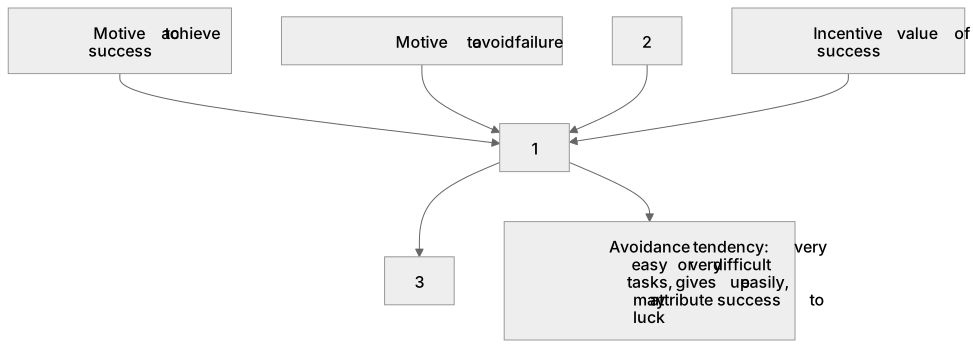
Some boxes have lost their names. Pick the right name for each number.
1Box 1
2Box 2
3Box 3
There is more to this lesson
The full lesson goes on to check your understanding and help you earn the marks. Create a free account to carry on, with your progress saved.
A week of Premium from your first lesson · Then the free plan continues · No card, no charge
Test your understanding of Achievement motivation theory: Atkinson’s Model of achievement motivation.
Active recall beats re-reading. Take an instant quiz now to test what you’ve learned and lock it into long-term memory.
A week of Premium from your first lesson · Then the free plan continues · No card, no charge