AQA · A-Level · Physical Education
Course version: 7582 · Version from Sept 2016
Students should develop knowledge and understanding of the changes within…
Full specification wording
Applied anatomy and physiology: Students should develop knowledge and understanding of the changes within the body systems prior to exercise, during exercise of differing intensities and during recovery.
This section builds a three-phase model of how the body responds to physical activity.
Checked against the AQA 7582 specification (opens in a new tab) on .
- 4 key terms
Study notes
From the checked teaching notes for this specification point.
The idea
This section builds a three-phase model of how the body responds to physical activity. Before exercise, anticipatory responses raise heart rate, stroke volume, ventilation and muscle blood flow through sympathetic stimulation and adrenaline release. During exercise, intensity determines the scale of change: at low intensity, cardiac output rises mainly through stroke volume, while at high intensity heart rate contributes more; ventilation increases through greater tidal volume and frequency; and the musculo-skeletal, cardio-respiratory and neuro-muscular systems adjust together. During recovery, heart rate, ventilation and blood lactate fall at different rates, with excess post-exercise oxygen consumption restoring oxygen stores and removing by-products. Learn each variable, its direction of change and the mechanism causing it.
What earns the marks
- Identifies that anticipatory (pre-exercise) changes include increased heart rate, stroke volume, ventilation and redirected blood flow, driven by sympathetic activity and adrenaline.
- Explains that during exercise of differing intensities, cardiac output increases, with stroke volume dominating at lower intensities and heart rate contributing more as intensity rises.
- Describes respiratory changes during exercise: increased tidal volume and breathing frequency raise pulmonary ventilation and oxygen uptake.
- States that during recovery, heart rate and ventilation decline gradually, oxygen debt or excess post-exercise oxygen consumption repays oxygen deficit and lactate is removed.
- Distinguishes the roles of the musculo-skeletal, cardio-respiratory and neuro-muscular systems in producing and supporting movement at each phase.
Common mistakes and how to put them right
Thinking heart rate returns to resting level immediately exercise stops.
Put it right: In fact it declines gradually, and the rate of decline depends on fitness and exercise intensity.
Confusing cardiac output with stroke volume.
Put it right: Cardiac output is the product of heart rate and stroke volume, so it is always the larger quantity.
Assuming ventilation increases only by breathing faster.
Put it right: Tidal volume also rises substantially, especially at moderate intensity.
Believing lactate is the sole cause of fatigue.
Put it right: Hydrogen ion accumulation and other metabolic factors also contribute.
Exam tips
- For multiple-choice items, eliminate options that reverse the direction of change, such as claiming stroke volume falls during exercise.
- Check whether the question specifies pre-exercise, during exercise or recovery, because the correct response differs by phase.
- Use the relationship cardiac output = heart rate × stroke volume to test whether a numerical option is plausible.
- Read the intensity qualifier carefully: low, moderate and maximal exercise produce different dominant mechanisms.
Try the lesson
The start of the Applied anatomy and physiology: Students should develop knowledge and understanding of the changes within the body systems prior to exercise, during exercise of differing intensities and during recovery. lesson, made from checked teaching notes for this specification point.
Have a go first
Which change occurs in the body systems before exercise begins, as the performer anticipates the physical demand?
Listen
This section builds a three-phase model of how the body responds to physical activity. Before exercise, anticipatory responses raise heart rate, stroke volume, ventilation and muscle blood flow through sympathetic stimulation and adrenaline release. During exercise, intensity determines the scale of change: at low intensity, cardiac output rises mainly through stroke volume, while at high intensity heart rate contributes more; ventilation increases through greater tidal volume and frequency; and the musculo-skeletal, cardio-respiratory and neuro-muscular systems adjust together. During recovery, heart rate, ventilation and blood lactate fall at different rates, with excess post-exercise oxygen consumption restoring oxygen stores and removing by-products. Learn each variable, its direction of change and the mechanism causing it. A strong answer earns marks for these points. Identifies that anticipatory (pre-exercise) changes include increased heart rate, stroke volume, ventilation and redirected blood flow, driven by sympathetic activity and adrenaline. Explains that during exercise of differing intensities, cardiac output increases, with stroke volume dominating at lower intensities and heart rate contributing more as intensity rises. Describes respiratory changes during exercise: increased tidal volume and breathing frequency raise pulmonary ventilation and oxygen uptake. States that during recovery, heart rate and ventilation decline gradually, oxygen debt or excess post-exercise oxygen consumption repays oxygen deficit and lactate is removed. Exam tip: For multiple-choice items, eliminate options that reverse the direction of change, such as claiming stroke volume falls during exercise.
See it
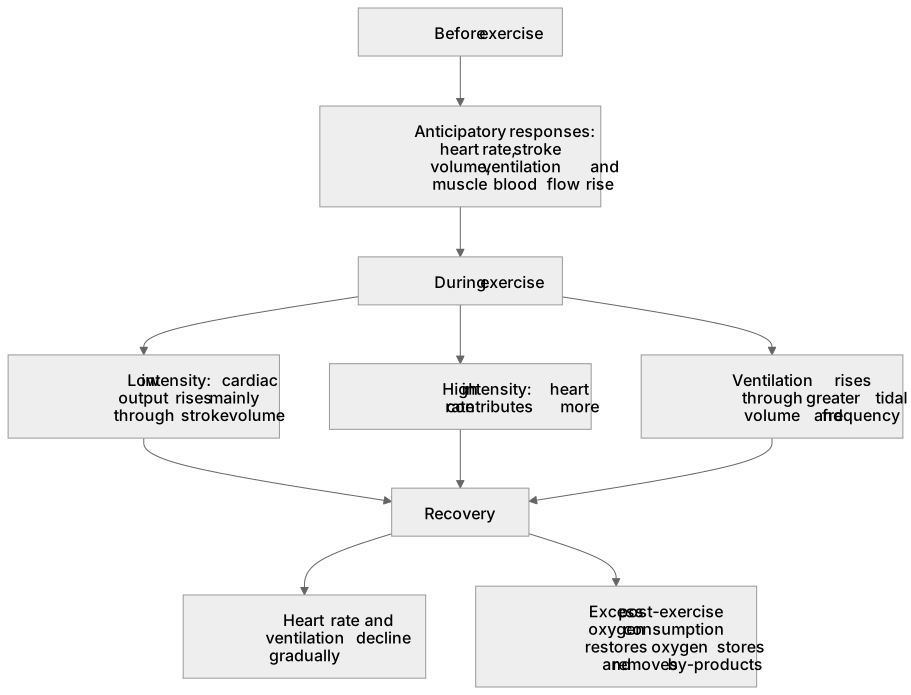
Watch it explained
What is the one idea the video explains? Say it in a sentence.
Read the described scene instead
This lesson builds a three-phase model of how the body responds to physical activity: before exercise, during exercise of differing intensities, and during recovery. Each phase changes heart rate, stroke volume, ventilation and blood flow in different ways. Before exercise, anticipatory responses raise heart rate, stroke volume, ventilation and muscle blood flow. These changes are driven by sympathetic stimulation and adrenaline release. This prepares the cardio-respiratory and musculo-skeletal systems for the demand ahead. During exercise, intensity determines the scale of change. Cardiac output increases. At low intensity, stroke volume contributes more to the rise; at high intensity, heart rate contributes more. Ventilation rises through greater tidal volume and breathing frequency, raising pulmonary ventilation and oxygen uptake. The musculo-skeletal, cardio-respiratory and neuro-muscular systems adjust together. Common mistakes to avoid: stroke volume does not fall during exercise. Do not think heart rate returns to resting level immediately exercise stops; it declines gradually, depending on fitness and exercise intensity. Cardiac output is not the same as stroke volume: cardiac output equals heart rate multiplied by stroke volume, so it is the larger quantity. Ventilation does not rise only by breathing faster; tidal volume also rises substantially, especially at moderate intensity. Lactate is not the sole cause of fatigue; hydrogen ion accumulation and other metabolic factors also contribute. During recovery, heart rate, ventilation and blood lactate fall at different rates. Excess post-exercise oxygen consumption restores oxygen stores and removes by-products. Heart rate does not return to resting level immediately; its decline depends on fitness and exercise intensity. This gradual process restores homeostasis. Remember the phase first. Before exercise, anticipatory sympathetic and adrenaline responses raise heart rate, stroke volume, ventilation and muscle blood flow. During exercise, intensity shapes the response: stroke volume dominates at low intensity, heart rate contributes more at high intensity, and ventilation rises through tidal volume and frequency. During recovery, heart rate and ventilation decline gradually, and EPOC restores oxygen stores and removes by-products.
Key words
Say what each word means before you turn the card.
Anticipatory responses before exercise
Try answering aloud or in your head before turning the card.
Intensity-dependent changes during exercise
Try answering aloud or in your head before turning the card.
Cardio-respiratory adjustments
Try answering aloud or in your head before turning the card.
Recovery and restoration of homeostasis
Try answering aloud or in your head before turning the card.
See every definition
- Anticipatory responses before exercise
- Before exercise, heart rate, stroke volume, ventilation and muscle blood flow are raised through sympathetic stimulation and adrenaline release.
- Intensity-dependent changes during exercise
- During exercise, intensity determines the scale of change, with stroke volume dominating cardiac output at low intensity and heart rate contributing more at high intensity.
- Cardio-respiratory adjustments
- During exercise, ventilation increases through greater tidal volume and frequency, while cardiac output rises and the musculo-skeletal, cardio-respiratory and neuro-muscular systems adjust together.
- Recovery and restoration of homeostasis
- During recovery, heart rate, ventilation and blood lactate fall at different rates, with excess post-exercise oxygen consumption restoring oxygen stores and removing by-products.
Label the diagram
Some boxes have lost their names. Pick the right name for each number.
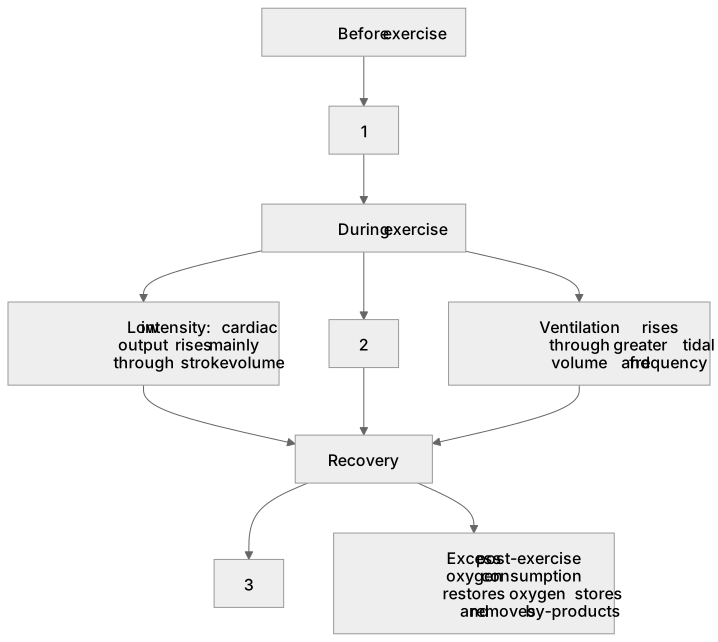
1Box 1
2Box 2
3Box 3
There is more to this lesson
The full lesson goes on to check your understanding and help you earn the marks. Create a free account to carry on, with your progress saved.
A week of Premium from your first lesson · Then the free plan continues · No card, no charge
Test your understanding of Applied anatomy and physiology: Students should develop knowledge and understanding of the changes within the body systems prior to exercise, during exercise of differing intensities and during recovery.
Active recall beats re-reading. Take an instant quiz now to test what you’ve learned and lock it into long-term memory.
A week of Premium from your first lesson · Then the free plan continues · No card, no charge