AQA · A-Level · Physical Education
Course version: 7582 · Version from Sept 2016
Strategies to avoid learned helplessness leading to improvements in…
Full specification wording
Attribution theory: Strategies to avoid learned helplessness leading to improvements in performance.
Learned helplessness develops when a performer repeatedly attributes failure to stable, internal and uncontrollable causes, such as lack of ability, and then stops trying.
Checked against the AQA 7582 specification (opens in a new tab) on .
- Point 8 of 8
- 3 key terms
Study notes
From the checked teaching notes for this specification point.
The idea
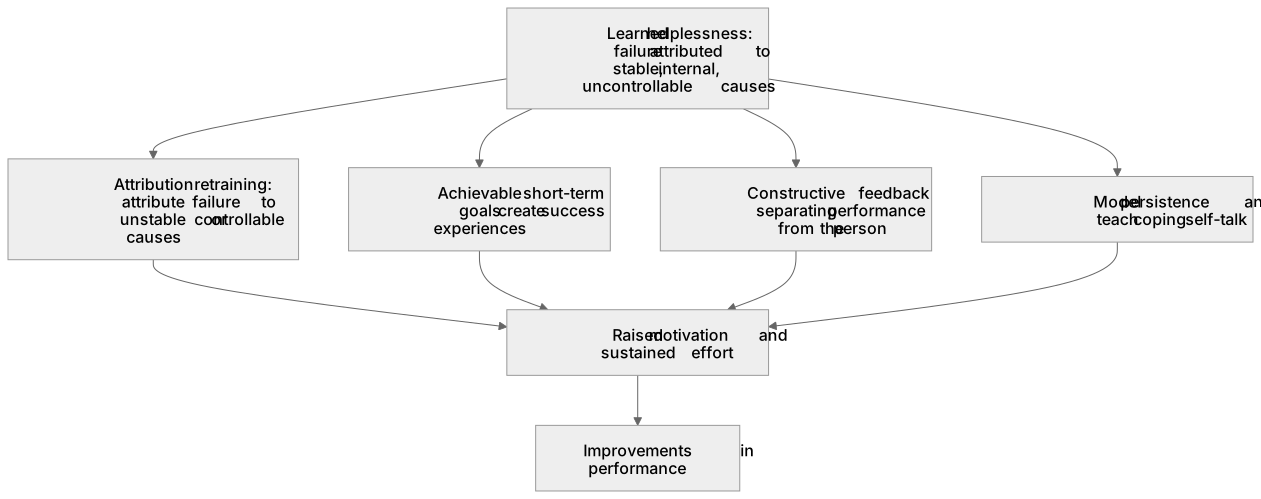
Learned helplessness develops when a performer repeatedly attributes failure to stable, internal and uncontrollable causes, such as lack of ability, and then stops trying. Strategies to avoid it aim to change those attributions and rebuild control. Attribution retraining encourages performers to attribute failure to unstable or controllable causes, such as insufficient effort or a poor tactical choice, so they believe improvement is possible. Setting achievable short-term goals creates success experiences that challenge the belief that effort is pointless. Coaches can also provide constructive feedback that separates the performance from the person, model persistence, and teach coping self-talk. Together these strategies raise motivation, sustain effort and lead to improvements in performance.
What earns the marks
- Learned helplessness is a state in which a performer repeatedly attributes failure to stable, internal and uncontrollable causes and stops trying.
- Attribution retraining encourages performers to attribute failure to unstable or controllable causes, such as insufficient effort or a poor tactical choice.
- Setting achievable short-term goals creates success experiences that challenge the belief that effort is pointless.
- Constructive feedback that separates the performance from the person helps performers maintain self-belief and persist.
- Modelling persistence and teaching coping self-talk give performers strategies to manage setbacks and sustain effort.
Common mistakes and how to put them right
Believing that learned helplessness is simply low motivation.
Put it right: It is a specific attribution pattern in which failure is explained by stable, internal and uncontrollable causes, leading to reduced effort.
Thinking that attributing failure to lack of ability is helpful because it is honest.
Put it right: Stable and uncontrollable attributions such as lack of ability increase helplessness, so retraining should redirect attention to controllable or unstable causes.
Assuming that one success will remove learned helplessness permanently.
Put it right: Repeated success experiences and consistent attribution retraining are needed to change established beliefs.
Confusing attribution retraining with ignoring failure.
Put it right: Retraining acknowledges failure but changes the explanation to one that supports future effort and improvement.
Exam tips
- Link each strategy to a change in attribution, such as moving from ability to effort, and then to the resulting improvement in performance.
- Use the terms stable, unstable, internal, external, controllable and uncontrollable accurately when explaining why a strategy works.
- Apply strategies to a realistic sporting example, such as a gymnast who keeps falling on a vault, to show how helplessness is reduced and performance improves.
Try the lesson
The start of the Attribution theory: Strategies to avoid learned helplessness leading to improvements in performance. lesson, made from checked teaching notes for this specification point.
Have a go first
A gymnast who has repeatedly failed a vault begins to believe that no amount of effort will change the outcome. Which coaching strategy is most likely to reduce this learned helplessness?
Listen
Learned helplessness develops when a performer repeatedly attributes failure to stable, internal and uncontrollable causes, such as lack of ability, and then stops trying. Strategies to avoid it aim to change those attributions and rebuild control. Attribution retraining encourages performers to attribute failure to unstable or controllable causes, such as insufficient effort or a poor tactical choice, so they believe improvement is possible. Setting achievable short-term goals creates success experiences that challenge the belief that effort is pointless. Coaches can also provide constructive feedback that separates the performance from the person, model persistence, and teach coping self-talk. Together these strategies raise motivation, sustain effort and lead to improvements in performance. A strong answer earns marks for these points. Learned helplessness is a state in which a performer repeatedly attributes failure to stable, internal and uncontrollable causes and stops trying. Attribution retraining encourages performers to attribute failure to unstable or controllable causes, such as insufficient effort or a poor tactical choice. Setting achievable short-term goals creates success experiences that challenge the belief that effort is pointless. Constructive feedback that separates the performance from the person helps performers maintain self-belief and persist. A common slip: Believing that learned helplessness is simply low motivation. Instead, it is a specific attribution pattern in which failure is explained by stable, internal and uncontrollable causes, leading to reduced effort. Exam tip: Link each strategy to a change in attribution, such as moving from ability to effort, and then to the resulting improvement in performance.
See it
Key words
Say what each word means before you turn the card.
Learned helplessness
Try answering aloud or in your head before turning the card.
Attribution retraining
Try answering aloud or in your head before turning the card.
Goal setting
Try answering aloud or in your head before turning the card.
See every definition
- Learned helplessness
- A state in which a performer repeatedly attributes failure to stable, internal and uncontrollable causes and stops trying.
- Attribution retraining
- Encourages performers to attribute failure to unstable or controllable causes, such as insufficient effort or a poor tactical choice, so they believe improvement is possible.
- Goal setting
- Setting achievable short-term goals creates success experiences that challenge the belief that effort is pointless.
Label the diagram
Some boxes have lost their names. Pick the right name for each number.
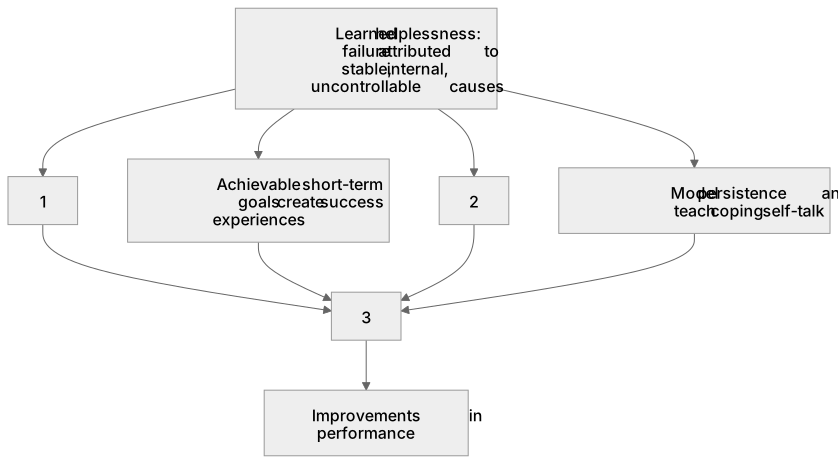
1Box 1
2Box 2
3Box 3
There is more to this lesson
The full lesson goes on to check your understanding and help you earn the marks. Create a free account to carry on, with your progress saved.
A week of Premium from your first lesson · Then the free plan continues · No card, no charge
Test your understanding of Attribution theory: Strategies to avoid learned helplessness leading to improvements in performance.
Active recall beats re-reading. Take an instant quiz now to test what you’ve learned and lock it into long-term memory.
A week of Premium from your first lesson · Then the free plan continues · No card, no charge