AQA · A-Level · Physical Education
Course version: 7582 · Version from Sept 2016
Students should have a knowledge and use of biomechanical definitions,…
Full specification wording
Biomechanical movement: Students should have a knowledge and use of biomechanical definitions, equations, formulae and units of measurement and demonstrate the ability to plot, label and interpret biomechanical graphs and diagrams.
This section requires you to know and apply biomechanical definitions, equations, formulae and units, and to plot, label and interpret graphs and diagrams.
Checked against the AQA 7582 specification (opens in a new tab) on .
- 4 key terms
Study notes
From the checked teaching notes for this specification point.
The idea
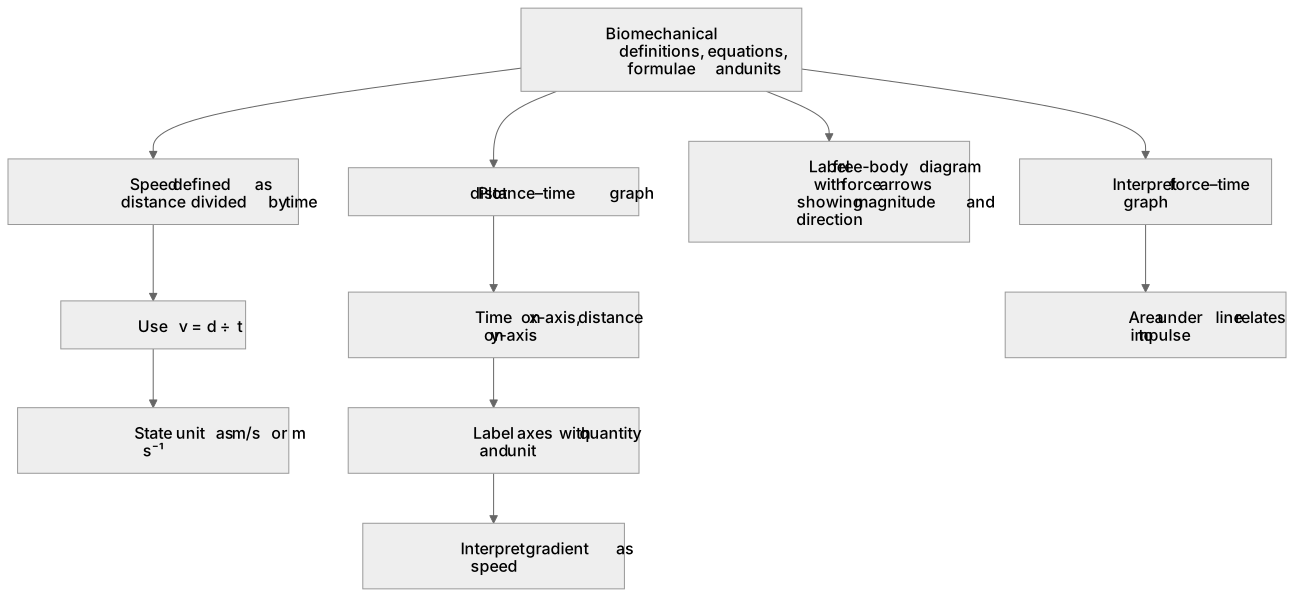
This section requires you to know and apply biomechanical definitions, equations, formulae and units, and to plot, label and interpret graphs and diagrams. For example, define speed as distance divided by time, use v = d ÷ t, and give the unit as m/s or m s⁻¹. You must plot a distance–time graph with time on the x-axis, label both axes with quantity and unit, and interpret the gradient as speed. Similarly, label a free-body diagram with force arrows showing magnitude and direction, and interpret a force–time graph by relating the area under the line to impulse.
What earns the marks
- Define biomechanical quantities correctly, for example speed as distance divided by time, and state the correct SI unit such as m/s or m s⁻¹.
- Use equations and formulae accurately, for example v = d ÷ t, and rearrange them correctly to find an unknown.
- Plot graphs with the independent variable on the x-axis and the dependent variable on the y-axis, using appropriate scales.
- Label axes with both the quantity and its unit, for example 'Time (s)' and 'Distance (m)'.
- Interpret the gradient of a distance–time graph as speed and the area under a force–time graph as impulse.
- Interpret biomechanical diagrams, such as free-body diagrams, by identifying force arrows with correct magnitude and direction.
Common mistakes and how to put them right
Omitting units entirely when stating a final answer.
Put it right: Include valid units like m/s or m s⁻¹.
Plotting the independent variable on the y-axis.
Put it right: The independent variable belongs on the x-axis.
Labelling axes with only the quantity or only the unit.
Put it right: Both are required, for example 'Force (N)'.
Assuming the gradient of any graph represents the same quantity.
Put it right: The gradient's meaning depends on the variables plotted.
Exam tips
- In MCQs, check the unit carefully: both m/s and m s⁻¹ are acceptable, but ensure the correct quantity is matched to its unit.
- When interpreting a graph, first identify what the gradient and area represent before selecting an answer.
- For labelling questions, always write the quantity and unit in brackets, for example 'Velocity (m/s)'.
Try the lesson
The start of the Biomechanical movement: Students should have a knowledge and use of biomechanical definitions, equations, formulae and units of measurement and demonstrate the ability to plot, label and interpret biomechanical graphs and diagrams. lesson, made from checked teaching notes for this specification point.
Have a go first
Which SI unit is used to measure force in biomechanical calculations?
Listen
This section requires you to know and apply biomechanical definitions, equations, formulae and units, and to plot, label and interpret graphs and diagrams. For example, define speed as distance divided by time, use v = d ÷ t, and give the unit as m/s or m s⁻¹. You must plot a distance–time graph with time on the x-axis, label both axes with quantity and unit, and interpret the gradient as speed. Similarly, label a free-body diagram with force arrows showing magnitude and direction, and interpret a force–time graph by relating the area under the line to impulse. A strong answer earns marks for these points. Define biomechanical quantities correctly, for example speed as distance divided by time, and state the correct SI unit such as m/s or m s⁻¹. Use equations and formulae accurately, for example v = d ÷ t, and rearrange them correctly to find an unknown. Plot graphs with the independent variable on the x-axis and the dependent variable on the y-axis, using appropriate scales. Label axes with both the quantity and its unit, for example 'Time (s)' and 'Distance (m)'. Exam tip: In MCQs, check the unit carefully: both m/s and m s⁻¹ are acceptable, but ensure the correct quantity is matched to its unit.
See it
Key words
Say what each word means before you turn the card.
Biomechanical definitions and units
Try answering aloud or in your head before turning the card.
Equations and formulae
Try answering aloud or in your head before turning the card.
Graph plotting and labelling
Try answering aloud or in your head before turning the card.
Graph and diagram interpretation
Try answering aloud or in your head before turning the card.
See every definition
- Biomechanical definitions and units
- Knowledge and use of biomechanical definitions together with their units of measurement, for example speed defined as distance divided by time with the unit m/s or m s⁻¹.
- Equations and formulae
- Using equations and formulae accurately, for example v = d ÷ t, and rearranging them correctly to find an unknown.
- Graph plotting and labelling
- Plotting graphs with the independent variable on the x-axis and the dependent variable on the y-axis using appropriate scales, and labelling axes with both the quantity and its unit.
- Graph and diagram interpretation
- Interpreting the gradient of a distance–time graph as speed, the area under a force–time graph as impulse, and force arrows in free-body diagrams with correct magnitude and direction.
Label the diagram
Some boxes have lost their names. Pick the right name for each number.
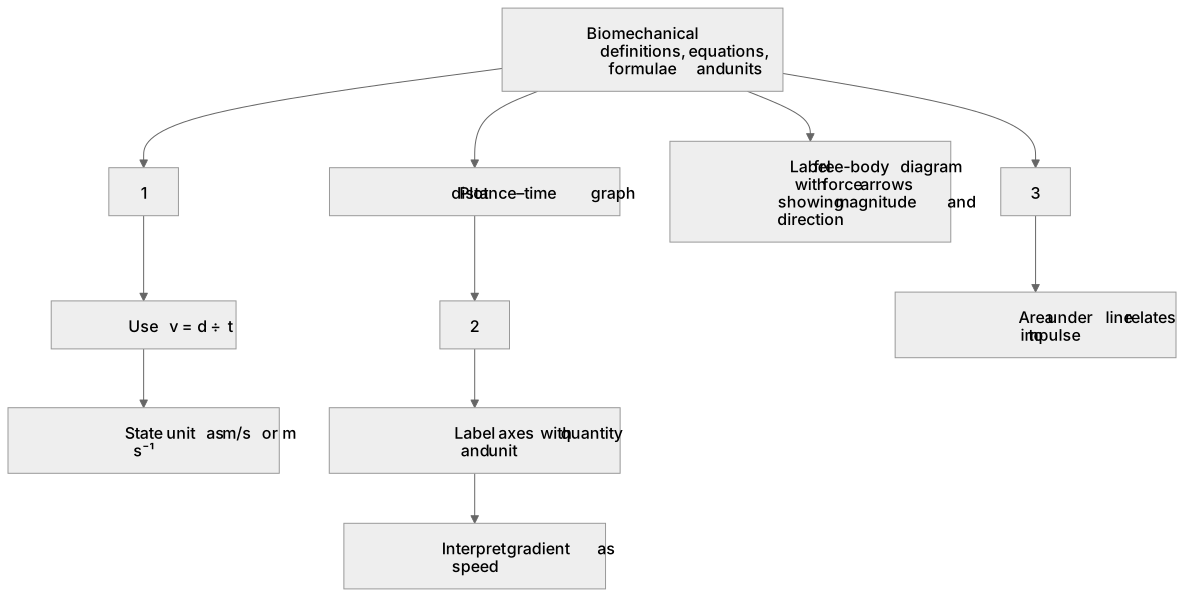
1Box 1
2Box 2
3Box 3
There is more to this lesson
The full lesson goes on to check your understanding and help you earn the marks. Create a free account to carry on, with your progress saved.
A week of Premium from your first lesson · Then the free plan continues · No card, no charge
Test your understanding of Biomechanical movement: Students should have a knowledge and use of biomechanical definitions, equations, formulae and units of measurement and demonstrate the ability to plot, label and interpret biomechanical graphs and diagrams.
Active recall beats re-reading. Take an instant quiz now to test what you’ve learned and lock it into long-term memory.
A week of Premium from your first lesson · Then the free plan continues · No card, no charge