AQA · A-Level · Physical Education
Course version: 7582 · Version from Sept 2016
Definitions, equations and units of example scalars.
Full specification wording
Biomechanical principles: Definitions, equations and units of example scalars.
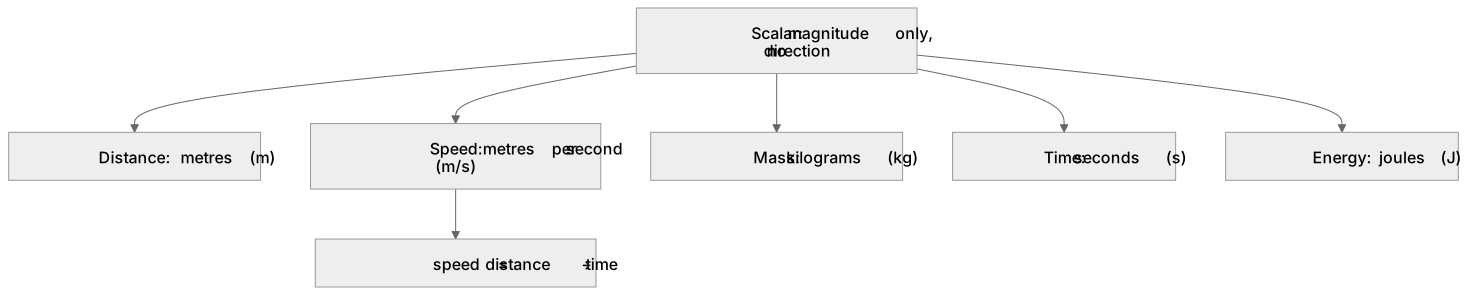
A scalar is a quantity with magnitude (size) only and no direction, unlike a vector which has both magnitude and direction.
Checked against the AQA 7582 specification (opens in a new tab) on .
- Point 3 of 7
- 4 key terms
Study notes
From the checked teaching notes for this specification point.
The idea
A scalar is a quantity with magnitude (size) only and no direction, unlike a vector which has both magnitude and direction. Example scalars in biomechanics include distance, speed, mass, time and energy. Distance is how far a performer travels along a path, measured in metres (m); speed is distance divided by time, speed = distance ÷ time, measured in metres per second (m/s); mass is the amount of matter in a body, measured in kilograms (kg); time is measured in seconds (s); and energy is measured in joules (J). Because scalars have no direction, a 400 m runner who returns to the start has covered a distance of 400 m even though displacement is zero.
What earns the marks
- A scalar is a quantity with magnitude only and no direction, whereas a vector has both magnitude and direction.
- Distance is the total length of the path travelled, measured in metres (m).
- Speed is the rate of change of distance, given by speed = distance ÷ time, measured in metres per second (m/s).
- Mass is the quantity of matter in a body, measured in kilograms (kg), and time is measured in seconds (s).
- Energy is a scalar measured in joules (J), and recognising which quantities are scalars helps select the correct equation and unit.
Common mistakes and how to put them right
Treating speed as a vector.
Put it right: Speed is a scalar with magnitude only, while velocity is the vector that also states direction.
Using the wrong unit for a scalar, such as giving speed in metres.
Put it right: Speed is measured in metres per second (m/s).
Confusing distance with displacement.
Put it right: Distance is a scalar path length in metres, while displacement is a vector with direction.
Rearranging speed = distance ÷ time incorrectly, for example multiplying distance by time.
Put it right: Divide distance by time to find speed.
Exam tips
- Identify whether the quantity in the stem is a scalar or a vector before selecting an option, since direction is the deciding feature.
- Match each scalar to its unit: distance in metres (m), speed in metres per second (m/s), mass in kilograms (kg), time in seconds (s) and energy in joules (J).
- For any calculation, write the equation first, such as speed = distance ÷ time, then substitute the values with units.
- Check that your answer's unit matches the quantity asked for, because a correct number with the wrong unit is still wrong.
Try the lesson
The start of the Biomechanical principles: Definitions, equations and units of example scalars. lesson, made from checked teaching notes for this specification point.
Have a go first
Which of the following quantities is a scalar, meaning it is fully described by magnitude alone with no direction?
Listen
A scalar is a quantity with magnitude (size) only and no direction, unlike a vector which has both magnitude and direction. Example scalars in biomechanics include distance, speed, mass, time and energy. Distance is how far a performer travels along a path, measured in metres (m); speed is distance divided by time, speed = distance ÷ time, measured in metres per second (m/s); mass is the amount of matter in a body, measured in kilograms (kg); time is measured in seconds (s); and energy is measured in joules (J). Because scalars have no direction, a 400 m runner who returns to the start has covered a distance of 400 m even though displacement is zero. A strong answer earns marks for these points. A scalar is a quantity with magnitude only and no direction, whereas a vector has both magnitude and direction. Distance is the total length of the path travelled, measured in metres (m). Speed is the rate of change of distance, given by speed = distance ÷ time, measured in metres per second (m/s). Mass is the quantity of matter in a body, measured in kilograms (kg), and time is measured in seconds (s). A common slip: Treating speed as a vector. Instead, speed is a scalar with magnitude only, while velocity is the vector that also states direction. Exam tip: Identify whether the quantity in the stem is a scalar or a vector before selecting an option, since direction is the deciding feature.
See it
Key words
Say what each word means before you turn the card.
Scalar
Try answering aloud or in your head before turning the card.
Distance
Try answering aloud or in your head before turning the card.
Speed
Try answering aloud or in your head before turning the card.
Mass
Try answering aloud or in your head before turning the card.
See every definition
- Scalar
- A quantity with magnitude (size) only and no direction, unlike a vector which has both magnitude and direction.
- Distance
- How far a performer travels along a path, measured in metres (m).
- Speed
- Distance divided by time, speed = distance ÷ time, measured in metres per second (m/s).
- Mass
- The amount of matter in a body, measured in kilograms (kg).
Label the diagram
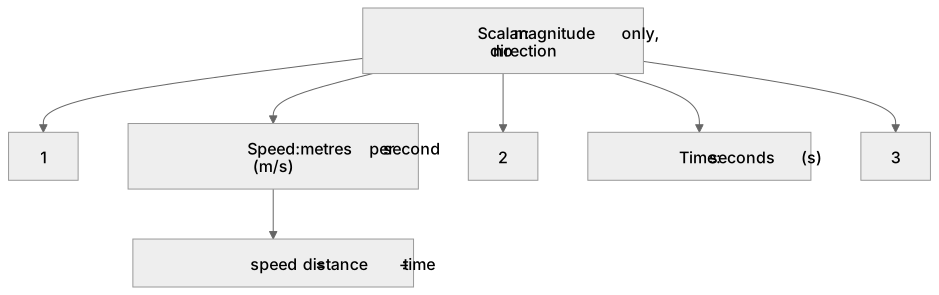
Some boxes have lost their names. Pick the right name for each number.
1Box 1
2Box 2
3Box 3
There is more to this lesson
The full lesson goes on to check your understanding and help you earn the marks. Create a free account to carry on, with your progress saved.
A week of Premium from your first lesson · Then the free plan continues · No card, no charge
Test your understanding of Biomechanical principles: Definitions, equations and units of example scalars.
Active recall beats re-reading. Take an instant quiz now to test what you’ve learned and lock it into long-term memory.
A week of Premium from your first lesson · Then the free plan continues · No card, no charge