AQA · A-Level · Physical Education
Course version: 7582 · Version from Sept 2016
Fitness (cardiac output – trained and untrained individuals, maximal and…
Full specification wording
Cardiovascular system: Fitness (cardiac output – trained and untrained individuals, maximal and sub- maximal exercise).
Cardiac output is the volume of blood pumped by the heart per minute.
Checked against the AQA 7582 specification (opens in a new tab) on .
- Point 3 of 25
- 4 key terms
Study notes
From the checked teaching notes for this specification point.
The idea
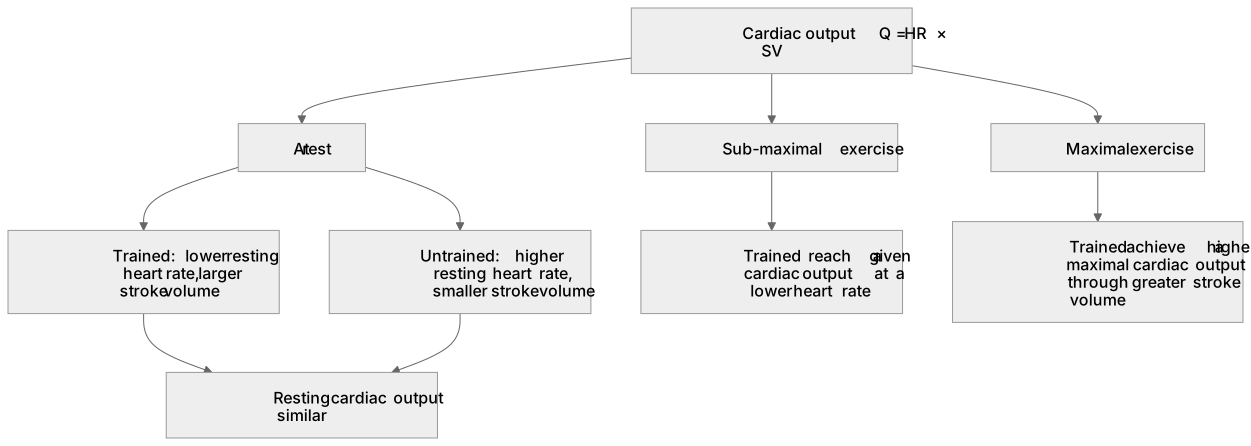
Cardiac output is the volume of blood pumped by the heart per minute. It is calculated as heart rate multiplied by stroke volume, so cardiac output (Q) = heart rate (HR) × stroke volume (SV). At rest, a trained individual often has a lower resting heart rate but a larger stroke volume, so cardiac output is similar to that of an untrained individual. During maximal exercise, trained individuals achieve a higher maximal cardiac output because their stroke volume can increase more, while heart rate is similar or slightly lower. During sub-maximal exercise, trained individuals reach a given cardiac output at a lower heart rate, reflecting greater stroke volume and more efficient oxygen delivery. These differences help explain why trained individuals can sustain exercise longer and recover faster.
What earns the marks
- Cardiac output is the product of heart rate and stroke volume: Q = HR × SV.
- At rest, trained individuals typically have a lower resting heart rate and a larger stroke volume than untrained individuals, with similar resting cardiac output.
- During maximal exercise, trained individuals achieve a higher maximal cardiac output, mainly through a greater stroke volume.
- During sub-maximal exercise, trained individuals produce a given cardiac output at a lower heart rate than untrained individuals.
Common mistakes and how to put them right
Misunderstanding: cardiac output is the same as heart rate.
Put it right: Cardiac output is heart rate multiplied by stroke volume, so it depends on both.
Misunderstanding: trained individuals always have a higher cardiac output at rest.
Put it right: Resting cardiac output is similar; the difference is a lower resting heart rate and larger stroke volume in trained individuals.
Misunderstanding: stroke volume cannot change with training.
Put it right: Endurance training increases stroke volume, which raises maximal cardiac output.
Misunderstanding: sub-maximal exercise requires the same heart rate in trained and untrained individuals.
Put it right: Trained individuals reach a given cardiac output at a lower heart rate.
Exam tips
- Use the equation Q = HR × SV to check whether an option is numerically possible.
- Compare trained and untrained responses at rest, during sub-maximal exercise and during maximal exercise separately.
- Look for options that confuse heart rate with stroke volume or that ignore the effect of training.
Try the lesson
The start of the Cardiovascular system: Fitness (cardiac output – trained and untrained individuals, maximal and sub- maximal exercise). lesson, made from checked teaching notes for this specification point.
Have a go first
How does the cardiac output of an endurance-trained athlete compare to that of an untrained individual during sub-maximal exercise at the same absolute workload?
Listen
Cardiac output is the volume of blood pumped by the heart per minute. It is calculated as heart rate multiplied by stroke volume, so cardiac output (Q) = heart rate (HR) × stroke volume (SV). At rest, a trained individual often has a lower resting heart rate but a larger stroke volume, so cardiac output is similar to that of an untrained individual. During maximal exercise, trained individuals achieve a higher maximal cardiac output because their stroke volume can increase more, while heart rate is similar or slightly lower. During sub-maximal exercise, trained individuals reach a given cardiac output at a lower heart rate, reflecting greater stroke volume and more efficient oxygen delivery. These differences help explain why trained individuals can sustain exercise longer and recover faster. A strong answer earns marks for these points. Cardiac output is the product of heart rate and stroke volume: Q = HR × SV. At rest, trained individuals typically have a lower resting heart rate and a larger stroke volume than untrained individuals, with similar resting cardiac output. During maximal exercise, trained individuals achieve a higher maximal cardiac output, mainly through a greater stroke volume. During sub-maximal exercise, trained individuals produce a given cardiac output at a lower heart rate than untrained individuals. A common slip: Misunderstanding: cardiac output is the same as heart rate. Instead, cardiac output is heart rate multiplied by stroke volume, so it depends on both. Exam tip: Use the equation Q = HR × SV to check whether an option is numerically possible.
See it
Key words
Say what each word means before you turn the card.
Cardiac output
Try answering aloud or in your head before turning the card.
Stroke volume
Try answering aloud or in your head before turning the card.
Heart rate
Try answering aloud or in your head before turning the card.
Training adaptations
Try answering aloud or in your head before turning the card.
See every definition
- Cardiac output
- The volume of blood pumped by the heart per minute, calculated as heart rate multiplied by stroke volume.
- Stroke volume
- A component of cardiac output which, when larger in trained individuals, allows a higher maximal cardiac output.
- Heart rate
- A component of cardiac output which, when multiplied by stroke volume, gives the volume of blood pumped per minute.
- Training adaptations
- Changes such as a greater stroke volume that improve oxygen delivery to working muscles and support endurance performance.
Label the diagram
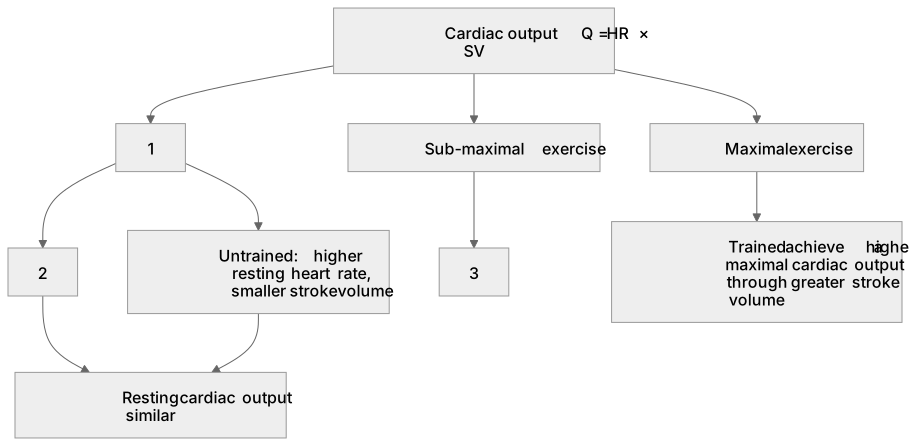
Some boxes have lost their names. Pick the right name for each number.
1Box 1
2Box 2
3Box 3
There is more to this lesson
The full lesson goes on to check your understanding and help you earn the marks. Create a free account to carry on, with your progress saved.
A week of Premium from your first lesson · Then the free plan continues · No card, no charge
Test your understanding of Cardiovascular system: Fitness (cardiac output – trained and untrained individuals, maximal and sub- maximal exercise).
Active recall beats re-reading. Take an instant quiz now to test what you’ve learned and lock it into long-term memory.
A week of Premium from your first lesson · Then the free plan continues · No card, no charge