AQA · A-Level · Physical Education
Course version: 7582 · Version from Sept 2016
Students should understand the adaptations to the body systems through…
Full specification wording
Exercise physiology: Students should understand the adaptations to the body systems through training or lifestyle, and how these changes affect the efficiency of those systems.
Training and lifestyle both remodel the body's systems, and the exam asks you to link each structural or functional change to a gain in efficiency.
Checked against the AQA 7582 specification (opens in a new tab) on .
- 4 key terms
Study notes
From the checked teaching notes for this specification point.
The idea
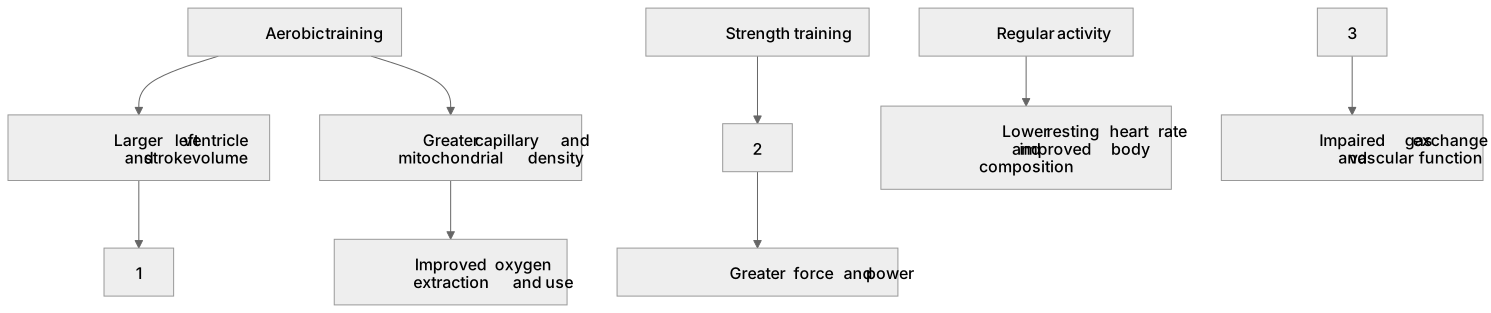
Training and lifestyle both remodel the body's systems, and the exam asks you to link each structural or functional change to a gain in efficiency. Aerobic training enlarges the left ventricle and raises stroke volume, so cardiac output at a given submaximal intensity is achieved at a lower heart rate; capillary and mitochondrial density in trained muscle improves oxygen extraction and use. Strength training increases muscle cross-sectional area and neural recruitment, raising force production. Lifestyle adaptations include a lower resting heart rate and improved body composition from regular activity, while smoking and inactivity reduce gas exchange and vascular efficiency. Always name the system, the specific change, and the efficiency consequence.
What earns the marks
- Aerobic training increases left ventricular cavity size and stroke volume, so cardiac output is maintained at a lower heart rate, improving cardiac efficiency.
- Increased capillary density and mitochondrial volume in trained skeletal muscle improve oxygen delivery, extraction and aerobic energy production.
- Strength training causes muscle hypertrophy and improved neural recruitment, increasing maximal force and power output.
- Regular activity lowers resting heart rate and can improve body composition, reducing the cardiac workload of everyday activity.
- Lifestyle factors such as smoking or inactivity impair gas exchange and vascular function, reducing the efficiency of the respiratory and cardiovascular systems.
Common mistakes and how to put them right
Claiming cardiac output falls at rest after training.
Put it right: Resting cardiac output is similar, but it is achieved through a larger stroke volume and lower heart rate.
Confusing hypertrophy with hyperplasia.
Put it right: Training mainly enlarges existing muscle fibres rather than increasing their number.
Stating that training increases the number of heart chambers or lungs.
Put it right: The change is in size, volume, wall thickness and function, not in the number of organs.
Treating all adaptation as immediate.
Put it right: Structural change requires sustained training over weeks and reverses with detraining.
Exam tips
- Use the chain system change, then functional effect, then efficiency gain, for example larger ventricle, greater stroke volume, lower submaximal heart rate.
- Distinguish training adaptations from lifestyle adaptations explicitly, because the statement names both.
- Quantify where you can, such as a lower resting heart rate in beats per minute, to show precise understanding.
- Check that every adaptation you name is matched to the correct system rather than listed generically.
Try the lesson
The start of the Exercise physiology: Students should understand the adaptations to the body systems through training or lifestyle, and how these changes affect the efficiency of those systems. lesson, made from checked teaching notes for this specification point.
Have a go first
Which change to the cardiovascular system is a typical adaptation to long-term aerobic training?
Listen
Training and lifestyle both remodel the body's systems, and the exam asks you to link each structural or functional change to a gain in efficiency. Aerobic training enlarges the left ventricle and raises stroke volume, so cardiac output at a given submaximal intensity is achieved at a lower heart rate; capillary and mitochondrial density in trained muscle improves oxygen extraction and use. Strength training increases muscle cross-sectional area and neural recruitment, raising force production. Lifestyle adaptations include a lower resting heart rate and improved body composition from regular activity, while smoking and inactivity reduce gas exchange and vascular efficiency. Always name the system, the specific change, and the efficiency consequence. A strong answer earns marks for these points. Aerobic training increases left ventricular cavity size and stroke volume, so cardiac output is maintained at a lower heart rate, improving cardiac efficiency. Increased capillary density and mitochondrial volume in trained skeletal muscle improve oxygen delivery, extraction and aerobic energy production. Strength training causes muscle hypertrophy and improved neural recruitment, increasing maximal force and power output. Regular activity lowers resting heart rate and can improve body composition, reducing the cardiac workload of everyday activity. Exam tip: Use the chain system change, then functional effect, then efficiency gain, for example larger ventricle, greater stroke volume, lower submaximal heart rate.
See it

Key words
Say what each word means before you turn the card.
Cardiovascular adaptation
Try answering aloud or in your head before turning the card.
Respiratory and gas exchange efficiency
Try answering aloud or in your head before turning the card.
Neuromuscular adaptation
Try answering aloud or in your head before turning the card.
Lifestyle effects on system efficiency
Try answering aloud or in your head before turning the card.
See every definition
- Cardiovascular adaptation
- Aerobic training enlarges the left ventricle and raises stroke volume, so cardiac output at a given submaximal intensity is achieved at a lower heart rate.
- Respiratory and gas exchange efficiency
- Lifestyle factors such as smoking or inactivity impair gas exchange and vascular function, reducing the efficiency of the respiratory and cardiovascular systems.
- Neuromuscular adaptation
- Strength training increases muscle cross-sectional area and neural recruitment, raising force production.
- Lifestyle effects on system efficiency
- Regular activity lowers resting heart rate and can improve body composition, reducing the cardiac workload of everyday activity.
Label the diagram
Some boxes have lost their names. Pick the right name for each number.
1Box 1
2Box 2
3Box 3
There is more to this lesson
The full lesson goes on to check your understanding and help you earn the marks. Create a free account to carry on, with your progress saved.
A week of Premium from your first lesson · Then the free plan continues · No card, no charge
Test your understanding of Exercise physiology: Students should understand the adaptations to the body systems through training or lifestyle, and how these changes affect the efficiency of those systems.
Active recall beats re-reading. Take an instant quiz now to test what you’ve learned and lock it into long-term memory.
A week of Premium from your first lesson · Then the free plan continues · No card, no charge