AQA · A-Level · Physical Education
Course version: 7582 · Version from Sept 2016
Fluid mechanics: Upward lift force (discus).
A discus in flight is an aerofoil-like shape.
Checked against the AQA 7582 specification (opens in a new tab) on .
- Point 5 of 6
- 3 key terms
Study notes
From the checked teaching notes for this specification point.
The idea
A discus in flight is an aerofoil-like shape. When it is thrown with the correct angle of attack, air travels faster over its upper surface than its lower surface. Faster air has lower pressure, so pressure above the discus is lower than pressure below it. The resulting pressure difference produces an upward lift force that opposes gravity and can extend the flight time. Lift depends on the discus's speed, its angle of attack and its orientation. If the angle of attack is too steep, airflow separates and lift falls while drag rises. A flat, non-angled discus produces little lift because the airflow over both surfaces is similar.
What earns the marks
- Identifies the discus as an aerofoil-like shape that can generate lift in flight.
- States that air moves faster over the upper surface than the lower surface at a suitable angle of attack.
- Links faster upper-surface airflow to lower pressure above the discus.
- Explains that the pressure difference between lower and upper surfaces produces an upward lift force.
- Notes that lift depends on speed, angle of attack and orientation, and that excessive angle of attack reduces lift and increases drag.
Common mistakes and how to put them right
Saying the discus is pushed up by air hitting its underside alone.
Put it right: Lift mainly comes from the pressure difference caused by different air speeds.
Thinking lift acts downwards.
Put it right: The pressure difference described produces an upward force.
Assuming any throw angle gives maximum lift.
Put it right: Too steep an angle of attack causes airflow separation and reduces lift.
Treating lift as independent of speed.
Put it right: Greater speed increases the pressure difference and therefore the lift force.
Exam tips
- State the direction of the lift force first, then explain the pressure difference that causes it.
- Use the terms upper surface, lower surface, angle of attack and pressure difference accurately.
- If a question gives a discus orientation, decide whether the angle of attack is suitable for lift before choosing an answer.
Try the lesson
The start of the Fluid mechanics: Upward lift force (discus). lesson, made from checked teaching notes for this specification point.
Have a go first
During its flight, a discus experiences an upward lift force that extends the distance of the throw. According to the Bernoulli principle, how is this upward lift force generated?
Listen
A discus in flight is an aerofoil-like shape. When it is thrown with the correct angle of attack, air travels faster over its upper surface than its lower surface. Faster air has lower pressure, so pressure above the discus is lower than pressure below it. The resulting pressure difference produces an upward lift force that opposes gravity and can extend the flight time. Lift depends on the discus's speed, its angle of attack and its orientation. If the angle of attack is too steep, airflow separates and lift falls while drag rises. A flat, non-angled discus produces little lift because the airflow over both surfaces is similar. A strong answer earns marks for these points. Identifies the discus as an aerofoil-like shape that can generate lift in flight. States that air moves faster over the upper surface than the lower surface at a suitable angle of attack. Links faster upper-surface airflow to lower pressure above the discus. Explains that the pressure difference between lower and upper surfaces produces an upward lift force. Exam tip: State the direction of the lift force first, then explain the pressure difference that causes it.
See it
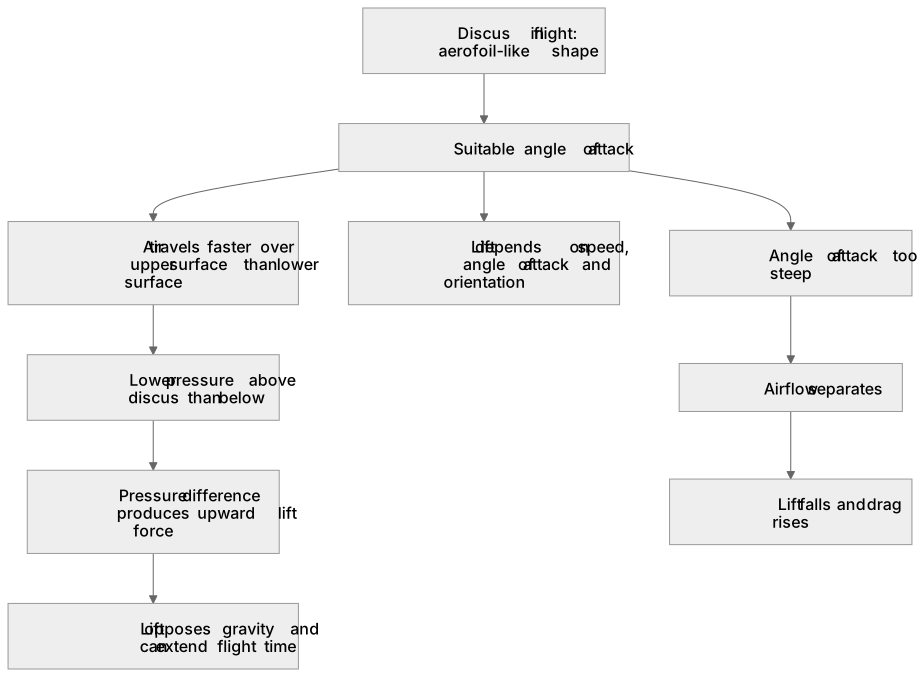
Key words
Say what each word means before you turn the card.
Aerofoil and lift
Try answering aloud or in your head before turning the card.
Pressure differences
Try answering aloud or in your head before turning the card.
Projectile flight in sport
Try answering aloud or in your head before turning the card.
See every definition
- Aerofoil and lift
- A discus in flight is an aerofoil-like shape that can generate an upward lift force when thrown with the correct angle of attack.
- Pressure differences
- Air travels faster over the upper surface than the lower surface, and faster air has lower pressure, so pressure above the discus is lower than below it.
- Projectile flight in sport
- The resulting pressure difference produces an upward lift force that opposes gravity and can extend the flight time.
Label the diagram
Some boxes have lost their names. Pick the right name for each number.
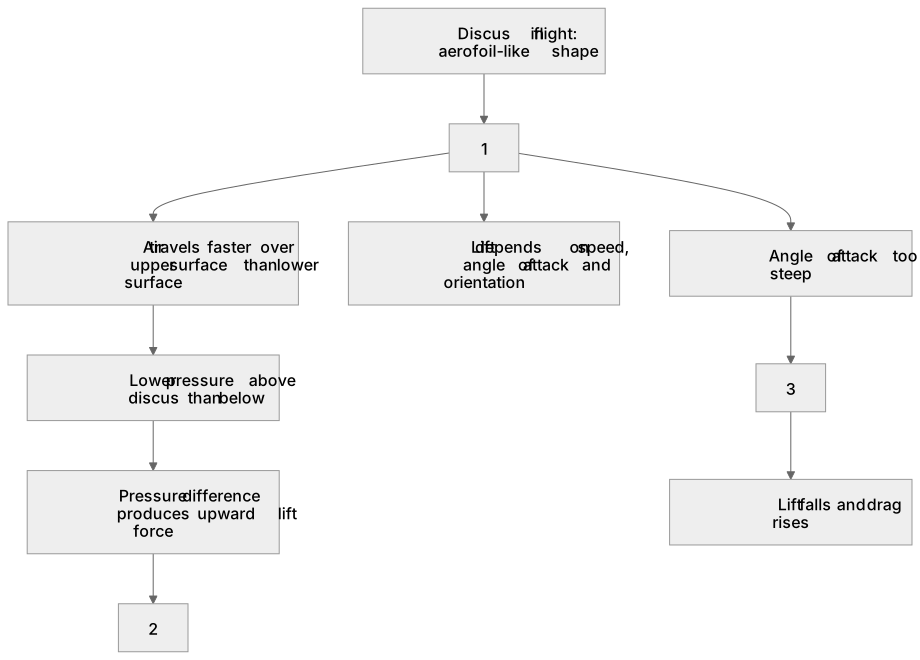
1Box 1
2Box 2
3Box 3
There is more to this lesson
The full lesson goes on to check your understanding and help you earn the marks. Create a free account to carry on, with your progress saved.
A week of Premium from your first lesson · Then the free plan continues · No card, no charge
Test your understanding of Fluid mechanics: Upward lift force (discus).
Active recall beats re-reading. Take an instant quiz now to test what you’ve learned and lock it into long-term memory.
A week of Premium from your first lesson · Then the free plan continues · No card, no charge