AQA · A-Level · Physical Education
Course version: 7582 · Version from Sept 2016
Variable.
Full specification wording
Impact of skill classification on structure of practice for learning: Variable.
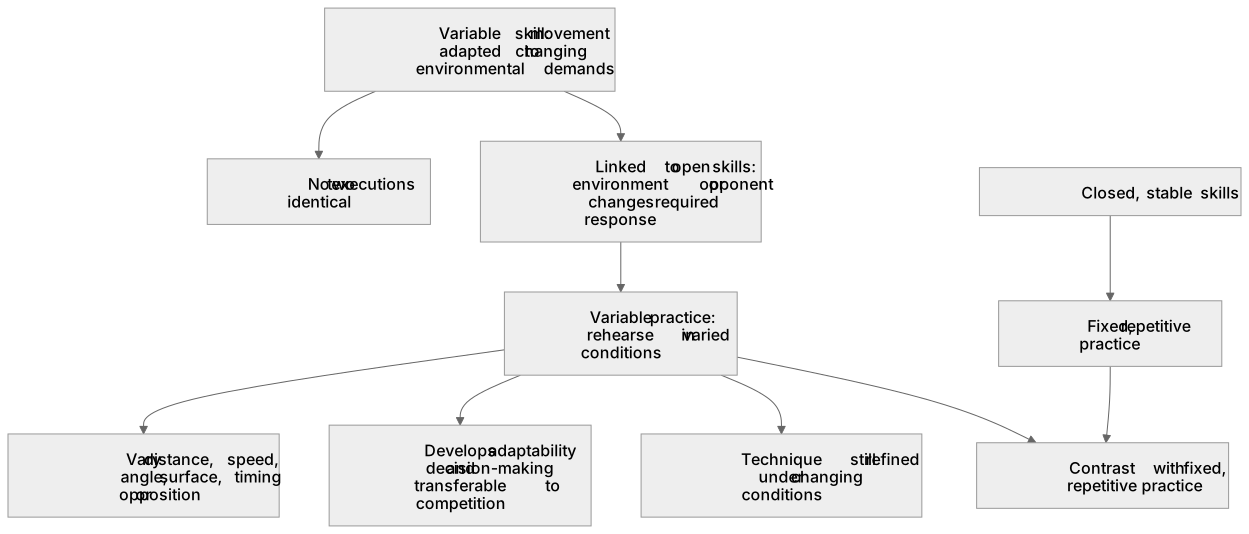
A variable skill is one where the performer must adapt movement to changing environmental demands, so no two executions are identical.
Checked against the AQA 7582 specification (opens in a new tab) on .
- Point 8 of 10
- 4 key terms
Study notes
From the checked teaching notes for this specification point.
The idea
A variable skill is one where the performer must adapt movement to changing environmental demands, so no two executions are identical. In AQA A-Level Physical Education, variable practice means rehearsing the skill in varied conditions: different distances, speeds, angles, surfaces or opponents. A tennis forehand practised from feeding machines, then rallying, then returning serve is variable practice. The classification matters because it shapes how practice is structured: closed, stable skills suit fixed, repetitive drills, while open, variable skills need variability so the performer builds adaptable movement solutions. The learner should be able to identify whether a skill is variable and select a practice structure that matches it.
What earns the marks
- Defines a variable skill as one performed in unpredictable or changing conditions, so each execution differs.
- Links variability to open skills, where the environment or opponent changes the required response.
- Explains that variable practice varies distance, speed, angle, surface, timing or opposition.
- States that variable practice develops adaptability and decision-making transferable to competition.
- Contrasts variable practice with fixed, repetitive practice suited to closed, stable skills.
- Applies the term to a named sporting example, such as a pass in invasion games or a return in tennis.
Common mistakes and how to put them right
Treating variable as meaning the skill is difficult.
Put it right: Variability concerns changing conditions and execution, not difficulty.
Assuming all practice should be variable.
Put it right: Closed skills such as a gymnastic vault benefit from fixed, repetitive practice.
Confusing variable practice with massed practice.
Put it right: Variable concerns variation in conditions, while massed concerns rest intervals.
Believing variable practice removes the need for technique.
Put it right: Technique is still refined, but under changing conditions.
Exam tips
- Define the term precisely before applying it to a sporting example.
- Use a named skill and state exactly what changes between attempts.
- Link the practice structure to the classification of the skill, not just to the sport.
Try the lesson
The start of the Impact of skill classification on structure of practice for learning: Variable. lesson, made from checked teaching notes for this specification point.
Have a go first
A coach designs a practice session in which a tennis player must return balls that are fed at different speeds, heights and directions on every attempt. Which type of practice is being used?
Listen
A variable skill is one where the performer must adapt movement to changing environmental demands, so no two executions are identical. In AQA A-Level Physical Education, variable practice means rehearsing the skill in varied conditions: different distances, speeds, angles, surfaces or opponents. A tennis forehand practised from feeding machines, then rallying, then returning serve is variable practice. The classification matters because it shapes how practice is structured: closed, stable skills suit fixed, repetitive drills, while open, variable skills need variability so the performer builds adaptable movement solutions. The learner should be able to identify whether a skill is variable and select a practice structure that matches it. A strong answer earns marks for these points. Defines a variable skill as one performed in unpredictable or changing conditions, so each execution differs. Links variability to open skills, where the environment or opponent changes the required response. Explains that variable practice varies distance, speed, angle, surface, timing or opposition. States that variable practice develops adaptability and decision-making transferable to competition. A common slip: Treating variable as meaning the skill is difficult. Instead, variability concerns changing conditions and execution, not difficulty. Exam tip: Define the term precisely before applying it to a sporting example.
See it
Key words
Say what each word means before you turn the card.
Variable skill
Try answering aloud or in your head before turning the card.
Variable practice
Try answering aloud or in your head before turning the card.
Open skills
Try answering aloud or in your head before turning the card.
Closed, stable skills
Try answering aloud or in your head before turning the card.
See every definition
- Variable skill
- One where the performer must adapt movement to changing environmental demands, so no two executions are identical.
- Variable practice
- Rehearsing the skill in varied conditions: different distances, speeds, angles, surfaces or opponents.
- Open skills
- Skills where the environment or opponent changes the required response, needing variability so the performer builds adaptable movement solutions.
- Closed, stable skills
- Skills that suit fixed, repetitive drills rather than variable practice.
Label the diagram
Some boxes have lost their names. Pick the right name for each number.
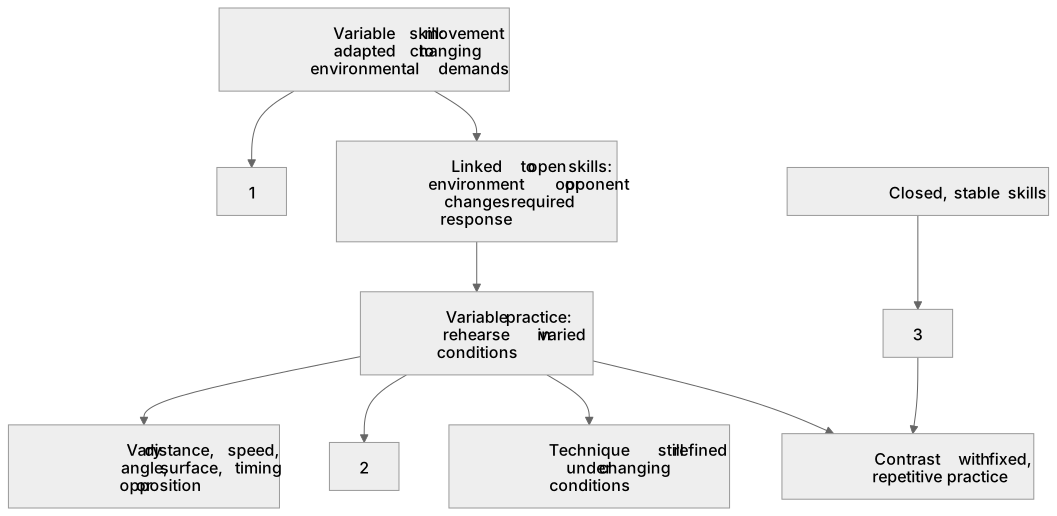
1Box 1
2Box 2
3Box 3
There is more to this lesson
The full lesson goes on to check your understanding and help you earn the marks. Create a free account to carry on, with your progress saved.
A week of Premium from your first lesson · Then the free plan continues · No card, no charge
Test your understanding of Impact of skill classification on structure of practice for learning: Variable.
Active recall beats re-reading. Take an instant quiz now to test what you’ve learned and lock it into long-term memory.
A week of Premium from your first lesson · Then the free plan continues · No card, no charge