AQA · A-Level · Physical Education
Course version: 7582 · Version from Sept 2016
Industrial and post-industrial (1780–1900): Public schools/universities
During the industrial and post-industrial period 1780–1900, public schools and universities were key developers of organised sport.
Checked against the AQA 7582 specification (opens in a new tab) on .
- Point 8 of 12
- 4 key terms
Study notes
From the checked teaching notes for this specification point.
The idea
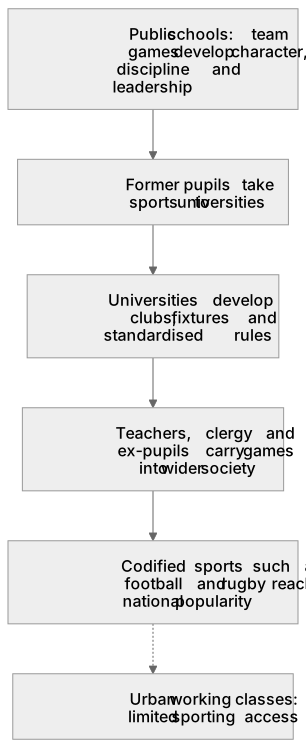
During the industrial and post-industrial period 1780–1900, public schools and universities were key developers of organised sport. Public schools used games to promote character, discipline and leadership, and former pupils took these sports to universities, where clubs, fixtures and standardised rules developed. This athleticism spread through society as teachers, clergy and ex-pupils carried the games to churches, clubs and the wider public. Understanding this route explains how codified sports such as football and rugby moved from elite institutions to national popularity, and it contrasts with the limited provision available to the urban working classes in the same period.
What earns the marks
- Public schools used team games to develop character, discipline and leadership.
- Universities developed clubs, fixtures and standardised rules for sports.
- Former public school pupils carried sports into universities and then into wider society.
- Codified sports such as football and rugby grew from this elite institutional base.
Common mistakes and how to put them right
Treating public schools and universities as the same institution.
Put it right: Public schools developed the games and universities codified and expanded them.
Assuming sport in public schools was only for fitness.
Put it right: It was mainly for character, discipline and leadership.
Believing the spread of sport stopped at university.
Put it right: Ex-pupils, teachers and clergy carried it into wider society.
Ignoring the class contrast.
Put it right: This elite provision differed sharply from limited working-class access in the same period.
Exam tips
- Name a specific sport, such as football or rugby, when explaining codification.
- Link public school values to athleticism and the spread of games.
- Keep all examples within 1780–1900.
- Contrast this provision with church and local authority provision for the working classes.
Try the lesson
The start of the Industrial and post-industrial (1780–1900): Public schools/universities lesson, made from checked teaching notes for this specification point.
Have a go first
In the period 1780–1900, which group of institutions is most closely associated with the development of codified team games and athletic sports in Britain?
Listen
During the industrial and post-industrial period 1780–1900, public schools and universities were key developers of organised sport. Public schools used games to promote character, discipline and leadership, and former pupils took these sports to universities, where clubs, fixtures and standardised rules developed. This athleticism spread through society as teachers, clergy and ex-pupils carried the games to churches, clubs and the wider public. Understanding this route explains how codified sports such as football and rugby moved from elite institutions to national popularity, and it contrasts with the limited provision available to the urban working classes in the same period. A strong answer earns marks for these points. Public schools used team games to develop character, discipline and leadership. Universities developed clubs, fixtures and standardised rules for sports. Former public school pupils carried sports into universities and then into wider society. Codified sports such as football and rugby grew from this elite institutional base. A common slip: Treating public schools and universities as the same institution. Instead, public schools developed the games and universities codified and expanded them. Exam tip: Name a specific sport, such as football or rugby, when explaining codification.
See it
Key words
Say what each word means before you turn the card.
Athleticism
Try answering aloud or in your head before turning the card.
Codification of sport
Try answering aloud or in your head before turning the card.
Character and leadership
Try answering aloud or in your head before turning the card.
Social spread of games
Try answering aloud or in your head before turning the card.
See every definition
- Athleticism
- The values of character, discipline and leadership promoted through team games in public schools, which spread through society via teachers, clergy and ex-pupils.
- Codification of sport
- The development of clubs, fixtures and standardised rules for sports, carried out by universities.
- Character and leadership
- Qualities that public schools used team games to develop in their pupils.
- Social spread of games
- The process by which teachers, clergy and ex-pupils carried games to churches, clubs and the wider public.
Label the diagram
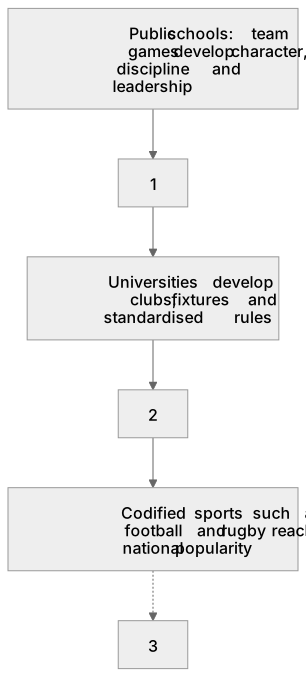
Some boxes have lost their names. Pick the right name for each number.
1Box 1
2Box 2
3Box 3
There is more to this lesson
The full lesson goes on to check your understanding and help you earn the marks. Create a free account to carry on, with your progress saved.
A week of Premium from your first lesson · Then the free plan continues · No card, no charge
Test your understanding of Industrial and post-industrial (1780–1900): Public schools/universities
Active recall beats re-reading. Take an instant quiz now to test what you’ve learned and lock it into long-term memory.
A week of Premium from your first lesson · Then the free plan continues · No card, no charge