AQA · A-Level · Physical Education
Course version: 7582 · Version from Sept 2016
The status of amateur and professional performers.
Full specification wording
Industrial and post-industrial (1780–1900): The status of amateur and professional performers.
In industrial and post-industrial Britain (1780–1900), amateur and professional performers had different status.
Checked against the AQA 7582 specification (opens in a new tab) on .
- Point 12 of 12
- 4 key terms
Study notes
From the checked teaching notes for this specification point.
The idea
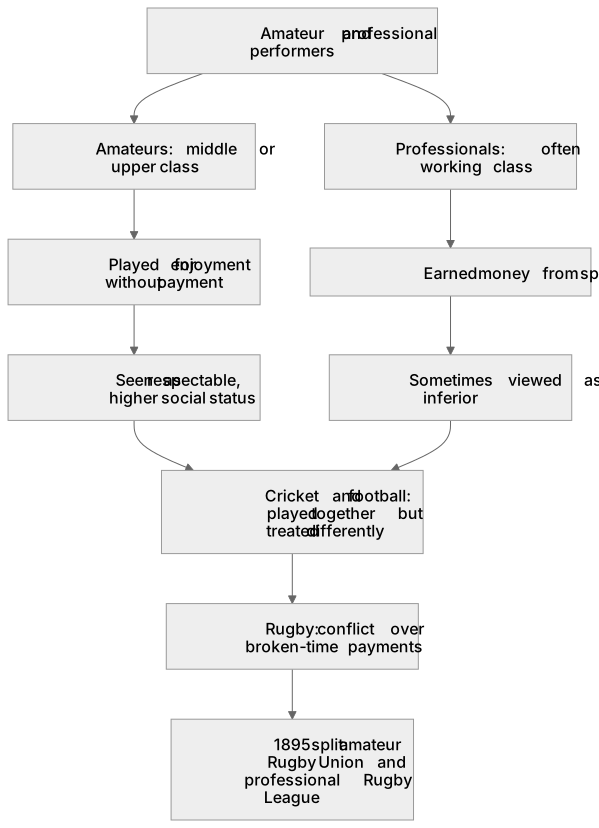
In industrial and post-industrial Britain (1780–1900), amateur and professional performers had different status. Amateurs were usually middle- or upper-class and played for enjoyment without payment, so they were seen as respectable. Professionals were often working-class and earned money from sport, so they were sometimes viewed as inferior. In cricket and football, amateurs and professionals could play together but were treated differently, for example in dressing rooms or captaincy. In rugby, the divide led to the 1895 split between amateur Rugby Union and professional Rugby League. This class-based divide shaped rules, competitions and attitudes, persisting even as commercial sport grew.
What earns the marks
- Amateurs did not receive payment for playing and were typically from the middle or upper classes.
- Professionals earned money from sport and were often from the working class.
- Amateurs were generally given higher social status and seen as more respectable than professionals.
- In sports such as cricket and football, amateurs and professionals could compete together but were treated differently in areas such as captaincy or facilities.
- In rugby, the conflict over professional payment (broken-time payments) led to the 1895 split into amateur Rugby Union and professional Rugby League.
Common mistakes and how to put them right
Misunderstanding: amateur meant a lower standard of play.
Put it right: Amateur described payment status and social class, not ability, and some amateurs were highly skilled.
Misunderstanding: amateurs and professionals played together peacefully in all sports.
Put it right: In rugby, the dispute over payment led to a complete split in 1895.
Misunderstanding: the divide was only about money.
Put it right: It also reflected class, respectability and control over sport.
Exam tips
- Define amateur and professional clearly before discussing their status, so your answer stays focused.
- Use the 1895 rugby split as a concrete example of how the amateur-professional divide fractured a sport.
- In multiple-choice questions, reject options that confuse payment status with playing ability or that claim professionals were always excluded from every sport.
Try the lesson
The start of the Industrial and post-industrial (1780–1900): The status of amateur and professional performers. lesson, made from checked teaching notes for this specification point.
Have a go first
In late nineteenth-century Britain, which social class background was most typical of the amateur sportsmen who governed national governing bodies such as the Football Association?
Listen
In industrial and post-industrial Britain (1780–1900), amateur and professional performers had different status. Amateurs were usually middle- or upper-class and played for enjoyment without payment, so they were seen as respectable. Professionals were often working-class and earned money from sport, so they were sometimes viewed as inferior. In cricket and football, amateurs and professionals could play together but were treated differently, for example in dressing rooms or captaincy. In rugby, the divide led to the 1895 split between amateur Rugby Union and professional Rugby League. This class-based divide shaped rules, competitions and attitudes, persisting even as commercial sport grew. A strong answer earns marks for these points. Amateurs did not receive payment for playing and were typically from the middle or upper classes. Professionals earned money from sport and were often from the working class. Amateurs were generally given higher social status and seen as more respectable than professionals. In sports such as cricket and football, amateurs and professionals could compete together but were treated differently in areas such as captaincy or facilities. A common slip: Misunderstanding: amateur meant a lower standard of play. Instead, amateur described payment status and social class, not ability, and some amateurs were highly skilled. Exam tip: Define amateur and professional clearly before discussing their status, so your answer stays focused.
See it
Key words
Say what each word means before you turn the card.
Amateurism and payment
Try answering aloud or in your head before turning the card.
Professionalism and social class
Try answering aloud or in your head before turning the card.
Respectability and moral status in sport
Try answering aloud or in your head before turning the card.
The 1895 rugby split and class-based treatment
Try answering aloud or in your head before turning the card.
See every definition
- Amateurism and payment
- Amateurs were usually middle- or upper-class and played for enjoyment without payment, so they were seen as respectable.
- Professionalism and social class
- Professionals were often working-class and earned money from sport, so they were sometimes viewed as inferior.
- Respectability and moral status in sport
- Amateurs were generally given higher social status and seen as more respectable than professionals.
- The 1895 rugby split and class-based treatment
- In rugby, the conflict over professional payment led to the 1895 split into amateur Rugby Union and professional Rugby League.
Label the diagram
Some boxes have lost their names. Pick the right name for each number.
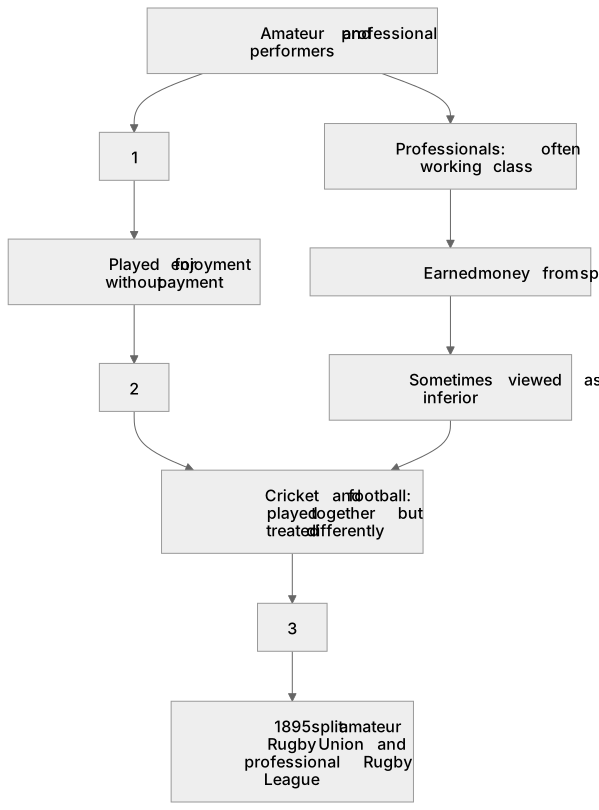
1Box 1
2Box 2
3Box 3
There is more to this lesson
The full lesson goes on to check your understanding and help you earn the marks. Create a free account to carry on, with your progress saved.
A week of Premium from your first lesson · Then the free plan continues · No card, no charge
Test your understanding of Industrial and post-industrial (1780–1900): The status of amateur and professional performers.
Active recall beats re-reading. Take an instant quiz now to test what you’ve learned and lock it into long-term memory.
A week of Premium from your first lesson · Then the free plan continues · No card, no charge