AQA · A-Level · Physical Education
Course version: 7582 · Version from Sept 2016
Mechanical advantage and mechanical disadvantage of each class of lever.
Full specification wording
Levers: Mechanical advantage and mechanical disadvantage of each class of lever.
Mechanical advantage depends on the relative lengths of the effort arm (fulcrum to effort) and the load arm (fulcrum to load).
Checked against the AQA 7582 specification (opens in a new tab) on .
- Point 2 of 2
- 4 key terms
Study notes
From the checked teaching notes for this specification point.
The idea
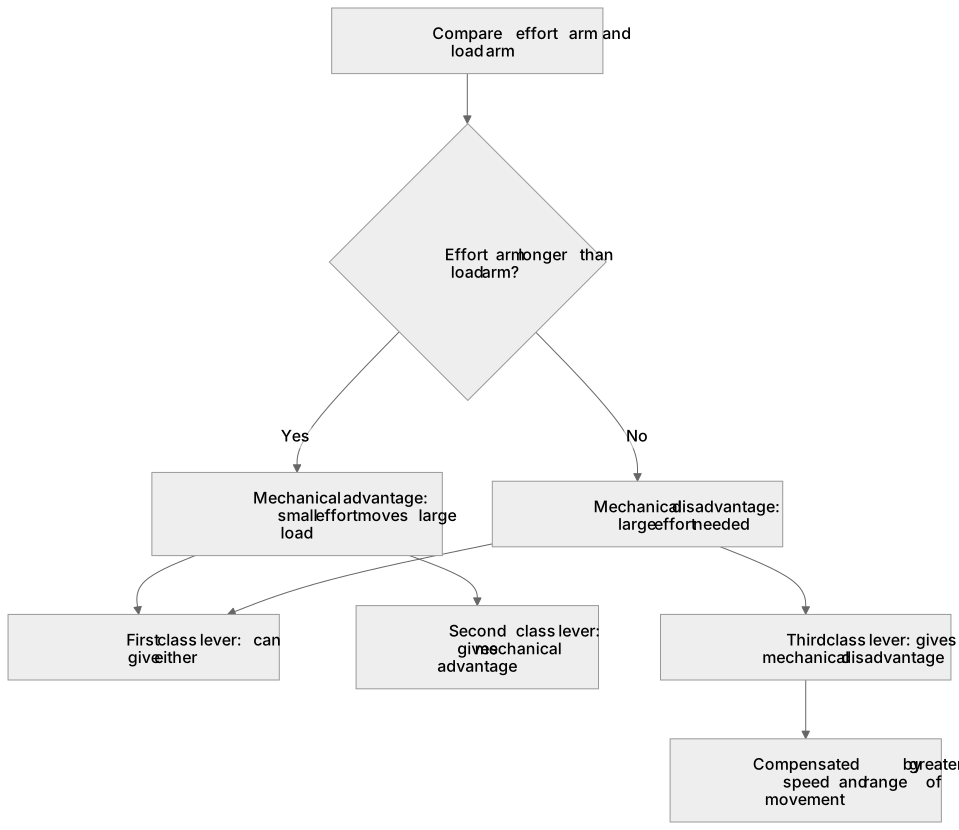
Mechanical advantage depends on the relative lengths of the effort arm (fulcrum to effort) and the load arm (fulcrum to load). When the effort arm is longer than the load arm, a smaller effort moves a larger load, giving mechanical advantage. When the effort arm is shorter than the load arm, a larger effort is needed to move the load, giving mechanical disadvantage. First class levers can give either, depending on arm lengths. Second class levers give mechanical advantage because the effort arm is longer. Third class levers give mechanical disadvantage because the effort arm is shorter, but they allow greater speed and range of movement.
What earns the marks
- Mechanical advantage occurs when the effort arm is longer than the load arm, so a small effort moves a large load.
- Mechanical disadvantage occurs when the effort arm is shorter than the load arm, so a large effort is needed.
- First class levers can produce advantage or disadvantage depending on the relative arm lengths.
- Second class levers give mechanical advantage because the effort arm is longer than the load arm.
- Third class levers give mechanical disadvantage because the effort arm is shorter than the load arm.
- Third class levers compensate for disadvantage by allowing greater speed and range of movement.
Common mistakes and how to put them right
Thinking mechanical advantage depends on the size of the load alone.
Put it right: It depends on the ratio of effort arm to load arm.
Assuming all first class levers give mechanical advantage.
Put it right: They can give either, depending on arm lengths.
Believing third class levers are useless because of disadvantage.
Put it right: They trade force for speed and range of movement.
Mixing up the effort arm and load arm.
Put it right: The effort arm runs from fulcrum to effort, the load arm from fulcrum to load.
Exam tips
- Compare the lengths of the effort arm and load arm before deciding advantage or disadvantage.
- Link each class to its typical outcome: second class advantage, third class disadvantage, first class either.
- Explain the sporting benefit of a third class lever, such as faster limb movement in a kick or throw.
Try the lesson
The start of the Levers: Mechanical advantage and mechanical disadvantage of each class of lever. lesson, made from checked teaching notes for this specification point.
Have a go first
A first-class lever has an effort arm of 0.60 m and a resistance arm of 0.20 m. What is its mechanical advantage?
Listen
Mechanical advantage depends on the relative lengths of the effort arm (fulcrum to effort) and the load arm (fulcrum to load). When the effort arm is longer than the load arm, a smaller effort moves a larger load, giving mechanical advantage. When the effort arm is shorter than the load arm, a larger effort is needed to move the load, giving mechanical disadvantage. First class levers can give either, depending on arm lengths. Second class levers give mechanical advantage because the effort arm is longer. Third class levers give mechanical disadvantage because the effort arm is shorter, but they allow greater speed and range of movement. A strong answer earns marks for these points. Mechanical advantage occurs when the effort arm is longer than the load arm, so a small effort moves a large load. Mechanical disadvantage occurs when the effort arm is shorter than the load arm, so a large effort is needed. First class levers can produce advantage or disadvantage depending on the relative arm lengths. Second class levers give mechanical advantage because the effort arm is longer than the load arm. Exam tip: Compare the lengths of the effort arm and load arm before deciding advantage or disadvantage.
See it
Key words
Say what each word means before you turn the card.
Effort arm and load arm
Try answering aloud or in your head before turning the card.
Mechanical advantage
Try answering aloud or in your head before turning the card.
Mechanical disadvantage
Try answering aloud or in your head before turning the card.
Trade-off between force and speed
Try answering aloud or in your head before turning the card.
See every definition
- Effort arm and load arm
- The effort arm runs from the fulcrum to the effort, and the load arm runs from the fulcrum to the load.
- Mechanical advantage
- This occurs when the effort arm is longer than the load arm, so a smaller effort moves a larger load.
- Mechanical disadvantage
- This occurs when the effort arm is shorter than the load arm, so a larger effort is needed to move the load.
- Trade-off between force and speed
- Third class levers give mechanical disadvantage but compensate by allowing greater speed and range of movement.
There is more to this lesson
The full lesson goes on to check your understanding and help you earn the marks. Create a free account to carry on, with your progress saved.
A week of Premium from your first lesson · Then the free plan continues · No card, no charge
Test your understanding of Levers: Mechanical advantage and mechanical disadvantage of each class of lever.
Active recall beats re-reading. Take an instant quiz now to test what you’ve learned and lock it into long-term memory.
A week of Premium from your first lesson · Then the free plan continues · No card, no charge