AQA · A-Level · Physical Education
Course version: 7582 · Version from Sept 2016
Motivation: Motivation.
Motivation is the internal and external drive that initiates, directs and sustains behaviour towards a goal.
Checked against the AQA 7582 specification (opens in a new tab) on .
- Point 1 of 2
- 3 key terms
Study notes
From the checked teaching notes for this specification point.
The idea
Motivation is the internal and external drive that initiates, directs and sustains behaviour towards a goal. Intrinsic motivation comes from within the performer, such as enjoyment, satisfaction or the desire to master a skill, and it tends to support long-term participation. Extrinsic motivation comes from external rewards or pressures. Extrinsic rewards can be tangible (physical items you can touch, such as trophies, medals or money) or intangible (non-physical rewards, such as praise, applause, records or selection). Extrinsic motivation can raise effort in the short term. Coaches often combine both types, using extrinsic rewards to build initial engagement while developing intrinsic interest. Over-reliance on extrinsic rewards can reduce intrinsic motivation, so the balance matters.
What earns the marks
- Motivation is the internal and external drive that initiates, directs and sustains goal-directed behaviour.
- Intrinsic motivation arises from within the performer, for example enjoyment, satisfaction, mastery or personal challenge.
- Extrinsic motivation arises from external rewards or pressures, which can be tangible or intangible.
- Tangible rewards are physical, for example trophies, medals, certificates or money.
- Intangible rewards are non-physical, for example praise, applause, selection or national records.
- Intrinsic motivation is generally associated with longer-term participation and persistence, while extrinsic rewards can raise effort in the short term.
Common mistakes and how to put them right
Treating intrinsic and extrinsic motivation as opposites that cannot coexist.
Put it right: Most performers experience both at the same time.
Assuming extrinsic rewards always increase motivation.
Put it right: They can reduce intrinsic interest if the performer begins to act only for the reward.
Confusing tangible and intangible rewards.
Put it right: Tangible rewards are physical objects (medals), whereas intangible rewards are non-physical (praise).
Believing that motivation is fixed.
Put it right: It is dynamic and can be raised or lowered by success, feedback, environment and goal setting.
Exam tips
- Classify the source of the drive as internal or external before choosing an answer, because the intrinsic and extrinsic labels depend on where the drive originates.
- When identifying extrinsic motivation, check if the question requires you to distinguish between tangible (physical) and intangible (non-physical) rewards.
- Use a concrete example such as playing for enjoyment or playing for a trophy to test each option against the definition.
Try the lesson
The start of the Motivation: Motivation. lesson, made from checked teaching notes for this specification point.
Have a go first
A gymnast trains hard because she enjoys the feeling of improving her own skills, not for trophies or praise. Which type of motivation is she displaying?
Listen
Motivation is the internal and external drive that initiates, directs and sustains behaviour towards a goal. Intrinsic motivation comes from within the performer, such as enjoyment, satisfaction or the desire to master a skill, and it tends to support long-term participation. Extrinsic motivation comes from external rewards or pressures. Extrinsic rewards can be tangible (physical items you can touch, such as trophies, medals or money) or intangible (non-physical rewards, such as praise, applause, records or selection). Extrinsic motivation can raise effort in the short term. Coaches often combine both types, using extrinsic rewards to build initial engagement while developing intrinsic interest. Over-reliance on extrinsic rewards can reduce intrinsic motivation, so the balance matters. A strong answer earns marks for these points. Motivation is the internal and external drive that initiates, directs and sustains goal-directed behaviour. Intrinsic motivation arises from within the performer, for example enjoyment, satisfaction, mastery or personal challenge. Extrinsic motivation arises from external rewards or pressures, which can be tangible or intangible. Tangible rewards are physical, for example trophies, medals, certificates or money. Exam tip: Classify the source of the drive as internal or external before choosing an answer, because the intrinsic and extrinsic labels depend on where the drive originates.
See it
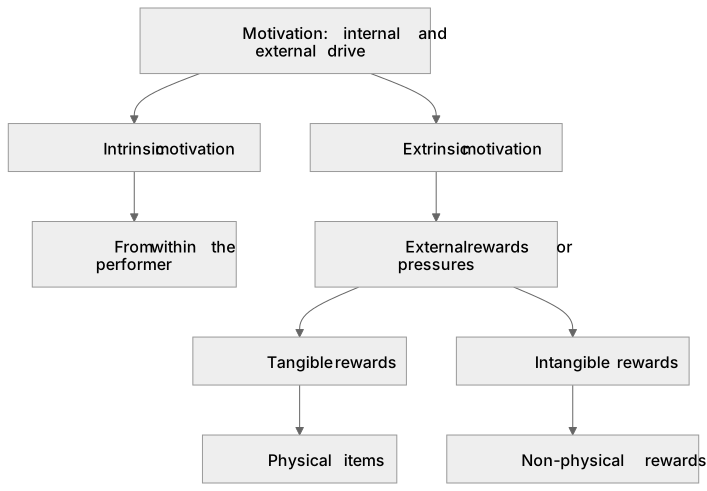
Key words
Say what each word means before you turn the card.
Intrinsic and extrinsic motivation
Try answering aloud or in your head before turning the card.
Tangible and intangible rewards
Try answering aloud or in your head before turning the card.
Goal-directed behaviour
Try answering aloud or in your head before turning the card.
See every definition
- Intrinsic and extrinsic motivation
- The first comes from within the performer, such as enjoyment, satisfaction or the desire to master a skill, while the second comes from external rewards or pressures.
- Tangible and intangible rewards
- The first are physical items you can touch, such as trophies, medals or money, while the second are non-physical rewards, such as praise, applause, records or selection.
- Goal-directed behaviour
- Behaviour that is initiated, directed and sustained by the internal and external drive towards a goal.
Label the diagram
Some boxes have lost their names. Pick the right name for each number.
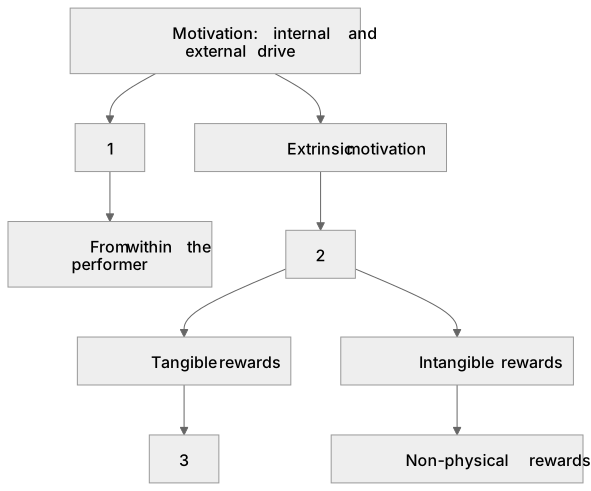
1Box 1
2Box 2
3Box 3
There is more to this lesson
The full lesson goes on to check your understanding and help you earn the marks. Create a free account to carry on, with your progress saved.
A week of Premium from your first lesson · Then the free plan continues · No card, no charge
Test your understanding of Motivation: Motivation.
Active recall beats re-reading. Take an instant quiz now to test what you’ve learned and lock it into long-term memory.
A week of Premium from your first lesson · Then the free plan continues · No card, no charge