AQA · A-Level · Physical Education
Course version: 7582 · Version from Sept 2016
Neuromuscular system: Nervous system.
The nervous system is the body's rapid communication network, allowing movement to be planned, initiated and adjusted.
Checked against the AQA 7582 specification (opens in a new tab) on .
- Point 6 of 16
- 3 key terms
Study notes
From the checked teaching notes for this specification point.
The idea
The nervous system is the body's rapid communication network, allowing movement to be planned, initiated and adjusted. It is divided into the central nervous system (CNS), comprising the brain and spinal cord, and the peripheral nervous system (PNS), which links the CNS to muscles, joints and receptors. The PNS carries sensory input towards the CNS and motor output away from it. Motor pathways divide into the somatic nervous system, which controls voluntary skeletal muscle, and the autonomic nervous system, which regulates involuntary functions. In sport, receptors detect changes such as muscle stretch, the CNS processes this information, and motor neurones deliver impulses to muscle fibres so that a skill such as a tennis serve can be executed and corrected.
What earns the marks
- The central nervous system consists of the brain and spinal cord and acts as the main processing and integration centre.
- The peripheral nervous system connects the CNS with receptors, muscles and joints, carrying sensory information inwards and motor commands outwards.
- Sensory (afferent) neurones transmit impulses from receptors towards the CNS, while motor (efferent) neurones transmit impulses from the CNS to effectors such as skeletal muscle.
- The somatic nervous system controls voluntary movement of skeletal muscle, whereas the autonomic nervous system controls involuntary functions.
- Receptors such as muscle spindles detect stimuli including stretch, and the resulting information allows movement to be monitored and adjusted.
- A correct sequence for a voluntary action is: receptor detects stimulus, sensory neurone carries impulse to CNS, CNS processes information, motor neurone carries impulse to muscle, muscle contracts.
Common mistakes and how to put them right
Thinking the peripheral nervous system is the same as the central nervous system.
Put it right: The CNS is the brain and spinal cord, while the PNS is all nervous tissue outside these structures.
Believing sensory neurones carry impulses away from the CNS.
Put it right: Sensory neurones carry impulses towards the CNS, and motor neurones carry impulses away from it.
Assuming all peripheral nerves are under voluntary control.
Put it right: The somatic division controls voluntary skeletal muscle, but the autonomic division controls involuntary functions.
Confusing the roles of the brain and spinal cord.
Put it right: The brain is the main processing centre, while the spinal cord transmits impulses and can produce rapid reflex responses.
Exam tips
- Learn the division of the nervous system as a simple flow diagram so you can trace a pathway from receptor to muscle.
- Use the correct directional terms: sensory neurones carry impulses towards the CNS and motor neurones carry impulses away from it.
- When a question describes a sporting action, identify the receptor, the sensory pathway, the CNS processing stage and the motor pathway in order.
- Check whether a question asks about structure or function, because marks are awarded for naming the correct component and stating what it does.
Try the lesson
The start of the Neuromuscular system: Nervous system. lesson, made from checked teaching notes for this specification point.
Have a go first
Which part of the nervous system carries nerve impulses from the central nervous system to the skeletal muscles?
Listen
The nervous system is the body's rapid communication network, allowing movement to be planned, initiated and adjusted. It is divided into the central nervous system (CNS), comprising the brain and spinal cord, and the peripheral nervous system (PNS), which links the CNS to muscles, joints and receptors. The PNS carries sensory input towards the CNS and motor output away from it. Motor pathways divide into the somatic nervous system, which controls voluntary skeletal muscle, and the autonomic nervous system, which regulates involuntary functions. In sport, receptors detect changes such as muscle stretch, the CNS processes this information, and motor neurones deliver impulses to muscle fibres so that a skill such as a tennis serve can be executed and corrected. A strong answer earns marks for these points. The central nervous system consists of the brain and spinal cord and acts as the main processing and integration centre. The peripheral nervous system connects the CNS with receptors, muscles and joints, carrying sensory information inwards and motor commands outwards. Sensory (afferent) neurones transmit impulses from receptors towards the CNS, while motor (efferent) neurones transmit impulses from the CNS to effectors such as skeletal muscle. The somatic nervous system controls voluntary movement of skeletal muscle, whereas the autonomic nervous system controls involuntary functions. Exam tip: Learn the division of the nervous system as a simple flow diagram so you can trace a pathway from receptor to muscle.
See it
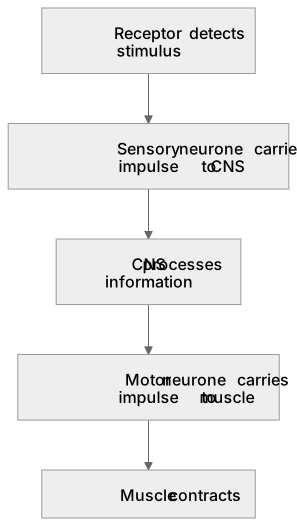
Put it in order
Put these steps in the order they happen.
- 1. Sensory neurone carries impulse to CNS
- 2. CNS processes information
- 3. Receptor detects stimulus
- 4. Muscle contracts
- 5. Motor neurone carries impulse to muscle
Key words
Say what each word means before you turn the card.
Central nervous system
Try answering aloud or in your head before turning the card.
Peripheral nervous system
Try answering aloud or in your head before turning the card.
Somatic nervous system
Try answering aloud or in your head before turning the card.
See every definition
- Central nervous system
- Comprising the brain and spinal cord, it acts as the main processing and integration centre.
- Peripheral nervous system
- Links the CNS to muscles, joints and receptors, carrying sensory input towards the CNS and motor output away from it.
- Somatic nervous system
- Controls voluntary movement of skeletal muscle.
Label the diagram
Some boxes have lost their names. Pick the right name for each number.
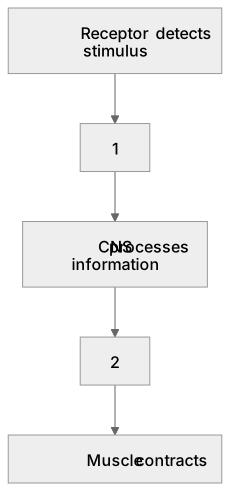
1Box 1
2Box 2
There is more to this lesson
The full lesson goes on to check your understanding and help you earn the marks. Create a free account to carry on, with your progress saved.
A week of Premium from your first lesson · Then the free plan continues · No card, no charge
Test your understanding of Neuromuscular system: Nervous system.
Active recall beats re-reading. Take an instant quiz now to test what you’ve learned and lock it into long-term memory.
A week of Premium from your first lesson · Then the free plan continues · No card, no charge