AQA · A-Level · Physical Education
Course version: 7582 · Version from Sept 2016
Pre-industrial (pre-1780): Two-tier class system.
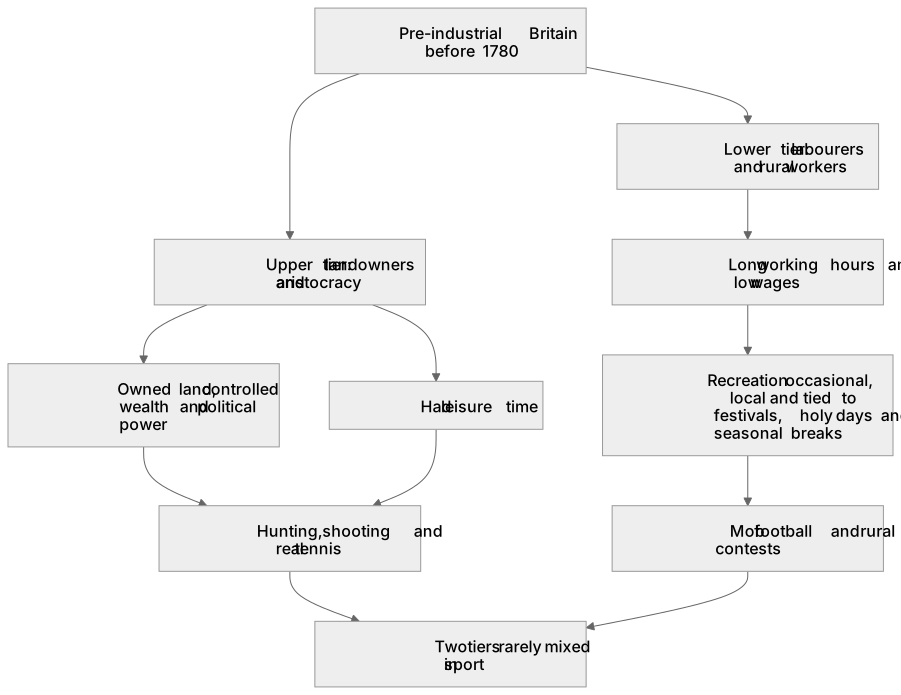
In pre-industrial Britain before 1780, society was organised as a two-tier class system: a small upper tier of landowners and aristocracy, and a large lower tier of labourers and rural workers.
Checked against the AQA 7582 specification (opens in a new tab) on .
- Point 1 of 6
- 4 key terms
Study notes
From the checked teaching notes for this specification point.
The idea
In pre-industrial Britain before 1780, society was organised as a two-tier class system: a small upper tier of landowners and aristocracy, and a large lower tier of labourers and rural workers. The upper tier owned land and controlled wealth, leisure time and political power, so its members could hunt, shoot and take part in occasional organised sport. The lower tier worked long hours on the land for low wages, so its recreation was mainly occasional, local and tied to festivals, holy days and seasonal breaks. The two tiers rarely mixed in sport, and activities such as real tennis or fox hunting were largely restricted to the upper tier, while mob football and rural contests belonged to the lower tier. Understanding this structure explains why pre-industrial sport was local, violent, occasional and wagered upon rather than codified.
What earns the marks
- Identifies pre-industrial Britain as a two-tier society: upper tier of landowners/aristocracy and lower tier of labourers/rural workers.
- Explains that the upper tier held land, wealth, power and leisure time, enabling activities such as hunting, shooting and real tennis.
- Explains that the lower tier had limited leisure because of long working hours, low wages and dependence on land owners.
- States that the two tiers rarely competed together and that sport was largely class-separated.
- Links the class structure to the characteristics of pre-industrial sport: local, occasional, violent, simple and wagered upon.
Common mistakes and how to put them right
Thinking the two tiers mixed freely in sport.
Put it right: In fact activities were largely class-separated, with upper-tier sports such as real tennis and lower-tier activities such as mob football.
Assuming the lower tier had plenty of leisure time.
Put it right: Long working hours and low wages meant recreation was occasional and tied to festivals or holy days.
Confusing the pre-industrial two-tier system with the later three-tier class system of industrial Britain.
Put it right: The pre-1780 structure had just upper and lower tiers.
Believing sport was already codified and national.
Put it right: Pre-industrial sport was local, simple and loosely organised, with rules varying from place to place.
Exam tips
- Anchor answers in the pre-1780 period and avoid importing industrial-era features such as the middle class or national governing bodies.
- Use the two tiers by name and give one upper-tier and one lower-tier activity to show the class divide.
- Link each tier's lifestyle to its sporting opportunities: land, money and time for the upper tier; work and wages for the lower tier.
- When a question asks about characteristics of pre-industrial sport, connect them back to the class system rather than listing them in isolation.
Try the lesson
The start of the Pre-industrial (pre-1780): Two-tier class system. lesson, made from checked teaching notes for this specification point.
Have a go first
In pre-industrial Britain before 1780, which two broad social groups made up the two-tier class system?
Listen
In pre-industrial Britain before 1780, society was organised as a two-tier class system: a small upper tier of landowners and aristocracy, and a large lower tier of labourers and rural workers. The upper tier owned land and controlled wealth, leisure time and political power, so its members could hunt, shoot and take part in occasional organised sport. The lower tier worked long hours on the land for low wages, so its recreation was mainly occasional, local and tied to festivals, holy days and seasonal breaks. The two tiers rarely mixed in sport, and activities such as real tennis or fox hunting were largely restricted to the upper tier, while mob football and rural contests belonged to the lower tier. Understanding this structure explains why pre-industrial sport was local, violent, occasional and wagered upon rather than codified. A strong answer earns marks for these points. Identifies pre-industrial Britain as a two-tier society: upper tier of landowners/aristocracy and lower tier of labourers/rural workers. Explains that the upper tier held land, wealth, power and leisure time, enabling activities such as hunting, shooting and real tennis. Explains that the lower tier had limited leisure because of long working hours, low wages and dependence on land owners. States that the two tiers rarely competed together and that sport was largely class-separated. Exam tip: Anchor answers in the pre-1780 period and avoid importing industrial-era features such as the middle class or national governing bodies.
See it
Key words
Say what each word means before you turn the card.
Two-tier class system
Try answering aloud or in your head before turning the card.
Upper tier
Try answering aloud or in your head before turning the card.
Lower tier
Try answering aloud or in your head before turning the card.
Class separation in sport
Try answering aloud or in your head before turning the card.
See every definition
- Two-tier class system
- A society organised into a small upper tier of landowners and aristocracy and a large lower tier of labourers and rural workers.
- Upper tier
- The small group of landowners and aristocracy who owned land and controlled wealth, leisure time and political power.
- Lower tier
- The large group of labourers and rural workers who worked long hours on the land for low wages.
- Class separation in sport
- The two tiers rarely mixed in sport, with activities such as real tennis or fox hunting largely restricted to the upper tier and mob football and rural contests belonging to the lower tier.
Label the diagram
Some boxes have lost their names. Pick the right name for each number.
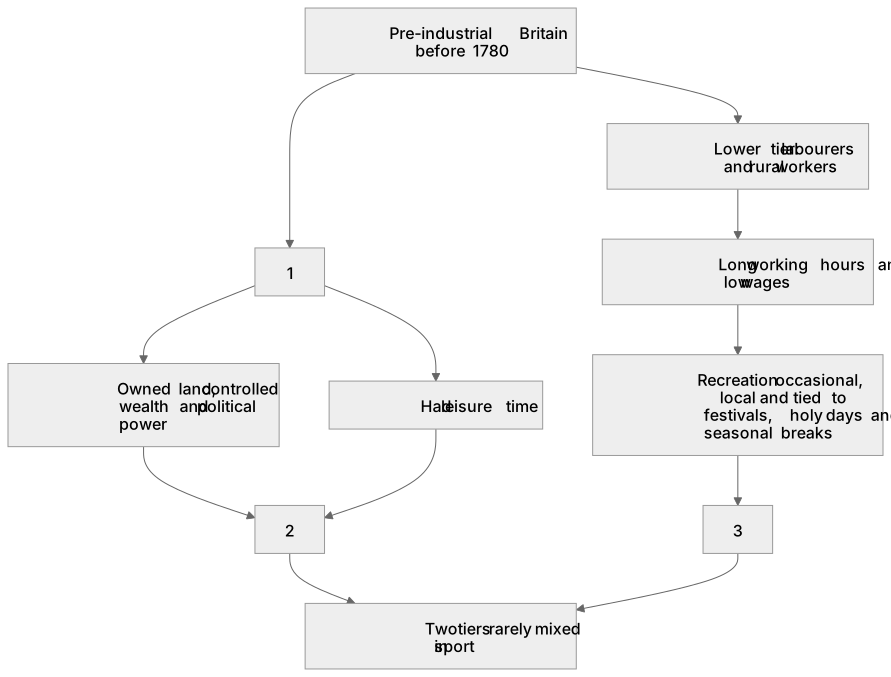
1Box 1
2Box 2
3Box 3
There is more to this lesson
The full lesson goes on to check your understanding and help you earn the marks. Create a free account to carry on, with your progress saved.
A week of Premium from your first lesson · Then the free plan continues · No card, no charge
Test your understanding of Pre-industrial (pre-1780): Two-tier class system.
Active recall beats re-reading. Take an instant quiz now to test what you’ve learned and lock it into long-term memory.
A week of Premium from your first lesson · Then the free plan continues · No card, no charge