AQA · A-Level · Physical Education
Course version: 7582 · Version from Sept 2016
Proprioceptive Neuromuscular Facilitation (PNF) (flexibility).
Full specification wording
Preparation and training methods in relation to maintaining physical activity and performance: Proprioceptive Neuromuscular Facilitation (PNF) (flexibility).
PNF is a flexibility method that uses the proprioceptors in muscle and tendon to override the stretch reflex and gain a longer range of movement.
Checked against the AQA 7582 specification (opens in a new tab) on .
- Point 19 of 19
- 4 key terms
Study notes
From the checked teaching notes for this specification point.
The idea
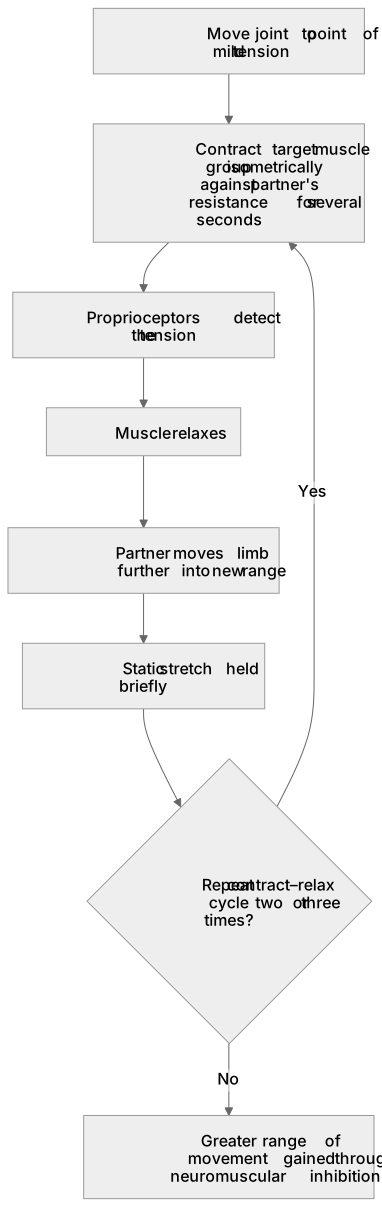
PNF is a flexibility method that uses the proprioceptors in muscle and tendon to override the stretch reflex and gain a longer range of movement. The performer moves the joint to the point of mild tension, then contracts the target muscle group isometrically against a partner's resistance for several seconds. The proprioceptors detect the tension and the muscle relaxes; the partner then moves the limb further into the new range. The contract–relax sequence may be repeated two or three times in one session. The static stretch that follows the contraction is held briefly before the next repetition. PNF therefore develops flexibility through neuromuscular inhibition rather than passive lengthening alone, and it needs a trained partner or coach to control the resistance safely.
What earns the marks
- PNF is a flexibility training method that uses the proprioceptors (muscle spindles and Golgi tendon organs) to reduce the stretch reflex and allow a greater range of movement.
- The performer contracts the target muscle group isometrically against resistance, usually provided by a partner, at the point of mild tension.
- After the isometric contraction the muscle relaxes, and the limb is moved passively into a new, greater range before the stretch is held briefly.
- The contract–relax cycle is typically repeated two or three times within a session to accumulate the flexibility gain.
- PNF requires a trained partner or coach because the resistance and the subsequent stretch must be controlled to avoid injury.
- PNF is distinct from static, ballistic and dynamic stretching because it relies on neuromuscular inhibition rather than passive holding or momentum.
Common mistakes and how to put them right
Thinking PNF is simply a long passive hold.
Put it right: It is not, because the defining feature is the isometric contraction against resistance before the passive stretch.
Believing the performer pushes the limb further themselves.
Put it right: The partner or coach moves the limb after the contraction, so the stretch is passive.
Confusing PNF with ballistic stretching.
Put it right: Ballistic uses bouncing momentum, whereas PNF uses a controlled isometric contraction and relaxation.
Assuming PNF can be performed safely alone with no resistance.
Put it right: Without a trained partner the resistance and range cannot be controlled, which raises injury risk.
Exam tips
- Name the proprioceptors involved (muscle spindles and Golgi tendon organs) and state what they detect, rather than writing only 'the muscle relaxes'.
- Sequence the method in order: move to mild tension, contract isometrically against resistance, relax, then stretch further passively.
- Link PNF to a named activity context, such as a gymnast or hurdler needing hip and hamstring range, to show applied understanding.
Try the lesson
The start of the Preparation and training methods in relation to maintaining physical activity and performance: Proprioceptive Neuromuscular Facilitation (PNF) (flexibility). lesson, made from checked teaching notes for this specification point.
Have a go first
Which description best matches how a performer carries out a PNF flexibility technique?
Listen
PNF is a flexibility method that uses the proprioceptors in muscle and tendon to override the stretch reflex and gain a longer range of movement. The performer moves the joint to the point of mild tension, then contracts the target muscle group isometrically against a partner's resistance for several seconds. The proprioceptors detect the tension and the muscle relaxes; the partner then moves the limb further into the new range. The contract–relax sequence may be repeated two or three times in one session. The static stretch that follows the contraction is held briefly before the next repetition. PNF therefore develops flexibility through neuromuscular inhibition rather than passive lengthening alone, and it needs a trained partner or coach to control the resistance safely. A strong answer earns marks for these points. PNF is a flexibility training method that uses the proprioceptors (muscle spindles and Golgi tendon organs) to reduce the stretch reflex and allow a greater range of movement. The performer contracts the target muscle group isometrically against resistance, usually provided by a partner, at the point of mild tension. After the isometric contraction the muscle relaxes, and the limb is moved passively into a new, greater range before the stretch is held briefly. The contract–relax cycle is typically repeated two or three times within a session to accumulate the flexibility gain. Exam tip: Name the proprioceptors involved (muscle spindles and Golgi tendon organs) and state what they detect, rather than writing only 'the muscle relaxes'.
See it
Key words
Say what each word means before you turn the card.
Flexibility training methods
Try answering aloud or in your head before turning the card.
Neuromuscular control of range of movement
Try answering aloud or in your head before turning the card.
Role of proprioceptors in inhibiting the stretch reflex
Try answering aloud or in your head before turning the card.
Safe practice and the need for a trained partner
Try answering aloud or in your head before turning the card.
See every definition
- Flexibility training methods
- PNF is a flexibility method that uses the proprioceptors in muscle and tendon to override the stretch reflex and gain a longer range of movement.
- Neuromuscular control of range of movement
- PNF develops flexibility through neuromuscular inhibition rather than passive lengthening alone.
- Role of proprioceptors in inhibiting the stretch reflex
- The proprioceptors detect the tension and the muscle relaxes, allowing the limb to be moved further into the new range.
- Safe practice and the need for a trained partner
- PNF needs a trained partner or coach to control the resistance safely.
There is more to this lesson
The full lesson goes on to check your understanding and help you earn the marks. Create a free account to carry on, with your progress saved.
A week of Premium from your first lesson · Then the free plan continues · No card, no charge
Test your understanding of Preparation and training methods in relation to maintaining physical activity and performance: Proprioceptive Neuromuscular Facilitation (PNF) (flexibility).
Active recall beats re-reading. Take an instant quiz now to test what you’ve learned and lock it into long-term memory.
A week of Premium from your first lesson · Then the free plan continues · No card, no charge