AQA · A-Level · Physical Education
Course version: 7582 · Version from Sept 2016
Projectile motion: Vector components of parabolic flight.
A projectile launched at an angle has one velocity vector, but it is far easier to analyse by splitting that vector into two independent components.
Checked against the AQA 7582 specification (opens in a new tab) on .
- Point 4 of 4
- 3 key terms
Study notes
From the checked teaching notes for this specification point.
The idea
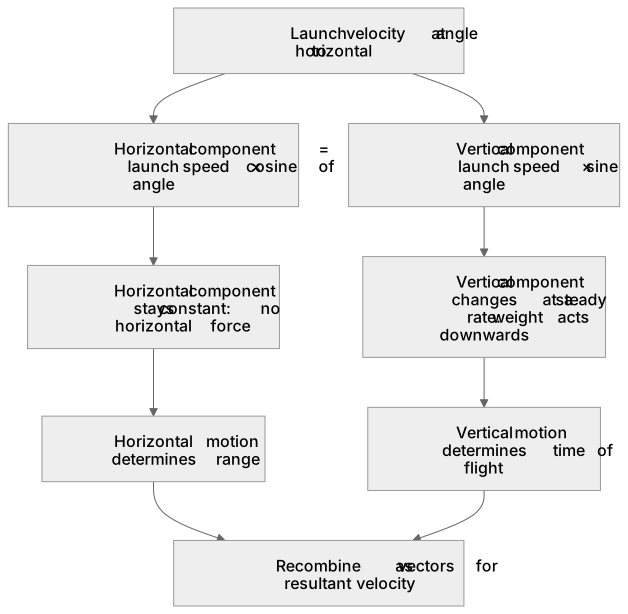
A projectile launched at an angle has one velocity vector, but it is far easier to analyse by splitting that vector into two independent components. The horizontal component is found from the launch speed and the cosine of the angle to the horizontal, and it stays constant because no horizontal force acts once the object is in flight. The vertical component is found from the launch speed and the sine of the angle, and it changes at a steady rate because gravity acts downwards throughout the parabolic path. For example, a ball struck at 20 m s⁻¹ at 30° to the horizontal has a horizontal component of 20 cos 30° ≈ 17.3 m s⁻¹ and an initial vertical component of 20 sin 30° = 10 m s⁻¹. Treating the two components separately lets you find time of flight from the vertical motion and range from the horizontal motion, then recombine them as vectors if a resultant velocity is needed.
What earns the marks
- Horizontal component equals launch speed multiplied by the cosine of the angle to the horizontal.
- Vertical component equals launch speed multiplied by the sine of the angle to the horizontal.
- The horizontal component remains constant during flight because no horizontal force acts on the projectile.
- The vertical component changes at a constant rate because the only force is weight acting downwards.
- The two components are independent, so vertical motion determines time of flight while horizontal motion determines range.
- Components can be recombined using Pythagoras and trigonometry to give the resultant velocity at any instant.
Common mistakes and how to put them right
Swapping sine and cosine.
Put it right: The horizontal component uses the cosine of the angle to the horizontal.
Treating the horizontal component as changing.
Put it right: It stays constant because no horizontal force acts.
Adding components as scalars.
Put it right: They are perpendicular vectors, so they must be combined by vector addition.
Forgetting that the vertical component is zero at the highest point.
Put it right: Only the horizontal component remains there.
Exam tips
- Sketch the launch vector with its angle and label the horizontal and vertical components before doing any calculation.
- State the angle you are measuring from, because sine and cosine swap if the angle is taken from the vertical.
- Check that your horizontal component is larger than the vertical component whenever the launch angle is below 45°.
- Keep the vertical sign convention consistent, taking upwards as positive or negative and applying it to every vertical value.
Try the lesson
The start of the Projectile motion: Vector components of parabolic flight. lesson, made from checked teaching notes for this specification point.
Have a go first
A ball is projected into the air and follows a parabolic path. Ignoring air resistance, which statement describes its horizontal velocity component during the flight?
Listen
A projectile launched at an angle has one velocity vector, but it is far easier to analyse by splitting that vector into two independent components. The horizontal component is found from the launch speed and the cosine of the angle to the horizontal, and it stays constant because no horizontal force acts once the object is in flight. The vertical component is found from the launch speed and the sine of the angle, and it changes at a steady rate because gravity acts downwards throughout the parabolic path. For example, a ball struck at 20 m s⁻¹ at 30° to the horizontal has a horizontal component of 20 cos 30° ≈ 17.3 m s⁻¹ and an initial vertical component of 20 sin 30° = 10 m s⁻¹. Treating the two components separately lets you find time of flight from the vertical motion and range from the horizontal motion, then recombine them as vectors if a resultant velocity is needed. A strong answer earns marks for these points. Horizontal component equals launch speed multiplied by the cosine of the angle to the horizontal. Vertical component equals launch speed multiplied by the sine of the angle to the horizontal. The horizontal component remains constant during flight because no horizontal force acts on the projectile. The vertical component changes at a constant rate because the only force is weight acting downwards. A common slip: Swapping sine and cosine: the error is using the sine for the horizontal component. Instead, the horizontal component uses the cosine of the angle to the horizontal. Exam tip: Sketch the launch vector with its angle and label the horizontal and vertical components before doing any calculation.
See it
Key words
Say what each word means before you turn the card.
Independence of horizontal and vertical motion
Try answering aloud or in your head before turning the card.
Constant horizontal velocity under zero horizontal force
Try answering aloud or in your head before turning the card.
Constant vertical acceleration due to gravity
Try answering aloud or in your head before turning the card.
See every definition
- Independence of horizontal and vertical motion
- Treating the two components separately, so vertical motion determines time of flight while horizontal motion determines range.
- Constant horizontal velocity under zero horizontal force
- The horizontal component stays constant because no horizontal force acts once the object is in flight.
- Constant vertical acceleration due to gravity
- The vertical component changes at a steady rate because gravity acts downwards throughout the parabolic path.
Label the diagram
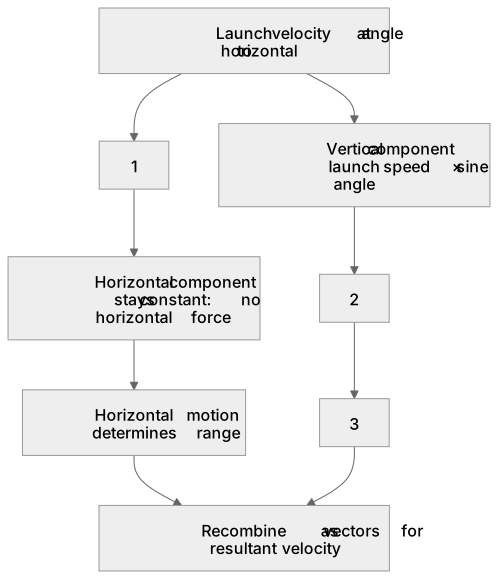
Some boxes have lost their names. Pick the right name for each number.
1Box 1
2Box 2
3Box 3
There is more to this lesson
The full lesson goes on to check your understanding and help you earn the marks. Create a free account to carry on, with your progress saved.
A week of Premium from your first lesson · Then the free plan continues · No card, no charge
Test your understanding of Projectile motion: Vector components of parabolic flight.
Active recall beats re-reading. Take an instant quiz now to test what you’ve learned and lock it into long-term memory.
A week of Premium from your first lesson · Then the free plan continues · No card, no charge