AQA · A-Level · Physical Education
Course version: 7582 · Version from Sept 2016
Impact of poor lifestyle choices on the respiratory system.
Full specification wording
Respiratory system: Impact of poor lifestyle choices on the respiratory system.
Poor lifestyle choices, specifically smoking, have a severely detrimental impact on the respiratory system and athletic performance.
Checked against the AQA 7582 specification (opens in a new tab) on .
- Point 15 of 17
- 3 key terms
Study notes
From the checked teaching notes for this specification point.
The idea
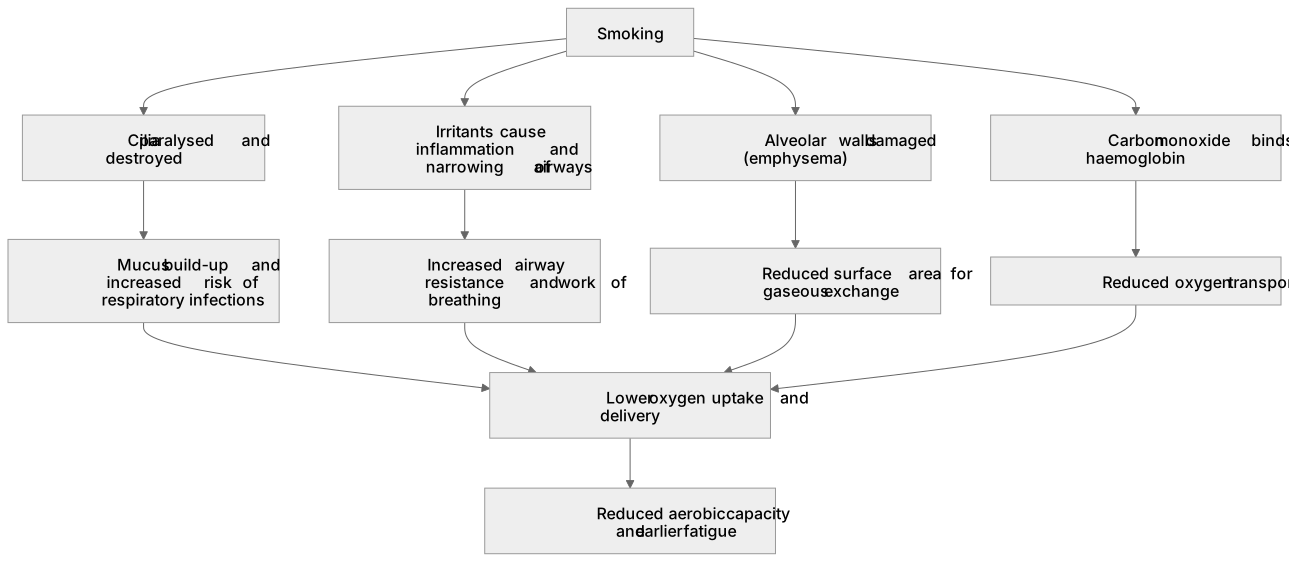
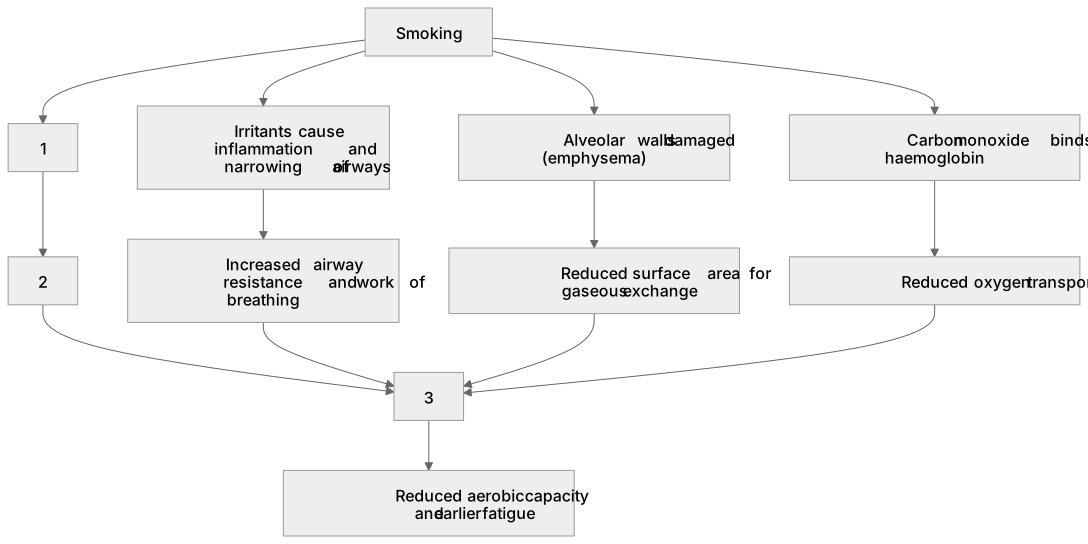
Poor lifestyle choices, specifically smoking, have a severely detrimental impact on the respiratory system and athletic performance. Smoking damages and paralyses the cilia, which are responsible for sweeping away mucus and trapped pathogens, leading to a build-up of mucus and increased risk of respiratory infections. The tar and irritants in cigarette smoke cause inflammation and narrowing of the airways, increasing airway resistance. Furthermore, smoking damages the alveolar walls, a condition known as emphysema, which significantly reduces the surface area available for gaseous exchange. Carbon monoxide from smoke also binds to haemoglobin, reducing oxygen transport. These factors combined lower oxygen uptake and delivery, reducing aerobic capacity and causing earlier fatigue.
What earns the marks
- Smoking paralyses and destroys cilia, leading to mucus build-up and increased risk of respiratory infections.
- Irritants in smoke cause inflammation and narrowing of the airways, increasing the work of breathing.
- Smoking damages alveolar walls (emphysema), reducing the surface area available for gaseous exchange.
- Carbon monoxide from smoking binds to haemoglobin, reducing the blood's oxygen-carrying capacity.
Common mistakes and how to put them right
Discussing lifestyle factors other than smoking.
Put it right: The specification explicitly limits this topic to the impact of smoking on the respiratory system.
Believing smoking only affects the lungs.
Put it right: It also affects oxygen transport because carbon monoxide binds to haemoglobin.
Vaguely stating smoking is bad for breathing without naming specific structures like cilia, alveoli, or airways.
Exam tips
- Focus exclusively on smoking when asked about poor lifestyle choices affecting the respiratory system in this specific context.
- Link the damage to specific structures (e.g., cilia, alveoli) to their functional consequence (e.g., reduced gaseous exchange).
- Connect the respiratory damage from smoking to its ultimate effect on exercise performance, such as reduced aerobic capacity and earlier fatigue.
Try the lesson
The start of the Respiratory system: Impact of poor lifestyle choices on the respiratory system. lesson, made from checked teaching notes for this specification point.
Have a go first
Which poor lifestyle choice most directly increases the risk of developing lung cancer and chronic obstructive pulmonary disease?
Listen
Poor lifestyle choices, specifically smoking, have a severely detrimental impact on the respiratory system and athletic performance. Smoking damages and paralyses the cilia, which are responsible for sweeping away mucus and trapped pathogens, leading to a build-up of mucus and increased risk of respiratory infections. The tar and irritants in cigarette smoke cause inflammation and narrowing of the airways, increasing airway resistance. Furthermore, smoking damages the alveolar walls, a condition known as emphysema, which significantly reduces the surface area available for gaseous exchange. Carbon monoxide from smoke also binds to haemoglobin, reducing oxygen transport. These factors combined lower oxygen uptake and delivery, reducing aerobic capacity and causing earlier fatigue. A strong answer earns marks for these points. Smoking paralyses and destroys cilia, leading to mucus build-up and increased risk of respiratory infections. Irritants in smoke cause inflammation and narrowing of the airways, increasing the work of breathing. Smoking damages alveolar walls (emphysema), reducing the surface area available for gaseous exchange. Carbon monoxide from smoking binds to haemoglobin, reducing the blood's oxygen-carrying capacity. Exam tip: Focus exclusively on smoking when asked about poor lifestyle choices affecting the respiratory system in this specific context.
See it
Key words
Say what each word means before you turn the card.
Cilia damage
Try answering aloud or in your head before turning the card.
Airway narrowing
Try answering aloud or in your head before turning the card.
Emphysema
Try answering aloud or in your head before turning the card.
See every definition
- Cilia damage
- Smoking paralyses and destroys the cilia, which are responsible for sweeping away mucus and trapped pathogens, leading to a build-up of mucus and increased risk of respiratory infections.
- Airway narrowing
- The tar and irritants in cigarette smoke cause inflammation and narrowing of the airways, increasing airway resistance and the work of breathing.
- Emphysema
- Smoking damages the alveolar walls, significantly reducing the surface area available for gaseous exchange.
Label the diagram
Some boxes have lost their names. Pick the right name for each number.
1Box 1
2Box 2
3Box 3
There is more to this lesson
The full lesson goes on to check your understanding and help you earn the marks. Create a free account to carry on, with your progress saved.
A week of Premium from your first lesson · Then the free plan continues · No card, no charge
Test your understanding of Respiratory system: Impact of poor lifestyle choices on the respiratory system.
Active recall beats re-reading. Take an instant quiz now to test what you’ve learned and lock it into long-term memory.
A week of Premium from your first lesson · Then the free plan continues · No card, no charge