AQA · A-Level · Physical Education
Course version: 7582 · Version from Sept 2016
Respiratory system: Inspiratory reserve volume.
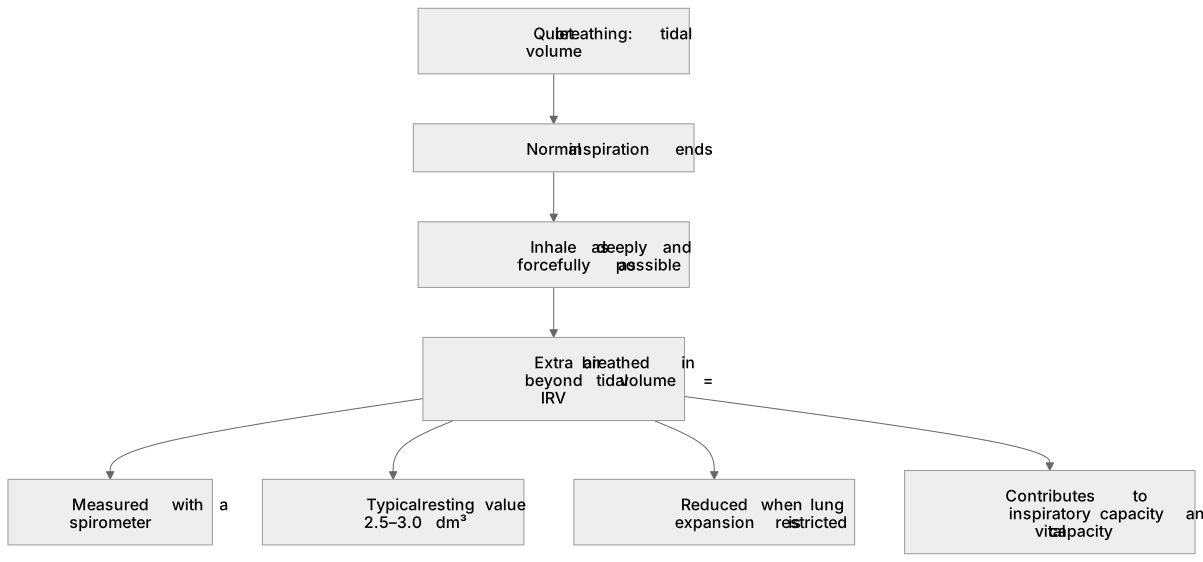
Inspiratory reserve volume (IRV) is the extra volume of air a person can forcibly breathe in after a normal, quiet inspiration has finished.
Checked against the AQA 7582 specification (opens in a new tab) on .
- Point 4 of 17
- 4 key terms
Study notes
From the checked teaching notes for this specification point.
The idea
Inspiratory reserve volume (IRV) is the extra volume of air a person can forcibly breathe in after a normal, quiet inspiration has finished. It is measured with a spirometer: the subject breathes quietly, then inhales as deeply and forcefully as possible, and the volume inspired beyond the tidal volume is the IRV. Typical resting values are around 2.5–3.0 dm³ (litres) in healthy young adults, and it is reduced in restrictive conditions that limit lung expansion. IRV is one of the four primary lung volumes, alongside tidal volume, expiratory reserve volume and residual volume, and it contributes to inspiratory capacity and vital capacity.
What earns the marks
- IRV is the additional volume of air that can be forcibly inhaled after the end of a normal tidal inspiration.
- Typical resting values are approximately 2.5–3.0 dm³ in healthy young adults.
- IRV is reduced when lung expansion is restricted, for example by restrictive disease or reduced chest compliance.
- IRV is a primary lung volume and contributes to inspiratory capacity and vital capacity.
Common mistakes and how to put them right
Confusing IRV with tidal volume.
Put it right: Tidal volume is the air moved in one quiet breath, whereas IRV is the extra air forcibly inhaled after that quiet breath.
Confusing IRV with vital capacity.
Put it right: Vital capacity is the total air exhaled after a maximal inhalation, which includes tidal volume, IRV and expiratory reserve volume.
Thinking IRV is the maximum volume the lungs can hold.
Put it right: Total lung capacity also includes residual volume, which cannot be exhaled.
Exam tips
- Learn the definition as 'extra air forcibly inhaled after a normal inspiration' and use those exact functional words in your answer.
- Link IRV to a spirometer trace: identify the section above the tidal volume baseline that represents the forced extra inhalation.
- Practise comparing IRV with the other lung volumes so you can eliminate distractors quickly in multiple-choice questions.
Try the lesson
The start of the Respiratory system: Inspiratory reserve volume. lesson, made from checked teaching notes for this specification point.
Have a go first
Which lung volume describes the extra air a person can breathe in beyond a normal resting breath?
Listen
Inspiratory reserve volume (IRV) is the extra volume of air a person can forcibly breathe in after a normal, quiet inspiration has finished. It is measured with a spirometer: the subject breathes quietly, then inhales as deeply and forcefully as possible, and the volume inspired beyond the tidal volume is the IRV. Typical resting values are around 2.5–3.0 dm³ (litres) in healthy young adults, and it is reduced in restrictive conditions that limit lung expansion. IRV is one of the four primary lung volumes, alongside tidal volume, expiratory reserve volume and residual volume, and it contributes to inspiratory capacity and vital capacity. A strong answer earns marks for these points. IRV is the additional volume of air that can be forcibly inhaled after the end of a normal tidal inspiration. Typical resting values are approximately 2.5–3.0 dm³ in healthy young adults. IRV is reduced when lung expansion is restricted, for example by restrictive disease or reduced chest compliance. IRV is a primary lung volume and contributes to inspiratory capacity and vital capacity. Exam tip: Learn the definition as 'extra air forcibly inhaled after a normal inspiration' and use those exact functional words in your answer.
See it
Key words
Say what each word means before you turn the card.
Inspiratory reserve volume
Try answering aloud or in your head before turning the card.
Spirometry and measurement
Try answering aloud or in your head before turning the card.
Lung volumes and capacities
Try answering aloud or in your head before turning the card.
Respiratory adaptations and limitations
Try answering aloud or in your head before turning the card.
See every definition
- Inspiratory reserve volume
- The extra volume of air a person can forcibly breathe in after a normal, quiet inspiration has finished.
- Spirometry and measurement
- A spirometer is used: the subject breathes quietly, then inhales as deeply and forcefully as possible, and the volume inspired beyond the tidal volume is the IRV.
- Lung volumes and capacities
- IRV is one of the four primary lung volumes, alongside tidal volume, expiratory reserve volume and residual volume, and it contributes to inspiratory capacity and vital capacity.
- Respiratory adaptations and limitations
- IRV is reduced in restrictive conditions that limit lung expansion.
Label the diagram
Some boxes have lost their names. Pick the right name for each number.
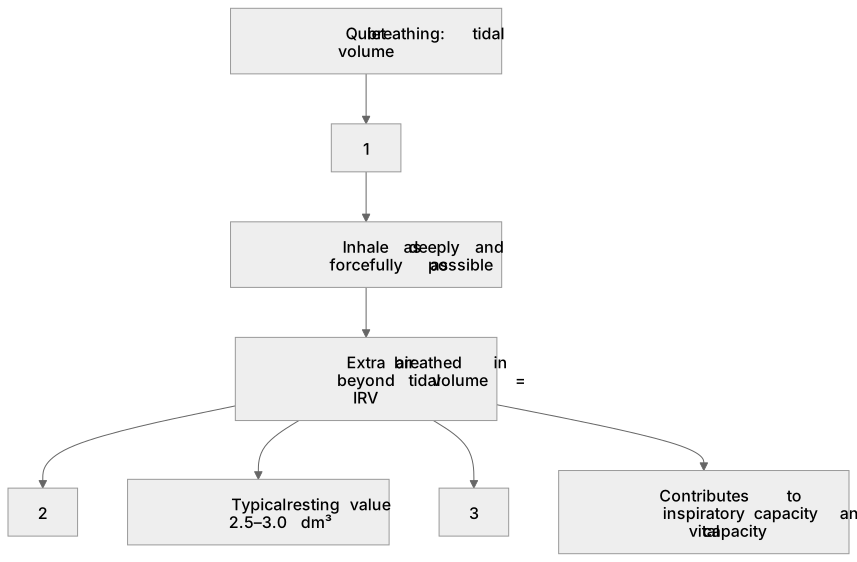
1Box 1
2Box 2
3Box 3
There is more to this lesson
The full lesson goes on to check your understanding and help you earn the marks. Create a free account to carry on, with your progress saved.
A week of Premium from your first lesson · Then the free plan continues · No card, no charge
Test your understanding of Respiratory system: Inspiratory reserve volume.
Active recall beats re-reading. Take an instant quiz now to test what you’ve learned and lock it into long-term memory.
A week of Premium from your first lesson · Then the free plan continues · No card, no charge