AQA · A-Level · Physical Education
Course version: 7582 · Version from Sept 2016
Respiratory system: Minute Ventilation.
Minute ventilation is the total volume of air moved into or out of the lungs in one minute.
Checked against the AQA 7582 specification (opens in a new tab) on .
- Point 6 of 17
Study notes
From the checked teaching notes for this specification point.
The idea
Minute ventilation is the total volume of air moved into or out of the lungs in one minute. It is calculated by multiplying tidal volume by breathing frequency, so a resting tidal volume of about 0.5 dm³ at 12 breaths per minute gives a minute ventilation of about 6 dm³ per minute. The value is expressed in dm³ min⁻¹ or litres per minute. During exercise both tidal volume and breathing frequency rise, so minute ventilation increases steeply, and it is measured by combining a spirometer reading of tidal volume with a count of breaths per minute.
What earns the marks
- Minute ventilation is the total volume of air breathed in or out in one minute.
- A typical resting value is about 6 dm³ min⁻¹, for example 0.5 dm³ × 12 breaths per minute.
Common mistakes and how to put them right
Confusing minute ventilation with tidal volume.
Put it right: Tidal volume is one breath, while minute ventilation is the volume for a whole minute.
Dividing instead of multiplying.
Put it right: Minute ventilation is tidal volume multiplied by breathing frequency, not divided by it.
Using the wrong time unit.
Put it right: The frequency must be breaths per minute so the answer is a volume per minute.
Assuming minute ventilation is fixed at rest.
Put it right: It increases during exercise as both tidal volume and breathing frequency rise.
Exam tips
- Write the equation as minute ventilation = tidal volume × breathing frequency before substituting values.
- Check that breathing frequency is given per minute; convert if it is stated per other time period.
- Keep units consistent, for example dm³ × min⁻¹ gives dm³ min⁻¹.
- Use a typical resting calculation such as 0.5 dm³ × 12 to sanity-check whether an answer is plausible.
Try the lesson
The start of the Respiratory system: Minute Ventilation. lesson, made from checked teaching notes for this specification point.
Have a go first
Which equation correctly defines minute ventilation?
Listen
Minute ventilation is the total volume of air moved into or out of the lungs in one minute. It is calculated by multiplying tidal volume by breathing frequency, so a resting tidal volume of about 0.5 dm³ at 12 breaths per minute gives a minute ventilation of about 6 dm³ per minute. The value is expressed in dm³ min⁻¹ or litres per minute. During exercise both tidal volume and breathing frequency rise, so minute ventilation increases steeply, and it is measured by combining a spirometer reading of tidal volume with a count of breaths per minute. A strong answer earns marks for these points. Minute ventilation is the total volume of air breathed in or out in one minute. A typical resting value is about 6 dm³ min⁻¹, for example 0.5 dm³ × 12 breaths per minute. Exam tip: Write the equation as minute ventilation = tidal volume × breathing frequency before substituting values.
See it
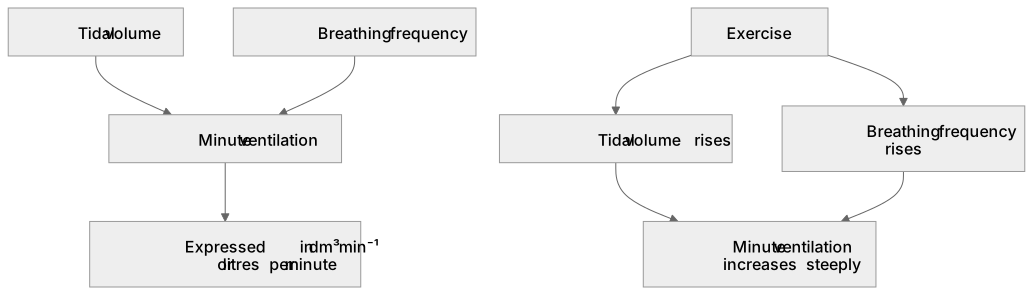
Label the diagram
Some boxes have lost their names. Pick the right name for each number.
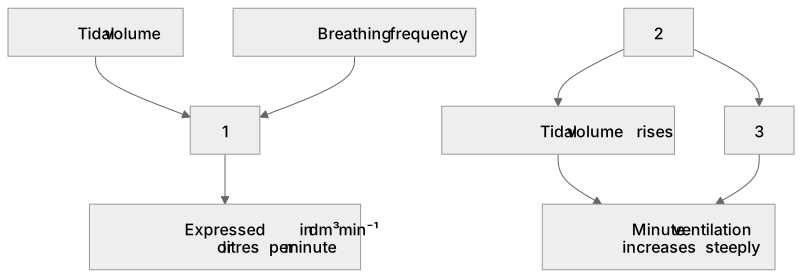
1Box 1
2Box 2
3Box 3
There is more to this lesson
The full lesson goes on to check your understanding and help you earn the marks. Create a free account to carry on, with your progress saved.
A week of Premium from your first lesson · Then the free plan continues · No card, no charge
Test your understanding of Respiratory system: Minute Ventilation.
Active recall beats re-reading. Take an instant quiz now to test what you’ve learned and lock it into long-term memory.
A week of Premium from your first lesson · Then the free plan continues · No card, no charge