AQA · A-Level · Physical Education
Course version: 7582 · Version from Sept 2016
Respiratory system: Oxygen transport.
Oxygen transport describes how oxygen moves from the lungs to the tissues and how much blood can carry.
Checked against the AQA 7582 specification (opens in a new tab) on .
- Point 17 of 17
- 4 key terms
Study notes
From the checked teaching notes for this specification point.
The idea
Oxygen transport describes how oxygen moves from the lungs to the tissues and how much blood can carry. Most oxygen binds reversibly to haemoglobin inside red blood cells, forming oxyhaemoglobin; a small fraction dissolves directly in plasma. Each haemoglobin molecule can bind four oxygen molecules, so fully saturated blood carries far more oxygen than plasma alone could. Binding depends on the partial pressure of oxygen: high at the alveoli, so oxygen loads onto haemoglobin, and lower at active muscle, so oxygen dissociates and diffuses into the fibres. The oxyhaemoglobin dissociation curve is S-shaped, and a rightward shift (Bohr effect) releases more oxygen when carbon dioxide, acidity or temperature rise. At the tissues, myoglobin also assists uptake.
What earns the marks
- Oxygen is carried mainly as oxyhaemoglobin, bound reversibly to haemoglobin in red blood cells.
- A small proportion of oxygen is dissolved directly in blood plasma.
- Each haemoglobin molecule can bind up to four oxygen molecules, giving a high carrying capacity.
- Loading occurs at the alveoli where partial pressure of oxygen is high; dissociation occurs at tissues where it is lower.
- The oxyhaemoglobin dissociation curve is S-shaped, and a rightward shift releases more oxygen.
- Carbon dioxide, increased acidity and raised temperature shift the curve right (Bohr effect).
Common mistakes and how to put them right
Thinking all oxygen travels bound to haemoglobin.
Put it right: A small amount dissolves in plasma, though haemoglobin carries the majority.
Believing oxygen is actively pumped onto haemoglobin.
Put it right: Binding is passive and depends on partial pressure gradients.
Assuming the dissociation curve is a straight line.
Put it right: It is S-shaped, so loading and unloading are not linear.
Confusing myoglobin with haemoglobin.
Put it right: Myoglobin stores oxygen in muscle and has a higher affinity, aiding uptake at the tissues.
Exam tips
- Link each transport step to the partial pressure gradient, naming alveoli and tissues explicitly.
- Use the terms loading, dissociation and oxyhaemoglobin precisely rather than vague wording.
- When explaining a rightward shift, name the specific factors (carbon dioxide, acidity, temperature) and the effect on oxygen release.
Try the lesson
The start of the Respiratory system: Oxygen transport. lesson, made from checked teaching notes for this specification point.
Have a go first
Most oxygen is transported in the blood combined with which substance inside red blood cells?
Listen
Oxygen transport describes how oxygen moves from the lungs to the tissues and how much blood can carry. Most oxygen binds reversibly to haemoglobin inside red blood cells, forming oxyhaemoglobin; a small fraction dissolves directly in plasma. Each haemoglobin molecule can bind four oxygen molecules, so fully saturated blood carries far more oxygen than plasma alone could. Binding depends on the partial pressure of oxygen: high at the alveoli, so oxygen loads onto haemoglobin, and lower at active muscle, so oxygen dissociates and diffuses into the fibres. The oxyhaemoglobin dissociation curve is S-shaped, and a rightward shift (Bohr effect) releases more oxygen when carbon dioxide, acidity or temperature rise. At the tissues, myoglobin also assists uptake. A strong answer earns marks for these points. Oxygen is carried mainly as oxyhaemoglobin, bound reversibly to haemoglobin in red blood cells. A small proportion of oxygen is dissolved directly in blood plasma. Each haemoglobin molecule can bind up to four oxygen molecules, giving a high carrying capacity. Loading occurs at the alveoli where partial pressure of oxygen is high; dissociation occurs at tissues where it is lower. Exam tip: Link each transport step to the partial pressure gradient, naming alveoli and tissues explicitly.
See it
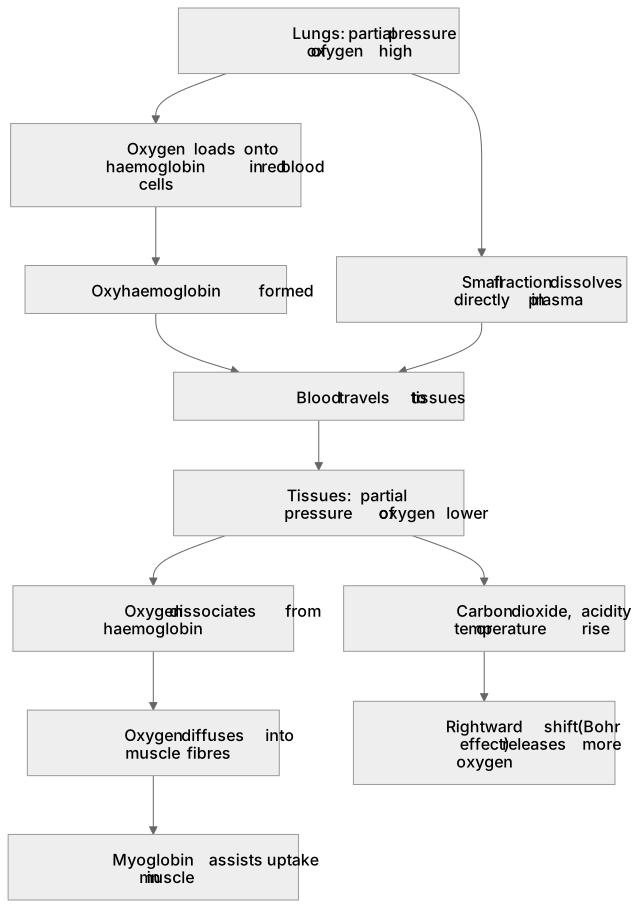
Key words
Say what each word means before you turn the card.
Oxygen carriage in blood
Try answering aloud or in your head before turning the card.
Haemoglobin and oxyhaemoglobin
Try answering aloud or in your head before turning the card.
Partial pressure gradients
Try answering aloud or in your head before turning the card.
Oxyhaemoglobin dissociation curve and Bohr effect
Try answering aloud or in your head before turning the card.
See every definition
- Oxygen carriage in blood
- Most oxygen binds reversibly to haemoglobin inside red blood cells, forming oxyhaemoglobin, while a small fraction dissolves directly in plasma.
- Haemoglobin and oxyhaemoglobin
- Each haemoglobin molecule can bind up to four oxygen molecules, so fully saturated blood carries far more oxygen than plasma alone could.
- Partial pressure gradients
- Binding depends on the partial pressure of oxygen: high at the alveoli, so oxygen loads onto haemoglobin, and lower at active muscle, so oxygen dissociates and diffuses into the fibres.
- Oxyhaemoglobin dissociation curve and Bohr effect
- The curve is S-shaped, and a rightward shift releases more oxygen when carbon dioxide, acidity or temperature rise.
Label the diagram
Some boxes have lost their names. Pick the right name for each number.
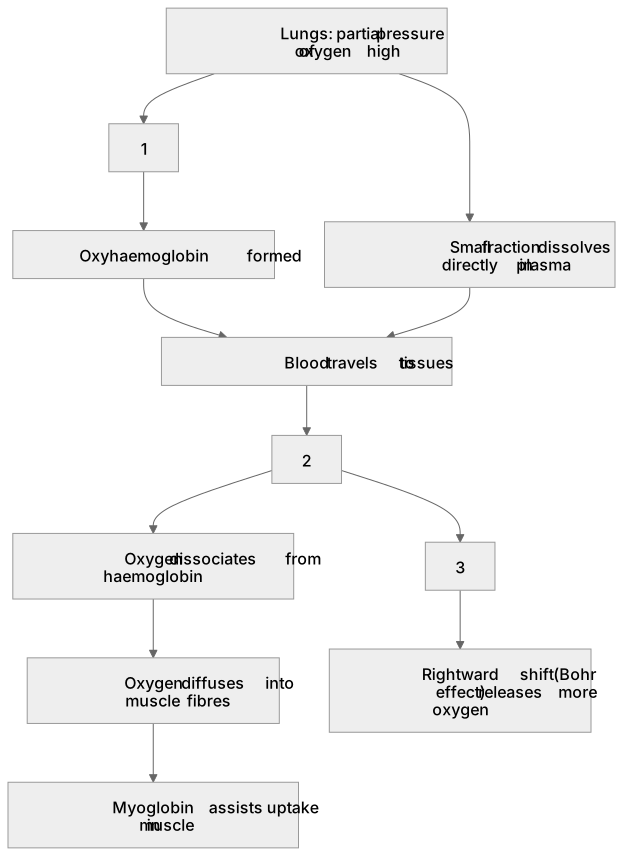
1Box 1
2Box 2
3Box 3
There is more to this lesson
The full lesson goes on to check your understanding and help you earn the marks. Create a free account to carry on, with your progress saved.
A week of Premium from your first lesson · Then the free plan continues · No card, no charge
Test your understanding of Respiratory system: Oxygen transport.
Active recall beats re-reading. Take an instant quiz now to test what you’ve learned and lock it into long-term memory.
A week of Premium from your first lesson · Then the free plan continues · No card, no charge