AQA · A-Level · Physical Education
Course version: 7582 · Version from Sept 2016
Respiratory system: Residual volume.
Residual volume is the volume of air that remains in the lungs after a maximal expiration.
Checked against the AQA 7582 specification (opens in a new tab) on .
- Point 2 of 17
- 3 key terms
Study notes
From the checked teaching notes for this specification point.
The idea
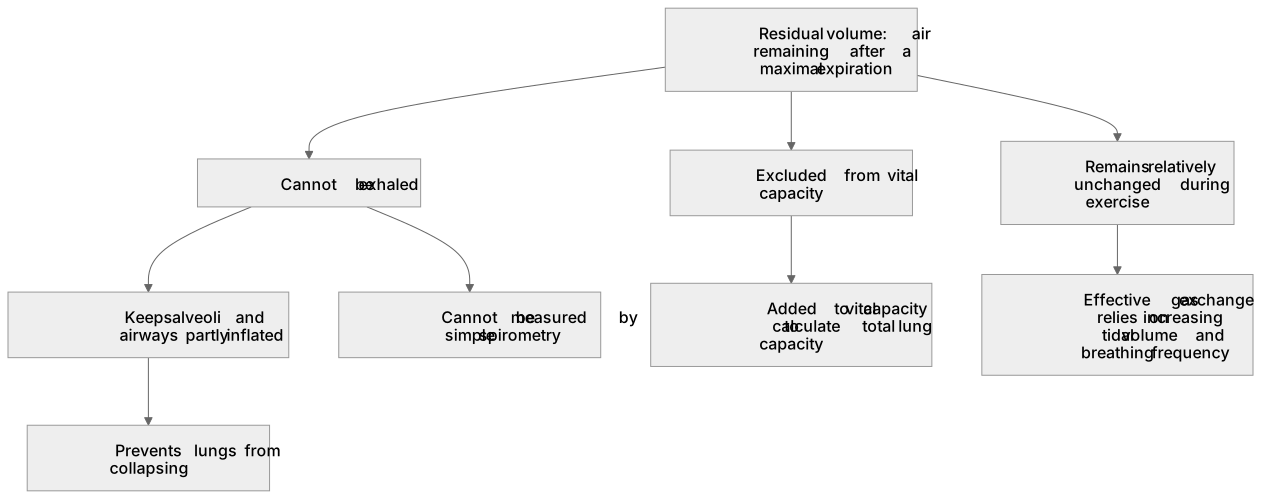
Residual volume is the volume of air that remains in the lungs after a maximal expiration. It cannot be exhaled, ensuring that the alveoli and airways remain partly inflated to prevent the lungs from collapsing. Because this air stays in the lungs, residual volume cannot be measured by simple spirometry. Residual volume is not part of vital capacity, but it is added to vital capacity to calculate total lung capacity. During exercise, residual volume remains relatively unchanged. However, because a proportion of each breath mixes with this residual stale air, effective gas exchange relies on increasing tidal volume and breathing frequency to ensure sufficient oxygen reaches the alveoli.
What earns the marks
- Residual volume is the volume of air remaining in the lungs after a maximal expiration.
- Residual volume cannot be measured by simple spirometry because the air does not leave the lungs.
- Residual volume is excluded from vital capacity but is added to vital capacity to calculate total lung capacity.
- During exercise, residual volume remains relatively unchanged while tidal volume increases.
Common mistakes and how to put them right
Misunderstanding: students believe residual volume can be exhaled with enough effort.
Put it right: It remains in the lungs after the most forceful expiration and cannot be breathed out.
Misunderstanding: students include residual volume within vital capacity.
Put it right: Vital capacity excludes residual volume, while total lung capacity includes it.
Misunderstanding: students think a spirometer alone can measure residual volume.
Put it right: Simple spirometry cannot record it because the air is not exhaled.
Exam tips
- Anchor the definition to the phrase 'after a maximal expiration' so you do not confuse residual volume with expiratory reserve volume.
- Remember the equation: total lung capacity equals vital capacity plus residual volume.
- If a question asks about spirometry traces, remember that residual volume will not be directly plotted as an exhaled volume.
Try the lesson
The start of the Respiratory system: Residual volume. lesson, made from checked teaching notes for this specification point.
Have a go first
Which lung volume is defined as the volume of air that remains in the lungs after a maximal forced expiration?
Listen
Residual volume is the volume of air that remains in the lungs after a maximal expiration. It cannot be exhaled, ensuring that the alveoli and airways remain partly inflated to prevent the lungs from collapsing. Because this air stays in the lungs, residual volume cannot be measured by simple spirometry. Residual volume is not part of vital capacity, but it is added to vital capacity to calculate total lung capacity. During exercise, residual volume remains relatively unchanged. However, because a proportion of each breath mixes with this residual stale air, effective gas exchange relies on increasing tidal volume and breathing frequency to ensure sufficient oxygen reaches the alveoli. A strong answer earns marks for these points. Residual volume is the volume of air remaining in the lungs after a maximal expiration. Residual volume cannot be measured by simple spirometry because the air does not leave the lungs. Residual volume is excluded from vital capacity but is added to vital capacity to calculate total lung capacity. During exercise, residual volume remains relatively unchanged while tidal volume increases. A common slip: Misunderstanding: students believe residual volume can be exhaled with enough effort. Instead, it remains in the lungs after the most forceful expiration and cannot be breathed out. Exam tip: Anchor the definition to the phrase 'after a maximal expiration' so you do not confuse residual volume with expiratory reserve volume.
See it
Key words
Say what each word means before you turn the card.
Residual volume
Try answering aloud or in your head before turning the card.
Role of residual volume in preventing alveolar collapse
Try answering aloud or in your head before turning the card.
Impact of exercise on lung volumes
Try answering aloud or in your head before turning the card.
See every definition
- Residual volume
- The volume of air that remains in the lungs after a maximal expiration and cannot be exhaled.
- Role of residual volume in preventing alveolar collapse
- Because it cannot be exhaled, it ensures that the alveoli and airways remain partly inflated to prevent the lungs from collapsing.
- Impact of exercise on lung volumes
- During exercise, residual volume remains relatively unchanged, while effective gas exchange relies on increasing tidal volume and breathing frequency.
Label the diagram
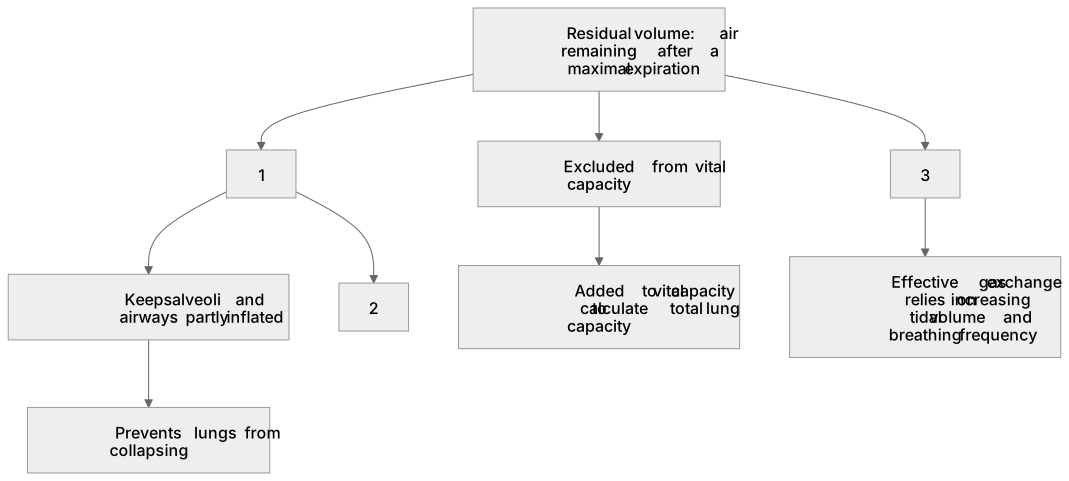
Some boxes have lost their names. Pick the right name for each number.
1Box 1
2Box 2
3Box 3
There is more to this lesson
The full lesson goes on to check your understanding and help you earn the marks. Create a free account to carry on, with your progress saved.
A week of Premium from your first lesson · Then the free plan continues · No card, no charge
Test your understanding of Respiratory system: Residual volume.
Active recall beats re-reading. Take an instant quiz now to test what you’ve learned and lock it into long-term memory.
A week of Premium from your first lesson · Then the free plan continues · No card, no charge