AQA · A-Level · Physical Education
Course version: 7582 · Version from Sept 2016
Sociological theory applied to equal opportunities: Disability.
Disability, in this sociological topic, means a reduced opportunity to take part in physical activity caused by the interaction between a person's impairment and barriers in sport and society.
Checked against the AQA 7582 specification (opens in a new tab) on .
- Point 7 of 18
- 4 key terms
Study notes
From the checked teaching notes for this specification point.
The idea
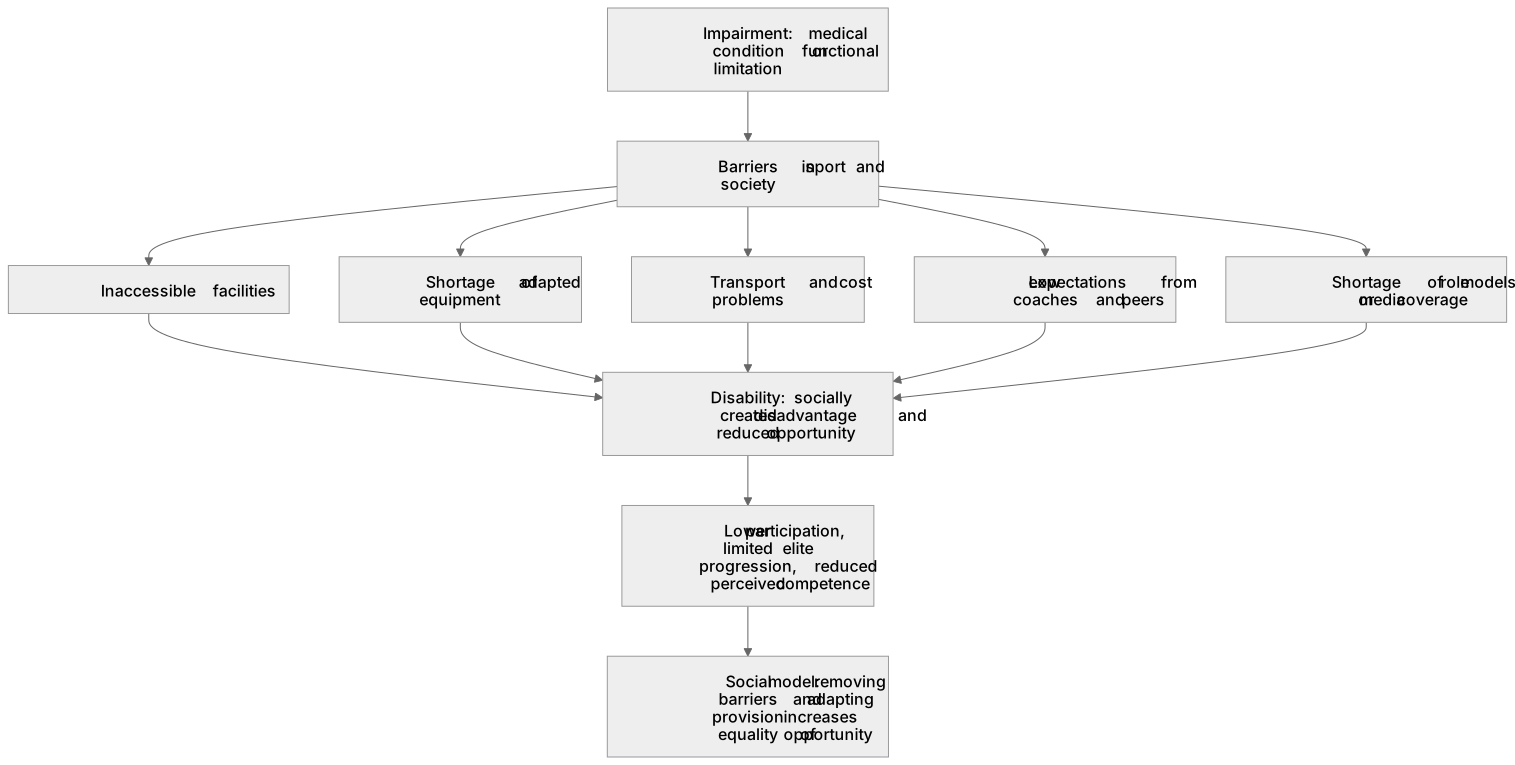
Disability, in this sociological topic, means a reduced opportunity to take part in physical activity caused by the interaction between a person's impairment and barriers in sport and society. Teach the difference between impairment (a medical condition or functional limitation) and disability (the social disadvantage that follows). Barriers include poor access to suitable facilities, limited adapted equipment, transport and cost problems, low expectations from coaches and peers, and a shortage of role models or media coverage. These barriers can lower participation, limit progression to elite pathways and reduce perceived competence. The social model argues that removing barriers, not changing the person, increases equality of opportunity.
What earns the marks
- Distinguishes impairment (medical or functional limitation) from disability (socially created disadvantage and reduced opportunity).
- Identifies environmental, economic and attitudinal barriers such as inaccessible facilities, transport, cost, adapted equipment shortages and low expectations.
- Explains how these barriers reduce participation, progression and perceived competence in physical activity and sport.
- Applies the social model: removing barriers and adapting provision increases equality of opportunity rather than expecting the individual to change.
Common mistakes and how to put them right
Treating disability and impairment as identical.
Put it right: Impairment is the condition, disability is the disadvantage created when society and sport fail to remove barriers.
Assuming low participation is caused by the impairment itself.
Put it right: Participation is limited mainly by environmental, economic and attitudinal barriers that can be removed.
Ignoring adapted equipment, coaching or transport.
Put it right: These practical provisions are central barriers and solutions in this topic.
Confusing equality with treating everyone identically.
Put it right: Equality of opportunity often requires adapted, differentiated provision.
Exam tips
- Define impairment and disability separately before applying them to a sporting example.
- Name specific barriers (facilities, transport, cost, equipment, attitudes) rather than saying 'society' vaguely.
- Link each barrier to a consequence such as lower participation or blocked elite progression.
- Use the social model to propose a concrete removal of a barrier, for example accessible changing rooms or adapted equipment.
Try the lesson
The start of the Sociological theory applied to equal opportunities: Disability. lesson, made from checked teaching notes for this specification point.
Have a go first
In the sociology of sport, what does the term disability refer to?
Listen
Disability, in this sociological topic, means a reduced opportunity to take part in physical activity caused by the interaction between a person's impairment and barriers in sport and society. Teach the difference between impairment (a medical condition or functional limitation) and disability (the social disadvantage that follows). Barriers include poor access to suitable facilities, limited adapted equipment, transport and cost problems, low expectations from coaches and peers, and a shortage of role models or media coverage. These barriers can lower participation, limit progression to elite pathways and reduce perceived competence. The social model argues that removing barriers, not changing the person, increases equality of opportunity. A strong answer earns marks for these points. Distinguishes impairment (medical or functional limitation) from disability (socially created disadvantage and reduced opportunity). Identifies environmental, economic and attitudinal barriers such as inaccessible facilities, transport, cost, adapted equipment shortages and low expectations. Explains how these barriers reduce participation, progression and perceived competence in physical activity and sport. Applies the social model: removing barriers and adapting provision increases equality of opportunity rather than expecting the individual to change. A common slip: Treating disability and impairment as identical. Instead, impairment is the condition, disability is the disadvantage created when society and sport fail to remove barriers. Exam tip: Define impairment and disability separately before applying them to a sporting example.
See it
Key words
Say what each word means before you turn the card.
Disability
Try answering aloud or in your head before turning the card.
Impairment
Try answering aloud or in your head before turning the card.
Barriers to participation
Try answering aloud or in your head before turning the card.
Social model
Try answering aloud or in your head before turning the card.
See every definition
- Disability
- A reduced opportunity to take part in physical activity caused by the interaction between a person's impairment and barriers in sport and society.
- Impairment
- A medical condition or functional limitation, which is distinct from the social disadvantage that follows it.
- Barriers to participation
- Obstacles including poor access to suitable facilities, limited adapted equipment, transport and cost problems, low expectations from coaches and peers, and a shortage of role models or media coverage.
- Social model
- The argument that removing barriers, not changing the person, increases equality of opportunity.
Label the diagram
Some boxes have lost their names. Pick the right name for each number.
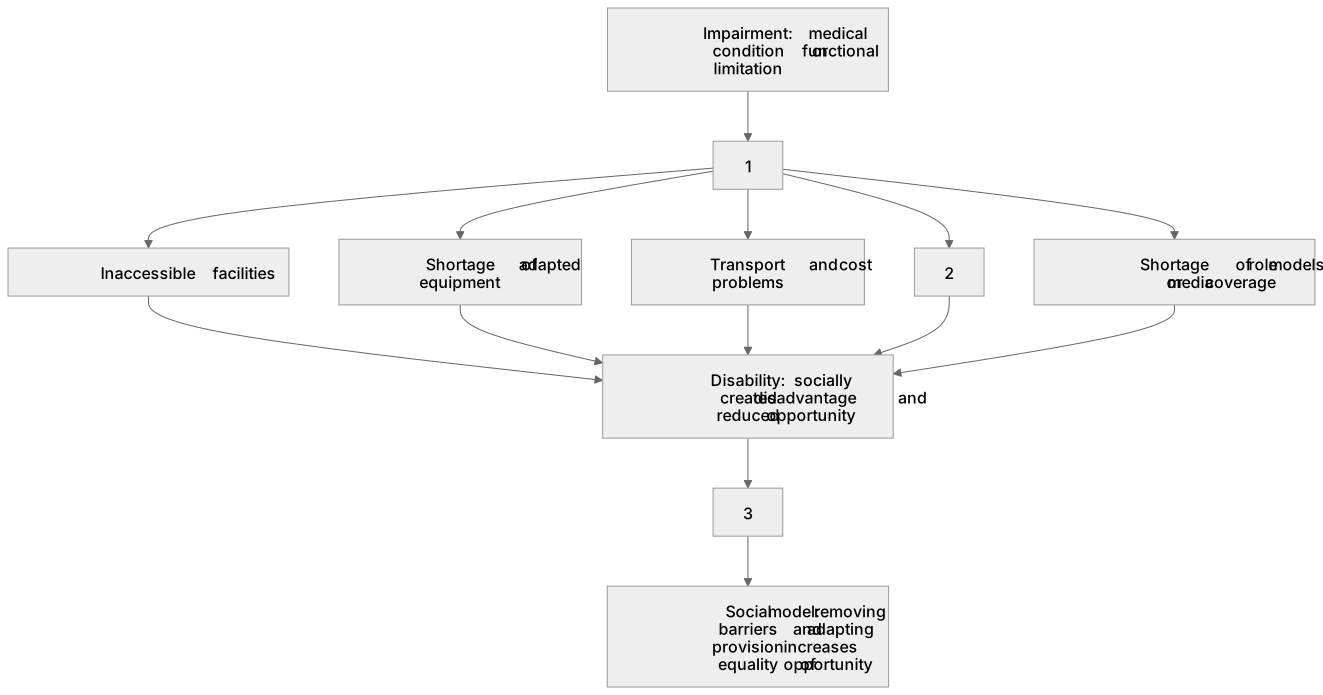
1Box 1
2Box 2
3Box 3
There is more to this lesson
The full lesson goes on to check your understanding and help you earn the marks. Create a free account to carry on, with your progress saved.
A week of Premium from your first lesson · Then the free plan continues · No card, no charge
Test your understanding of Sociological theory applied to equal opportunities: Disability.
Active recall beats re-reading. Take an instant quiz now to test what you’ve learned and lock it into long-term memory.
A week of Premium from your first lesson · Then the free plan continues · No card, no charge