AQA · A-Level · Physical Education
Course version: 7582 · Version from Sept 2016
Elbow and knee (flexion and extension).
Full specification wording
The musculo-skeletal system and analysis of movement in physical activities: Elbow and knee (flexion and extension).
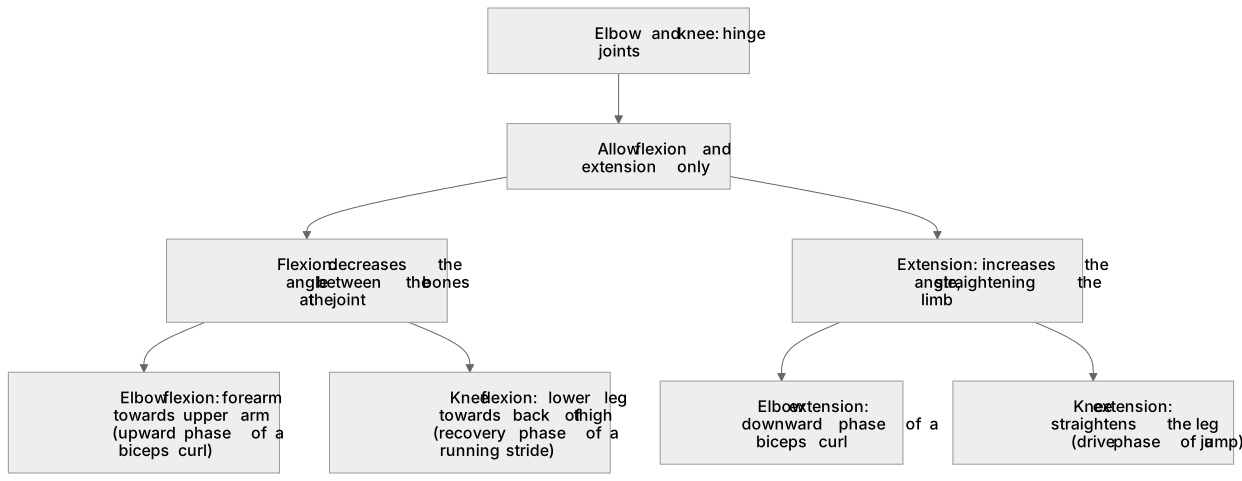
The elbow and the knee are both hinge joints, so each permits movement in one plane only: flexion and extension.
Checked against the AQA 7582 specification (opens in a new tab) on .
- Point 3 of 10
- 4 key terms
Study notes
From the checked teaching notes for this specification point.
The idea
The elbow and the knee are both hinge joints, so each permits movement in one plane only: flexion and extension. Flexion decreases the angle between the two bones meeting at the joint, while extension increases that angle back towards the straight position. At the elbow, flexion carries the forearm towards the upper arm, as in the upward phase of a biceps curl, and extension returns it, as in the downward phase. At the knee, flexion carries the lower leg towards the back of the thigh, as in the recovery phase of a running stride, and extension straightens the leg, as in the drive phase of a jump. In multiple-choice questions you must match the joint named in the stem to the correct movement and to the correct phase of the sporting action described.
What earns the marks
- The elbow is a hinge joint that allows flexion and extension only.
- The knee is a hinge joint that allows flexion and extension only.
- Flexion decreases the angle between the bones at the joint.
- Extension increases the angle between the bones at the joint, straightening the limb.
- At the elbow, flexion brings the forearm towards the upper arm, for example in the upward phase of a biceps curl.
- At the knee, flexion brings the lower leg towards the back of the thigh, for example in the recovery phase of a running stride.
- Extension at the knee straightens the leg, for example in the drive phase of a jump.
Common mistakes and how to put them right
Treating the elbow or knee as a ball-and-socket joint.
Put it right: The misunderstanding is that these joints allow rotation and sideways movement, but the correction is that both are hinge joints permitting only flexion and extension.
Reversing the definitions: the misunderstanding is that flexion straightens the limb, but the correction is that flexion decreases the joint angle and extension increases it.
Confusing the movement with the muscle producing it.
Put it right: The misunderstanding is that naming the biceps brachii or quadriceps answers a question about movement type, but the correction is that the question asks for the movement, so flexion or extension must be named.
Applying the wrong phase of an action.
Put it right: The misunderstanding is that the downward phase of a biceps curl is flexion, but the correction is that the downward phase is extension because the elbow angle increases.
Exam tips
- Read the stem carefully to identify which joint is named, then eliminate options that describe movements of the other joint.
- Check the direction of the movement described: if the angle at the joint is getting smaller, the answer is flexion; if it is getting larger, the answer is extension.
- Link each option to a familiar action, such as a biceps curl for the elbow or a squat for the knee, to test whether the movement named matches the action.
Try the lesson
The start of the The musculo-skeletal system and analysis of movement in physical activities: Elbow and knee (flexion and extension). lesson, made from checked teaching notes for this specification point.
Have a go first
During the upward phase of a bicep curl, the elbow joint moves so that the angle between the upper arm and forearm decreases. Which movement is occurring at the elbow?
Listen
The elbow and the knee are both hinge joints, so each permits movement in one plane only: flexion and extension. Flexion decreases the angle between the two bones meeting at the joint, while extension increases that angle back towards the straight position. At the elbow, flexion carries the forearm towards the upper arm, as in the upward phase of a biceps curl, and extension returns it, as in the downward phase. At the knee, flexion carries the lower leg towards the back of the thigh, as in the recovery phase of a running stride, and extension straightens the leg, as in the drive phase of a jump. In multiple-choice questions you must match the joint named in the stem to the correct movement and to the correct phase of the sporting action described. A strong answer earns marks for these points. The elbow is a hinge joint that allows flexion and extension only. The knee is a hinge joint that allows flexion and extension only. Flexion decreases the angle between the bones at the joint. Extension increases the angle between the bones at the joint, straightening the limb. Exam tip: Read the stem carefully to identify which joint is named, then eliminate options that describe movements of the other joint.
See it
Key words
Say what each word means before you turn the card.
Hinge joint
Try answering aloud or in your head before turning the card.
Flexion
Try answering aloud or in your head before turning the card.
Extension
Try answering aloud or in your head before turning the card.
Elbow flexion
Try answering aloud or in your head before turning the card.
See every definition
- Hinge joint
- The elbow and the knee are both hinge joints, so each permits movement in one plane only.
- Flexion
- Decreases the angle between the two bones meeting at the joint.
- Extension
- Increases the angle between the two bones back towards the straight position.
- Elbow flexion
- Carries the forearm towards the upper arm, as in the upward phase of a biceps curl.
Label the diagram
Some boxes have lost their names. Pick the right name for each number.
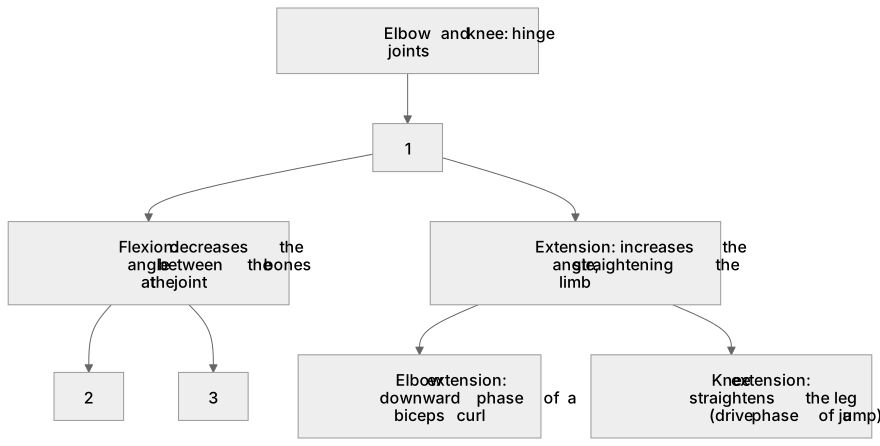
1Box 1
2Box 2
3Box 3
There is more to this lesson
The full lesson goes on to check your understanding and help you earn the marks. Create a free account to carry on, with your progress saved.
A week of Premium from your first lesson · Then the free plan continues · No card, no charge
Test your understanding of The musculo-skeletal system and analysis of movement in physical activities: Elbow and knee (flexion and extension).
Active recall beats re-reading. Take an instant quiz now to test what you’ve learned and lock it into long-term memory.
A week of Premium from your first lesson · Then the free plan continues · No card, no charge