AQA · A-Level · Physical Education
Course version: 7582 · Version from Sept 2016
Isotonic (concentric and eccentric) and Isometric.
Full specification wording
The musculo-skeletal system and analysis of movement in physical activities: Isotonic (concentric and eccentric) and Isometric.
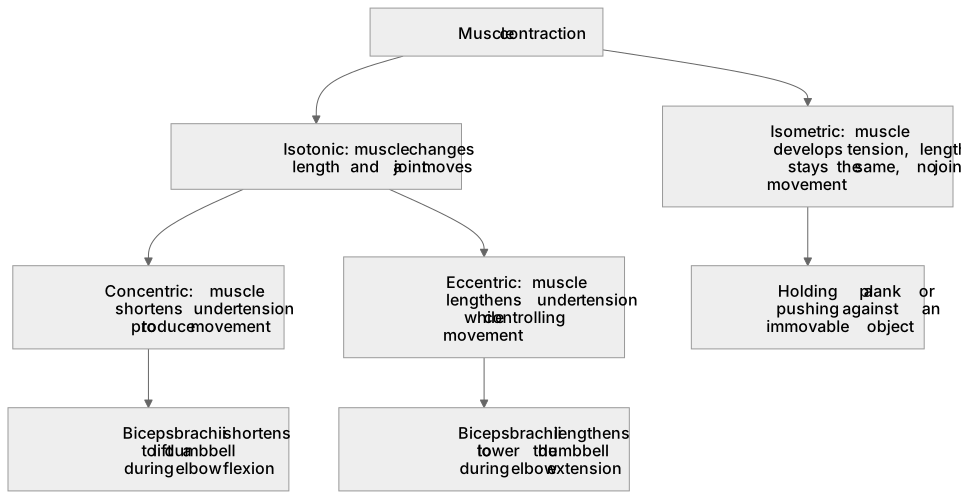
Muscle contraction is classified by whether the muscle changes length and whether a joint moves.
Checked against the AQA 7582 specification (opens in a new tab) on .
- Point 10 of 10
- 4 key terms
Study notes
From the checked teaching notes for this specification point.
The idea
Muscle contraction is classified by whether the muscle changes length and whether a joint moves. In isotonic contraction the muscle changes length and a joint moves. Isotonic contraction has two phases: concentric, where the muscle shortens under tension to produce movement, as when the biceps brachii shortens to lift a dumbbell during elbow flexion; and eccentric, where the muscle lengthens under tension while controlling movement, as when the biceps brachii lengthens to lower the dumbbell during elbow extension. In isometric contraction the muscle develops tension but its length stays the same and no joint movement occurs, as when holding a plank or pushing against an immovable object. The same muscle can work concentrically in one phase and eccentrically in the next, so the classification depends on what the muscle is doing at that moment.
What earns the marks
- Defines isotonic contraction as contraction in which the muscle changes length and a joint moves.
- Defines concentric contraction as the muscle shortening under tension to produce movement, for example the biceps brachii during elbow flexion.
- Defines eccentric contraction as the muscle lengthening under tension while controlling movement, for example the biceps brachii during elbow extension.
- Defines isometric contraction as the muscle developing tension without changing length and without joint movement, for example holding a plank.
- Applies the correct term to a described action, such as labelling the lowering phase of a biceps curl as eccentric.
- Recognises that the same muscle can act concentrically and eccentrically in different phases of one movement.
Common mistakes and how to put them right
Believing that eccentric contraction means the muscle is relaxed.
Put it right: The muscle lengthens while still under tension and controlling the movement.
Assuming isometric contraction involves no muscle activity.
Put it right: Tension is developed, but muscle length stays the same and no joint movement occurs.
Calling any shortening of a muscle concentric regardless of context.
Put it right: Concentric contraction requires the muscle to shorten under tension to produce movement.
Treating a muscle as permanently concentric or eccentric.
Put it right: The same muscle can act concentrically in one phase and eccentrically in the next.
Exam tips
- Identify whether the stem describes a joint moving or a position being held before selecting a contraction type.
- For a described action, decide whether the muscle is shortening or lengthening under tension, then match that to concentric or eccentric.
- Check that the option you choose accounts for both muscle length change and joint movement, since these distinguish the contraction types.
- Use a familiar example such as a biceps curl or a plank to test each option against what the muscle is actually doing.
Try the lesson
The start of the The musculo-skeletal system and analysis of movement in physical activities: Isotonic (concentric and eccentric) and Isometric. lesson, made from checked teaching notes for this specification point.
Have a go first
Which type of muscle contraction occurs when a muscle shortens while producing movement?
Listen
Muscle contraction is classified by whether the muscle changes length and whether a joint moves. In isotonic contraction the muscle changes length and a joint moves. Isotonic contraction has two phases: concentric, where the muscle shortens under tension to produce movement, as when the biceps brachii shortens to lift a dumbbell during elbow flexion; and eccentric, where the muscle lengthens under tension while controlling movement, as when the biceps brachii lengthens to lower the dumbbell during elbow extension. In isometric contraction the muscle develops tension but its length stays the same and no joint movement occurs, as when holding a plank or pushing against an immovable object. The same muscle can work concentrically in one phase and eccentrically in the next, so the classification depends on what the muscle is doing at that moment. A strong answer earns marks for these points. Defines isotonic contraction as contraction in which the muscle changes length and a joint moves. Defines concentric contraction as the muscle shortening under tension to produce movement, for example the biceps brachii during elbow flexion. Defines eccentric contraction as the muscle lengthening under tension while controlling movement, for example the biceps brachii during elbow extension. Defines isometric contraction as the muscle developing tension without changing length and without joint movement, for example holding a plank. Exam tip: Identify whether the stem describes a joint moving or a position being held before selecting a contraction type.
See it
Key words
Say what each word means before you turn the card.
Isotonic contraction
Try answering aloud or in your head before turning the card.
Concentric
Try answering aloud or in your head before turning the card.
Eccentric
Try answering aloud or in your head before turning the card.
Isometric contraction
Try answering aloud or in your head before turning the card.
See every definition
- Isotonic contraction
- Contraction in which the muscle changes length and a joint moves.
- Concentric
- Phase where the muscle shortens under tension to produce movement, as when the biceps brachii shortens to lift a dumbbell during elbow flexion.
- Eccentric
- Phase where the muscle lengthens under tension while controlling movement, as when the biceps brachii lengthens to lower the dumbbell during elbow extension.
- Isometric contraction
- Contraction in which the muscle develops tension but its length stays the same and no joint movement occurs, as when holding a plank.
Label the diagram
Some boxes have lost their names. Pick the right name for each number.
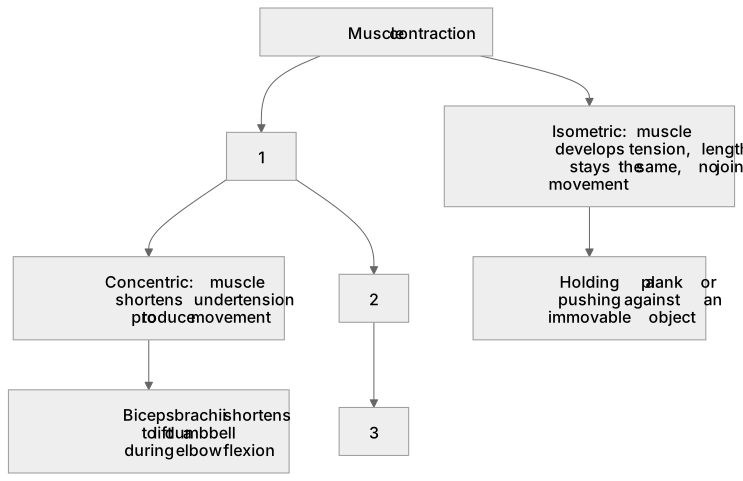
1Box 1
2Box 2
3Box 3
There is more to this lesson
The full lesson goes on to check your understanding and help you earn the marks. Create a free account to carry on, with your progress saved.
A week of Premium from your first lesson · Then the free plan continues · No card, no charge
Test your understanding of The musculo-skeletal system and analysis of movement in physical activities: Isotonic (concentric and eccentric) and Isometric.
Active recall beats re-reading. Take an instant quiz now to test what you’ve learned and lock it into long-term memory.
A week of Premium from your first lesson · Then the free plan continues · No card, no charge