AQA · A-Level · Physical Education
Course version: 7582 · Version from Sept 2016
Joint actions in the sagittal plane/transverse axis.
Full specification wording
The musculo-skeletal system and analysis of movement in physical activities: Joint actions in the sagittal plane/transverse axis.
A plane is a flat surface through which a body or limb moves, while an axis is the line about which that rotation occurs.
Checked against the AQA 7582 specification (opens in a new tab) on .
- Point 1 of 10
- 4 key terms
Study notes
From the checked teaching notes for this specification point.
The idea
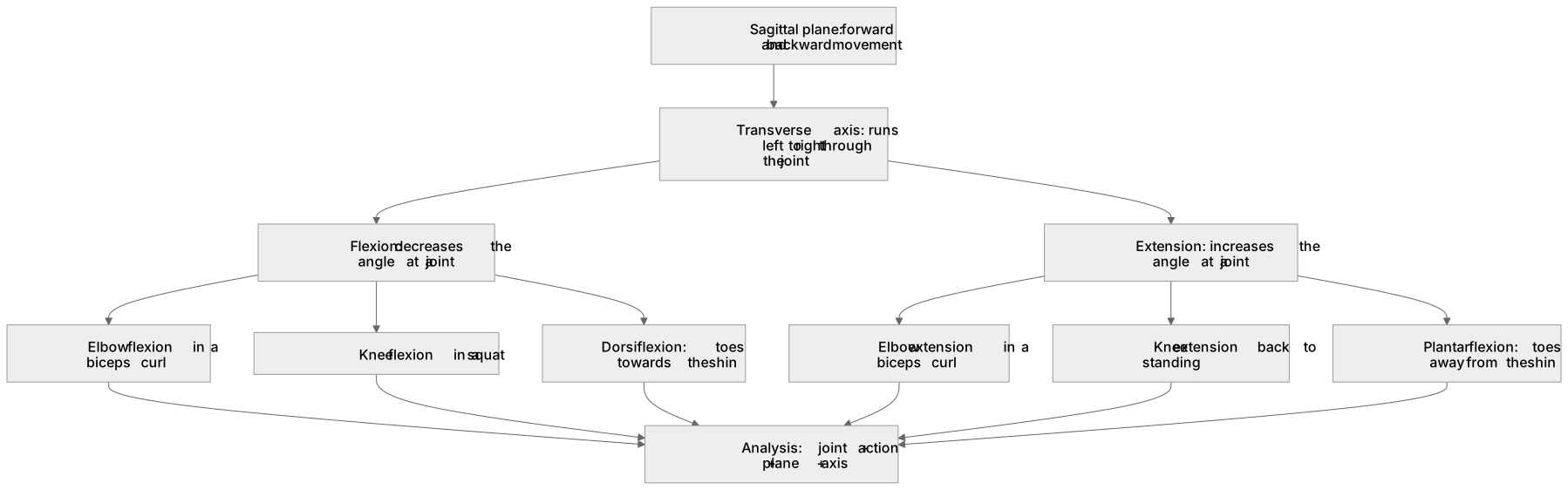
A plane is a flat surface through which a body or limb moves, while an axis is the line about which that rotation occurs. In the sagittal plane, movement happens forwards and backwards, and the axis is transverse, running left to right through the joint. Flexion and extension are the classic sagittal-plane actions: at the elbow during a biceps curl, the forearm moves towards the upper arm (flexion) and then away (extension). At the knee during a squat, the lower leg flexes towards the thigh and extends back to standing. At the ankle during a jump, dorsiflexion lifts the toes towards the shin and plantar flexion points them away. To analyse a skill, identify the joint, name the action, then state that it occurs in the sagittal plane about a transverse axis. This links directly to sporting technique and to muscle roles such as agonist and antagonist.
What earns the marks
- The sagittal plane divides the body into left and right portions and permits forward and backward movement.
- The transverse axis runs horizontally from side to side and is the axis about which sagittal-plane rotation occurs.
- Flexion decreases the angle at a joint, for example the elbow during the upward phase of a biceps curl.
- Extension increases the angle at a joint, for example the elbow during the downward phase of a biceps curl.
- Dorsiflexion at the ankle lifts the toes towards the shin, while plantar flexion points the toes away from the shin.
- A complete analysis names the joint, the action, the plane and the axis, for example knee extension in the sagittal plane about a transverse axis.
Common mistakes and how to put them right
Confusing the sagittal plane with the frontal plane.
Put it right: The frontal plane divides the body into front and back and allows sideways movement, whereas the sagittal plane allows forward and backward movement.
Naming the wrong axis for sagittal-plane movement.
Put it right: The correct axis is transverse (side to side), not longitudinal (top to bottom) or sagittal (front to back).
Describing flexion and extension as the same action.
Put it right: Flexion decreases the joint angle, while extension increases it, so they are opposite movements.
Forgetting to state the joint when naming an action.
Put it right: 'flexion' alone is incomplete because flexion at the elbow and flexion at the knee are different joint actions.
Exam tips
- Use the structure 'joint + action + plane + axis' in every analysis answer, for example 'extension at the knee in the sagittal plane about a transverse axis'.
- Sketch a simple stick figure with a side-on view to check that the movement is forwards or backwards before committing to the sagittal plane.
- Link each action to a named sporting example, such as the knee during the kicking action in football, to show applied understanding.
- Check that the axis is perpendicular to the plane: sagittal plane pairs with transverse axis, frontal plane with sagittal axis, transverse plane with longitudinal axis.
Try the lesson
The start of the The musculo-skeletal system and analysis of movement in physical activities: Joint actions in the sagittal plane/transverse axis. lesson, made from checked teaching notes for this specification point.
Have a go first
A gymnast performs a forward roll. During the roll, the body rotates about a transverse axis. Which plane does this rotation occur in?
Listen
A plane is a flat surface through which a body or limb moves, while an axis is the line about which that rotation occurs. In the sagittal plane, movement happens forwards and backwards, and the axis is transverse, running left to right through the joint. Flexion and extension are the classic sagittal-plane actions: at the elbow during a biceps curl, the forearm moves towards the upper arm (flexion) and then away (extension). At the knee during a squat, the lower leg flexes towards the thigh and extends back to standing. At the ankle during a jump, dorsiflexion lifts the toes towards the shin and plantar flexion points them away. To analyse a skill, identify the joint, name the action, then state that it occurs in the sagittal plane about a transverse axis. This links directly to sporting technique and to muscle roles such as agonist and antagonist. A strong answer earns marks for these points. The sagittal plane divides the body into left and right portions and permits forward and backward movement. The transverse axis runs horizontally from side to side and is the axis about which sagittal-plane rotation occurs. Flexion decreases the angle at a joint, for example the elbow during the upward phase of a biceps curl. Extension increases the angle at a joint, for example the elbow during the downward phase of a biceps curl. Exam tip: Use the structure 'joint + action + plane + axis' in every analysis answer, for example 'extension at the knee in the sagittal plane about a transverse axis'.
See it
Key words
Say what each word means before you turn the card.
Planes and axes of movement
Try answering aloud or in your head before turning the card.
Joint actions and ranges of movement
Try answering aloud or in your head before turning the card.
Applied analysis of sporting techniques
Try answering aloud or in your head before turning the card.
Links between joint action and muscle contraction
Try answering aloud or in your head before turning the card.
See every definition
- Planes and axes of movement
- A plane is a flat surface through which a body or limb moves, while an axis is the line about which that rotation occurs.
- Joint actions and ranges of movement
- Flexion decreases the angle at a joint, extension increases it, dorsiflexion lifts the toes towards the shin and plantar flexion points them away.
- Applied analysis of sporting techniques
- To analyse a skill, identify the joint, name the action, then state that it occurs in the sagittal plane about a transverse axis.
- Links between joint action and muscle contraction
- This links directly to sporting technique and to muscle roles such as agonist and antagonist.
Label the diagram
Some boxes have lost their names. Pick the right name for each number.
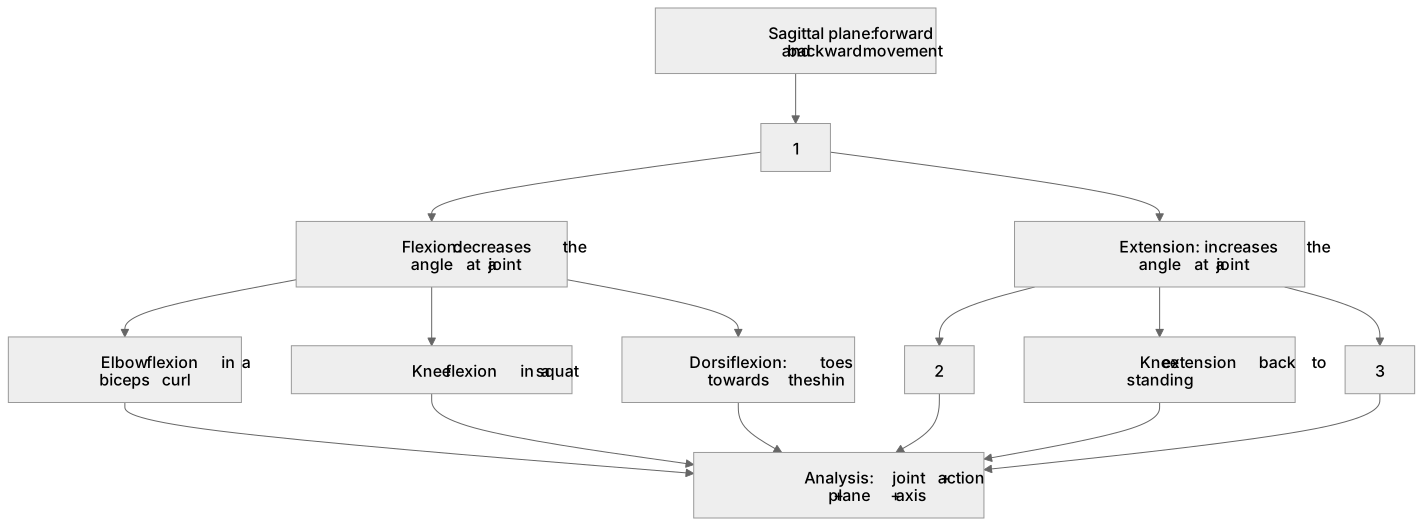
1Box 1
2Box 2
3Box 3
There is more to this lesson
The full lesson goes on to check your understanding and help you earn the marks. Create a free account to carry on, with your progress saved.
A week of Premium from your first lesson · Then the free plan continues · No card, no charge
Test your understanding of The musculo-skeletal system and analysis of movement in physical activities: Joint actions in the sagittal plane/transverse axis.
Active recall beats re-reading. Take an instant quiz now to test what you’ve learned and lock it into long-term memory.
A week of Premium from your first lesson · Then the free plan continues · No card, no charge