AQA · A-Level · Physical Education
Course version: 7582 · Version from Sept 2016
Use of guidance and feedback: Knowledge of performance.
Knowledge of performance (KP) is information about the quality or technique of a movement, rather than its outcome.
Checked against the AQA 7582 specification (opens in a new tab) on .
- Point 7 of 11
- 4 key terms
Study notes
From the checked teaching notes for this specification point.
The idea
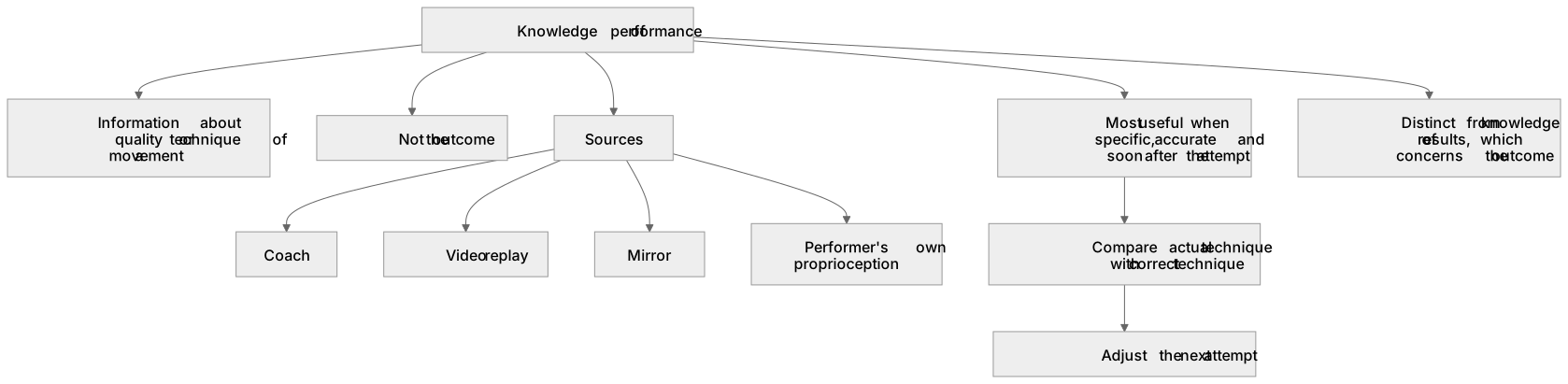
Knowledge of performance (KP) is information about the quality or technique of a movement, rather than its outcome. It tells a performer how the movement was executed: for example, a coach may say that a gymnast's hips were too high during a handstand or that a javelin thrower's elbow dropped on release. KP can come from a coach, video replay, a mirror or the performer's own proprioception. It is most useful when it is specific, accurate and given soon after the attempt, because it helps the learner compare their actual technique with the correct technique and adjust the next attempt.
What earns the marks
- Knowledge of performance is information about the quality or technique of a movement, not its outcome.
Common mistakes and how to put them right
Confusing knowledge of performance with knowledge of results.
Put it right: KP describes how the movement was performed, while KR describes the outcome such as time, distance or score.
Assuming KP must come from an external source.
Put it right: The performer's own proprioception can also provide KP.
Thinking KP is only useful after a failed attempt.
Put it right: It can improve technique after successful attempts too.
Believing KP should be vague to avoid overloading the learner.
Put it right: Specific, accurate KP is more useful for technique correction.
Exam tips
- Read the feedback description carefully and ask whether it tells the performer about the movement itself or only about the result.
- Look for words such as technique, body position, limb action or execution, which point to knowledge of performance.
- Eliminate options that describe outcome measures such as time, distance, score or win/loss, because these are knowledge of results.
Try the lesson
The start of the Use of guidance and feedback: Knowledge of performance. lesson, made from checked teaching notes for this specification point.
Have a go first
Which of the following statements provides the most accurate definition of 'knowledge of performance' in skill acquisition?
Listen
Knowledge of performance (KP) is information about the quality or technique of a movement, rather than its outcome. It tells a performer how the movement was executed: for example, a coach may say that a gymnast's hips were too high during a handstand or that a javelin thrower's elbow dropped on release. KP can come from a coach, video replay, a mirror or the performer's own proprioception. It is most useful when it is specific, accurate and given soon after the attempt, because it helps the learner compare their actual technique with the correct technique and adjust the next attempt. Exam tip: Read the feedback description carefully and ask whether it tells the performer about the movement itself or only about the result.
See it
Key words
Say what each word means before you turn the card.
Knowledge of performance
Try answering aloud or in your head before turning the card.
Knowledge of results
Try answering aloud or in your head before turning the card.
Proprioception
Try answering aloud or in your head before turning the card.
Technique correction
Try answering aloud or in your head before turning the card.
See every definition
- Knowledge of performance
- Information about the quality or technique of a movement, rather than its outcome.
- Knowledge of results
- Feedback that concerns the outcome of the movement rather than the movement itself.
- Proprioception
- A source from which knowledge of performance can come, alongside a coach, video replay or a mirror.
- Technique correction
- Helped when knowledge of performance is specific, accurate and given soon after the attempt, so the learner can compare actual technique with correct technique and adjust the next attempt.
Label the diagram
Some boxes have lost their names. Pick the right name for each number.
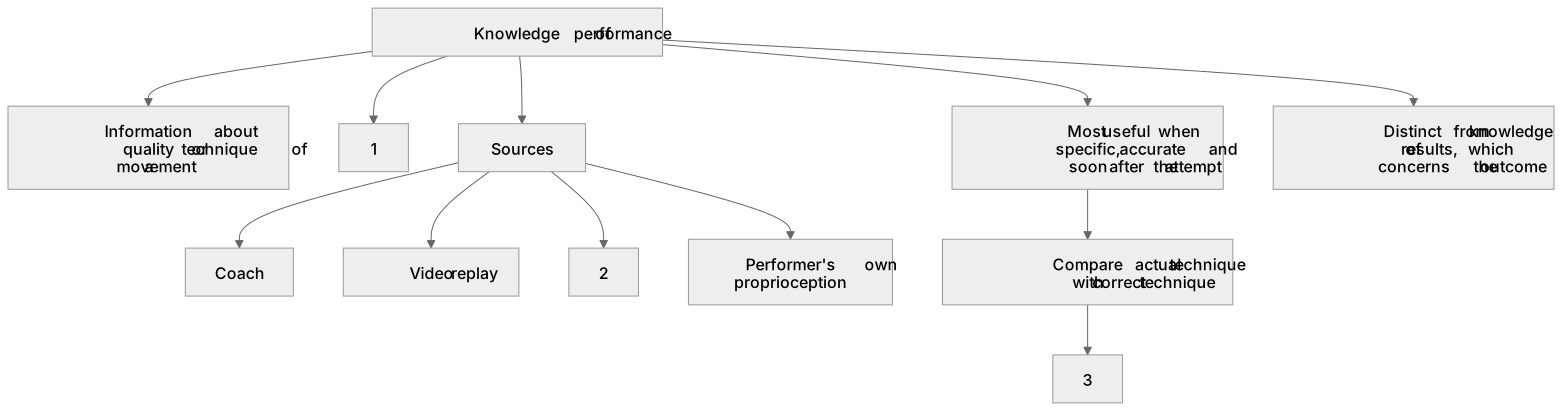
1Box 1
2Box 2
3Box 3
There is more to this lesson
The full lesson goes on to check your understanding and help you earn the marks. Create a free account to carry on, with your progress saved.
A week of Premium from your first lesson · Then the free plan continues · No card, no charge
Test your understanding of Use of guidance and feedback: Knowledge of performance.
Active recall beats re-reading. Take an instant quiz now to test what you’ve learned and lock it into long-term memory.
A week of Premium from your first lesson · Then the free plan continues · No card, no charge