AQA · A-Level · Physical Education
Course version: 7582 · Version from Sept 2016
Use of guidance and feedback: Manual.
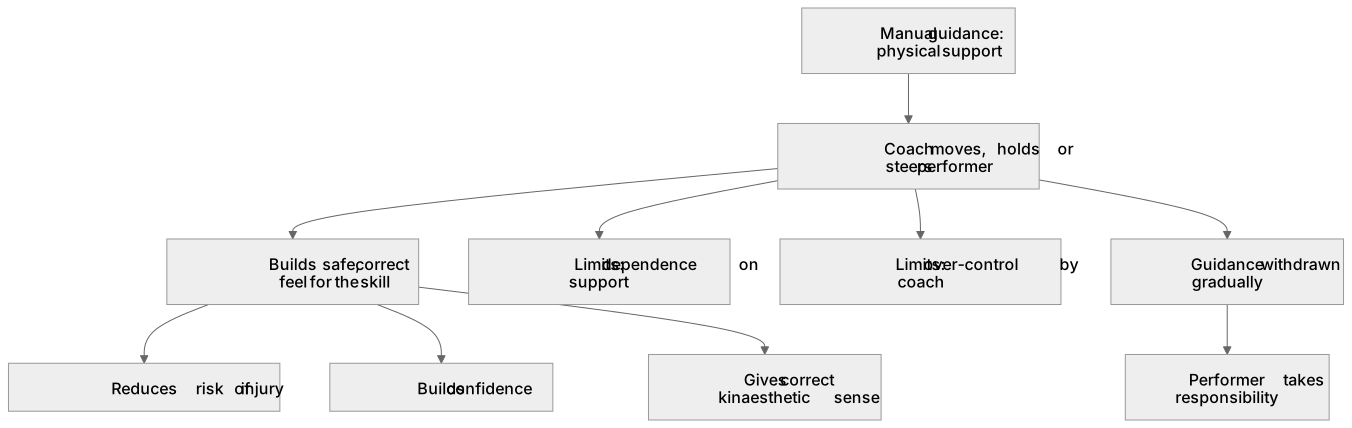
Manual guidance is physical support given by a coach or teacher who moves, holds or steers a performer through a movement.
Checked against the AQA 7582 specification (opens in a new tab) on .
- Point 4 of 11
Study notes
From the checked teaching notes for this specification point.
The idea
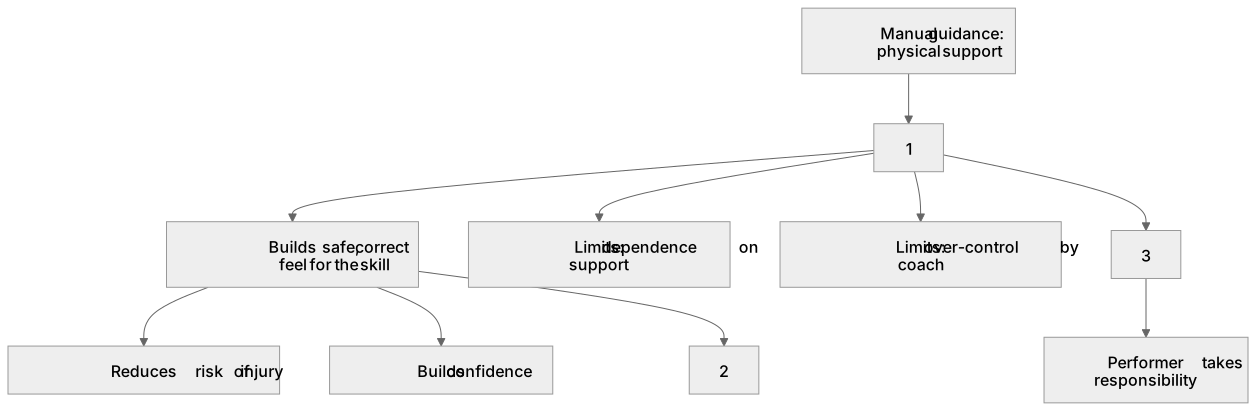
Manual guidance is physical support given by a coach or teacher who moves, holds or steers a performer through a movement. In AQA A-level Physical Education, 3.1.2.4, you learn that it is used to build a safe, correct feel for a skill before the learner can perform it alone. A coach teaching a gymnast a backward roll might support the hips and guide the rotation; a swimming teacher might hold a learner's legs while they practise a flutter kick. Manual guidance reduces the risk of injury, builds confidence and can give the learner the correct kinaesthetic sense of the movement. Its limits are that the learner can become dependent on the support, the coach may over-control the movement, and the guidance must be withdrawn gradually so the performer takes responsibility.
What earns the marks
- Manual guidance is physical support in which a coach or teacher moves, holds or steers a performer through a movement.
- A coach might support a gymnast's hips through a backward roll, or a swimming teacher might hold a learner's legs during a flutter kick.
- Its limitations include dependence on the support, over-control by the coach, and the need to withdraw the guidance gradually.
Common mistakes and how to put them right
Confusing manual guidance with verbal guidance.
Put it right: Manual guidance is physical support in which the coach moves, holds or steers the performer, whereas verbal guidance is spoken.
Thinking manual guidance should continue until the skill is fully mastered.
Put it right: It must be withdrawn gradually, or the learner becomes dependent on the support and does not take responsibility for the movement.
Assuming manual guidance is only for safety.
Put it right: It also builds confidence and gives the learner the correct kinaesthetic feel of the movement.
Exam tips
- Name the body part being supported and the skill being taught, such as supporting the hips through a backward roll, so the example is precise.
- When evaluating, pair one benefit, such as reduced injury risk, with one drawback, such as dependence on the coach.
- Explain how the coach withdraws the support over time, because progression towards independent performance is the point of the guidance.
Try the lesson
The start of the Use of guidance and feedback: Manual. lesson, made from checked teaching notes for this specification point.
Have a go first
A coach physically places a gymnast's arms into the correct position during a handstand and supports the legs while the skill is performed. Which type of guidance is being used?
Listen
Manual guidance is physical support given by a coach or teacher who moves, holds or steers a performer through a movement. In AQA A-level Physical Education, 3.1.2.4, you learn that it is used to build a safe, correct feel for a skill before the learner can perform it alone. A coach teaching a gymnast a backward roll might support the hips and guide the rotation; a swimming teacher might hold a learner's legs while they practise a flutter kick. Manual guidance reduces the risk of injury, builds confidence and can give the learner the correct kinaesthetic sense of the movement. Its limits are that the learner can become dependent on the support, the coach may over-control the movement, and the guidance must be withdrawn gradually so the performer takes responsibility. A strong answer earns marks for these points. Manual guidance is physical support in which a coach or teacher moves, holds or steers a performer through a movement. A coach might support a gymnast's hips through a backward roll, or a swimming teacher might hold a learner's legs during a flutter kick. Its limitations include dependence on the support, over-control by the coach, and the need to withdraw the guidance gradually. A common slip: Confusing manual guidance with verbal guidance. Instead, manual guidance is physical support in which the coach moves, holds or steers the performer, whereas verbal guidance is spoken. Exam tip: Name the body part being supported and the skill being taught, such as supporting the hips through a backward roll, so the example is precise.
See it
Label the diagram
Some boxes have lost their names. Pick the right name for each number.
1Box 1
2Box 2
3Box 3
There is more to this lesson
The full lesson goes on to check your understanding and help you earn the marks. Create a free account to carry on, with your progress saved.
A week of Premium from your first lesson · Then the free plan continues · No card, no charge
Test your understanding of Use of guidance and feedback: Manual.
Active recall beats re-reading. Take an instant quiz now to test what you’ve learned and lock it into long-term memory.
A week of Premium from your first lesson · Then the free plan continues · No card, no charge