AQA · A-Level · Physical Education
Course version: 7582 · Version from Sept 2016
Use of guidance and feedback: Methods of guidance.
Guidance is the information a coach or teacher gives to help a performer learn or refine a skill.
Checked against the AQA 7582 specification (opens in a new tab) on .
- Point 1 of 11
- 4 key terms
Study notes
From the checked teaching notes for this specification point.
The idea
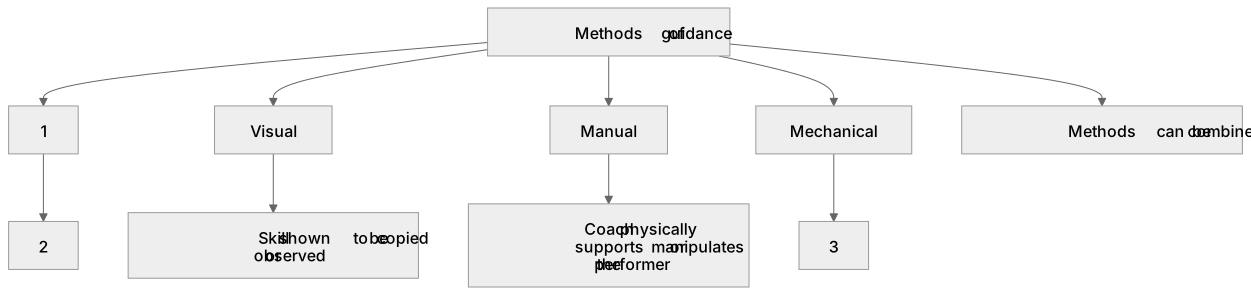
Guidance is the information a coach or teacher gives to help a performer learn or refine a skill. The main methods are verbal, visual, manual and mechanical. Verbal guidance uses spoken words, such as a coach saying "drive your knee up" during a sprint drill. Visual guidance shows the skill, for example a demonstration or a video clip. Manual guidance physically moves the learner, such as a coach supporting a gymnast's hips through a handstand. Mechanical guidance uses equipment, such as a float supporting a swimmer's legs or a harness supporting a trampolinist. Methods are often combined, and the best choice depends on the skill, the learner's stage of learning and safety. Beginners usually benefit from visual and manual support, while more advanced performers rely more on verbal cues.
What earns the marks
- Verbal guidance is information given through spoken words, such as instructions, cues or feedback during a practice drill.
- Visual guidance presents the skill to be copied or observed, for example a live demonstration, a video or a diagram of a movement pattern.
- Manual guidance involves the coach physically supporting or manipulating the performer's body, such as guiding a gymnast's hips through a handstand.
- Mechanical guidance uses equipment or apparatus to shape or support movement, such as a float for a swimmer's legs or a harness for a trampolinist.
- The choice of method depends on factors such as the learner's stage of learning, the complexity and risk of the skill, and the learner's age or confidence.
- Methods can be combined, for example a demonstration with a spoken cue and light manual support, to reinforce correct technique.
Common mistakes and how to put them right
Confusing manual guidance with mechanical guidance.
Put it right: Manual guidance is the coach's direct physical contact, whereas mechanical guidance uses equipment such as a harness or float.
Assuming verbal guidance alone is best for beginners.
Put it right: Beginners often need visual demonstration and physical support before spoken cues become effective.
Treating guidance as only for beginners.
Put it right: Advanced performers still use verbal and visual guidance to refine technique and tactics.
Believing guidance guarantees learning.
Put it right: Guidance supports practice but the learner must still repeat and process the skill to retain it.
Exam tips
- Read the scenario carefully and name the method that matches the description, rather than choosing the most familiar method.
- Link each method to a specific example from a sport, such as a coach demonstrating a tennis serve for visual guidance.
- When a question asks for the most suitable method, justify it using the learner's stage of learning or the risk of the skill.
Try the lesson
The start of the Use of guidance and feedback: Methods of guidance. lesson, made from checked teaching notes for this specification point.
Have a go first
Which method of guidance involves a coach physically moving a performer's limbs through the correct movement pattern?
Listen
Guidance is the information a coach or teacher gives to help a performer learn or refine a skill. The main methods are verbal, visual, manual and mechanical. Verbal guidance uses spoken words, such as a coach saying "drive your knee up" during a sprint drill. Visual guidance shows the skill, for example a demonstration or a video clip. Manual guidance physically moves the learner, such as a coach supporting a gymnast's hips through a handstand. Mechanical guidance uses equipment, such as a float supporting a swimmer's legs or a harness supporting a trampolinist. Methods are often combined, and the best choice depends on the skill, the learner's stage of learning and safety. Beginners usually benefit from visual and manual support, while more advanced performers rely more on verbal cues. A strong answer earns marks for these points. Verbal guidance is information given through spoken words, such as instructions, cues or feedback during a practice drill. Visual guidance presents the skill to be copied or observed, for example a live demonstration, a video or a diagram of a movement pattern. Manual guidance involves the coach physically supporting or manipulating the performer's body, such as guiding a gymnast's hips through a handstand. Mechanical guidance uses equipment or apparatus to shape or support movement, such as a float for a swimmer's legs or a harness for a trampolinist. Exam tip: Read the scenario carefully and name the method that matches the description, rather than choosing the most familiar method.
See it

Key words
Say what each word means before you turn the card.
Methods of guidance
Try answering aloud or in your head before turning the card.
Verbal guidance
Try answering aloud or in your head before turning the card.
Visual guidance
Try answering aloud or in your head before turning the card.
Manual and mechanical guidance
Try answering aloud or in your head before turning the card.
See every definition
- Methods of guidance
- The information a coach or teacher gives to help a performer learn or refine a skill, the main methods being verbal, visual, manual and mechanical.
- Verbal guidance
- Information given through spoken words, such as a coach saying "drive your knee up" during a sprint drill.
- Visual guidance
- Showing the skill to be copied or observed, for example a demonstration or a video clip.
- Manual and mechanical guidance
- Physically moving the learner, such as a coach supporting a gymnast's hips through a handstand, or using equipment, such as a float supporting a swimmer's legs or a harness supporting a trampolinist.
Label the diagram
Some boxes have lost their names. Pick the right name for each number.
1Box 1
2Box 2
3Box 3
There is more to this lesson
The full lesson goes on to check your understanding and help you earn the marks. Create a free account to carry on, with your progress saved.
A week of Premium from your first lesson · Then the free plan continues · No card, no charge
Test your understanding of Use of guidance and feedback: Methods of guidance.
Active recall beats re-reading. Take an instant quiz now to test what you’ve learned and lock it into long-term memory.
A week of Premium from your first lesson · Then the free plan continues · No card, no charge